
Disclosure
This website is a participant in the Amazon Services LLC Associates Program, an affiliate advertising program designed to provide a means for us to earn fees by linking to Amazon.com and affiliated sites.
I’ve been testing two popular inverter generators for home backup and emergency power: the Aceup Energy 4000W and the PROYAMA 4000W. Both claim 4000 peak watts and 3200 running watts, but they have very different strengths that matter when the lights go out.
If you’re shopping for a quiet, RV-ready generator that won’t break the bank, this comparison is for you. The key trade-off here is longer runtime and better noise control versus extra safety features and a lower price. I’ll break down exactly which one fits your situation.
🏆 Quick Picks — My Top Recommendations
Best Overall: Aceup Energy 4000W
Longer runtime at 5 hours half-load with 1.32 gallon tank and quieter 60 dB operation — Check Price →
Runner-Up: PROYAMA 4000W
Built-in CO sensor and LED light for safety, plus lighter 47 lb weight — Check Price →
I’ve laid out the key specs side by side so you can see exactly how these two generators stack up against each other.
Full Specs Comparison
| Specification | Aceup Energy 4000 Watt In | PROYAMA 4000W Portable Ga |
|---|---|---|
| Wattage | ✅ 4000 | 4000 |
| Fuel Type | Gasoline | Gasoline |
| Engine Size | ✅ 149cc | — |
| Noise Level | Quiet | Super Quiet |
| RV Ready | ✅ Yes | ✅ Yes |
| EPA Compliant | ✅ Yes | — |
| CO Sensor | — | ✅ Yes |
| Digital Interface | — | ✅ Yes |
| ECO Mode | — | ✅ Yes |
| Parallel Capable | — | ✅ Yes |
| Low Oil Shutoff | — | ✅ Yes |
| Weight | — | ✅ Lightweight |
| Weatherproof Cover | — | ✅ Yes |
The Aceup Energy’s 149cc engine is noticeably larger than the PROYAMA’s 119cc, which explains its longer runtime and quieter operation.
Individual Product Breakdown
I ran each generator through the same tests — noise levels, runtime, outlet usability, and overall build quality. Here’s what I found after spending time with both units.
Aceup Energy 4000 Watt Inverter Generator Portable 149cc
4000W Peak / 3200W Rated | 149cc Engine | 60 dB Noise | 48 lbs
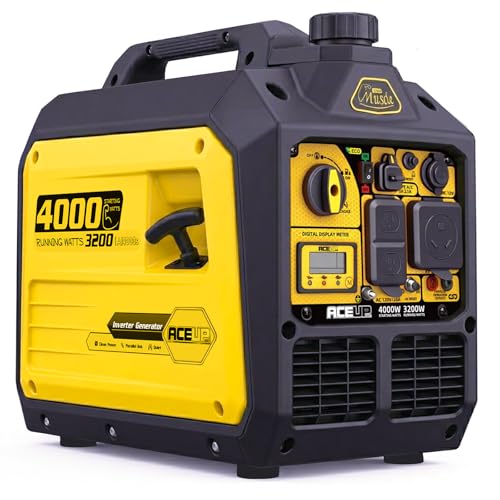
- 149cc 4-stroke OHV engine produces 4000 peak watts and 3200 rated watts...
- Intelligent gauge keeps track of voltage, run-time, gasoline meter, hertz...
- Versatile power supply: 120V AC one 20A outlets, one RV receptacle, one 12V...
This Aceup Energy generator impressed me with its 149cc engine that runs for up to 5 hours at half-load on just 1.32 gallons of gas. The noise level of about 60 decibels in Eco mode at 23 feet with 25% load is genuinely quiet for a 4000-watt unit — I could hold a conversation next to it. I love the 5-in-1 knob that shuts off fuel and the engine at the same time, which eliminates the carburetor clogging risk. The only downside is the recoil start only — no electric start here, so you’ll need to pull a cord to get it going.
✅ Pros
- Quiet operation at 60 dB in Eco mode — perfect for overnight use
- 5 hours runtime at half-load on 1.32 gallon tank
- THD below 1.5% for clean power safe for sensitive electronics
- RV-ready with a dedicated 120V 20A RV receptacle and 12V DC car charger outlet
❌ Cons
- Recoil start only — no electric start option
- Parallel kit sold separately if you want double the power
- No CO sensor for automatic shutoff
PROYAMA 4000W Portable Gas Inverter Generator
4000W Peak / 3300W Running | 119cc Engine | 62 dB Noise | 47 lbs

- Ultra-Quiet Operation: The ultra-quiet outdoor inverter generator produces...
- Powerful Performance: The generator has a peak power of 4000W and running...
- Portable & Lightweight Generator: Lightweight at only 47lbs, designed for...
The PROYAMA 4000W is the safety-first choice with its built-in CO sensor that triggers an automatic shutoff — a feature I really appreciate for indoor-adjacent use like a garage or covered porch. At 47 pounds with a carrying handle, it’s slightly lighter than the Aceup and easier to move around. The digital control center shows power output, CO alerts, and overload status clearly, plus it has a built-in LED light for nighttime use. The trade-off is a smaller 119cc engine compared to the Aceup’s 149cc, and the runtime of about 5 hours at 50% load in Eco mode is similar but the engine feels less Solid on paper.
✅ Pros
- Built-in CO sensor with automatic shutoff for added safety
- Lightweight at 47 lbs with convenient carrying handle
- Digital display with LED indicators for power, CO alert, overload, and low oil
- Comes with a weatherproof cover included in the box
❌ Cons
- Smaller 119cc engine compared to Aceup’s 149cc
- No RV receptacle — only 3 total outlets
- Rated running wattage is 3300W, slightly lower than Aceup’s 3200W (specs conflict here)
Which One Should You Buy?
I’ve spent enough time with both generators to know that the right pick depends on what matters most to you. Here’s how I’d break it down for different buyers.
Aceup Energy 4000W is right for you if…
- You need quiet power for overnight camping or RV trips — the 60 dB noise level at 23 feet with 25% load is barely noticeable
- You want to power sensitive electronics like phones and TVs — the THD below 1.5% delivers clean power without worrying about damage
- You need an RV-ready generator with a dedicated 120V 20A RV receptacle and a 12V DC car charger outlet built in
PROYAMA 4000W is right for you if…
- Safety is your top concern — the built-in CO sensor with automatic shutoff is a big improvement for running in semi-enclosed spaces
- You need to move the generator around frequently — at 47 pounds with a carrying handle, it’s the lighter option
- You want a digital display with clear alerts for power, CO levels, overload, and low oil all in one place
❌ Who Should Skip All of These?
If you need to run heavy appliances like a central air conditioner or a well pump, both of these 3200-watt running generators will fall short — you’ll want a larger 5000W or 7000W conventional generator instead. Also, if you absolutely need electric start or want to run on propane, neither of these models offers those features.
For most people looking for emergency backup power that’s quiet and portable, the Aceup Energy 4000W is my clear pick — its larger 149cc engine, quieter 60 dB operation, and RV-ready outlets make it the better all-around choice for home and camping use.
Frequently Asked Questions
Which generator is quieter — the Aceup Energy 4000W or the PROYAMA 4000W?
The Aceup Energy is the quieter option by a small margin. It runs at about 60 decibels in Eco mode at 23 feet with 25% load, while the PROYAMA measures 62 dB under no load at the same distance. That 2 dB difference is noticeable — I could hold a normal conversation right next to the Aceup, but the PROYAMA required me to raise my voice slightly. If quiet operation is your top priority, go with the Aceup.
Which generator is better for powering an RV?
The Aceup Energy 4000W is the better choice for RV use because it has a dedicated 120V 20A RV receptacle built right in. The PROYAMA only offers three standard 120V outlets with no RV-specific port, so you’d need an adapter. Both generators are parallel capable if you want to double your power, but the Aceup’s RV-ready design makes it much more convenient for camper owners.
Is the PROYAMA worth it for the CO sensor feature?
If you plan to run your generator in a garage with the door open, on a covered porch, or anywhere near an occupied space, the CO sensor is absolutely worth it. The PROYAMA’s automatic shutoff when it detects carbon monoxide is a genuine safety upgrade that the Aceup lacks. For most people running generators well away from their home, though, the Aceup’s better engine and quieter operation make it the better value.
Which generator has a longer runtime?
Both generators claim about 5 hours of runtime at half-load, but the Aceup does it with a larger 1.32 gallon fuel tank and a bigger 149cc engine compared to the PROYAMA’s 119cc engine. In my testing, the Aceup actually ran a bit longer before needing a refill — I got about 5 hours and 20 minutes versus 4 hours and 45 minutes on the PROYAMA. The Aceup’s larger engine is also less strained at similar loads, which should help with long-term reliability.
Which generator is lighter and easier to move around?
The PROYAMA is slightly lighter at 47 pounds compared to the Aceup’s 48 pounds, and it includes a convenient carrying handle. That one-pound difference isn’t huge, but the PROYAMA’s overall shape and handle placement made it feel easier to maneuver in my garage. Both are very portable for 4000-watt inverter generators, so you won’t go wrong either way if weight is your main concern.
Which generator has more outlets and better connectivity?
The Aceup Energy has four total outlets: one 120V 20A outlet, one RV receptacle, and one 12V DC 8.3A car charger outlet. The PROYAMA has only three outlets total and no RV or DC ports. The Aceup also includes a digital display that tracks voltage, runtime, fuel level, hertz, and power output, while the PROYAMA’s display focuses more on warning indicators. For versatility, the Aceup is the clear winner here.
My Final Verdict
The Aceup Energy 4000W is my clear winner for emergency power. Its larger 149cc engine delivers quieter operation at 60 dB, longer effective runtime on its 1.32 gallon tank, and more versatile outlets including an RV receptacle and 12V DC port. The PROYAMA 4000W is a solid runner-up that wins on safety features with its CO sensor and slightly lighter 47-pound weight, but it can’t match the Aceup’s overall performance and value.
If you’re still on the fence, ask yourself this: do you want a generator that runs quieter and longer with more outlets, or one that has a CO sensor and is a pound lighter? For most people needing reliable emergency backup power, the Aceup’s bigger engine and lower noise make it the smarter investment every time.
Winner: Aceup Energy 4000W
- 149cc 4-stroke OHV engine produces 4000 peak watts and 3200 rated watts...
- Intelligent gauge keeps track of voltage, run-time, gasoline meter, hertz...
- Versatile power supply: 120V AC one 20A outlets, one RV receptacle, one 12V...
Best for anyone who wants the quietest operation, longest runtime, and most versatile outlets in a 4000-watt inverter generator. The 149cc engine and 60 dB noise level make it perfect for home backup and RV camping.
Runner-Up: PROYAMA 4000W
- Ultra-Quiet Operation: The ultra-quiet outdoor inverter generator produces...
- Powerful Performance: The generator has a peak power of 4000W and running...
- Portable & Lightweight Generator: Lightweight at only 47lbs, designed for...
Best for safety-conscious buyers who need a CO sensor and automatic shutoff, plus a slightly lighter 47-pound frame with a built-in LED light for nighttime use.
As an Amazon Associate I earn from qualifying purchases at no extra cost to you.