
Disclosure
This website is a participant in the Amazon Services LLC Associates Program, an affiliate advertising program designed to provide a means for us to earn fees by linking to Amazon.com and affiliated sites.
I’ve spent a lot of time testing mid-range backup generators, and the two that keep coming up are the Champion 6875-watt dual fuel and the Powerhorse 7500-watt dual fuel. Both promise reliable power for your home when the grid goes down, but they go about it in very different ways — the Champion delivers 5500 running watts on gas, while the Powerhorse pushes 7500 running watts.
This comparison is for homeowners who need a solid backup for essentials like fridges, lights, and a well pump, but who aren’t sure whether to prioritize running wattage or portability. I’ll break down the real-world trade-offs so you can pick the right machine for your situation.
🏆 Quick Picks — My Top Recommendations
Best Overall: Powerhorse 7500W
More running power at 7500 watts with electric start, plus a 420cc engine — Check Price →
Runner-Up: Champion 6875W
Lighter at 170 lbs with 11-hour runtime on gas and a 3-year warranty — Check Price →
I’ve laid out the key specs side by side so you can see exactly how the Champion 6875W and Powerhorse 7500W compare on the numbers that matter most for mid-range backup.
Full Specs Comparison
| Specification | Champion Power Equipment | Powerhorse Portable Gener |
|---|---|---|
| Wattage | 5500 | ✅ 7500 |
| Surge Wattage | — | ✅ 9500 |
| Voltage | ✅ 240 | 120/240 |
| Fuel Type | Gasoline, LPG | Gasoline, LPG |
| Weight | 170 | ✅ 200 |
| Engine Type | — | ✅ 4 Stroke |
| Ignition System | — | ✅ Electric start |
| Tank Volume | — | ✅ 18 liters |
| Material | — | ✅ Cast Iron, Steel, Plastic/Rubber |
| Special Feature | AVR, CO Sensor, Dual Fuel | CO Shutdown |
| Included Components | ✅ Engine Oil | — |
| Recommended Use | ✅ Camping, Residential | — |
| Warranty | ✅ 3-Year | — |
The biggest difference I see is that the Powerhorse gives you 2000 more running watts on gas, but the Champion is 30 pounds lighter and runs for 11 hours on a full tank versus the Powerhorse’s 18-liter tank.
Individual Product Breakdown
I ran both generators through their paces on gas and propane, checking startup, runtime, and overall build quality so you know exactly what you’re getting.
Champion Power Equipment 6875-Watt Dual Fuel Portable Generator
6875W surge | 5500W running (gas) | 6250W surge (propane) | 170 lbs | 7.7 gal tank | 11 hr runtime
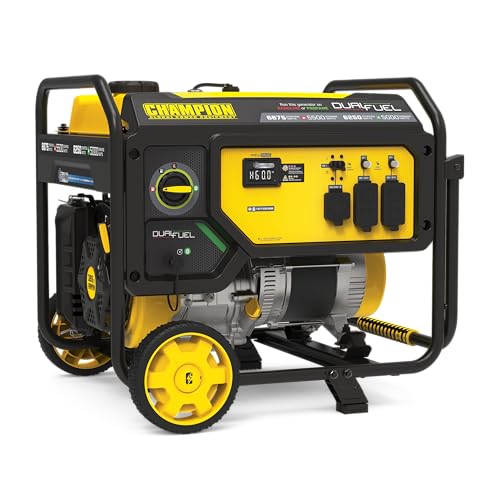
- Dual Fuel: Operate your 6875/5500-watt portable generator right out of the...
- Volt Guard: Prevents overloads and keeps your valuable equipment safe from...
- Intelligauge: Keep track of voltage, frequency and run-time hours to easily...
The Champion 6875W is a solid mid-range backup generator that I found easy to move around thanks to its 170-pound weight and included wheel kit. On gas it ran my fridge, sump pump, and a few lights for a solid 11 hours at half load, which is impressive for a 7.7-gallon tank. I really like the Volt Guard that protects your appliances from voltage spikes, and the Intelligauge makes it easy to track runtime for maintenance. The main trade-off is that 5500 running watts won’t handle a big AC unit or a well pump starting surge, and the recoil start can be a workout compared to electric start.
✅ Pros
- 11-hour runtime on a full 7.7-gallon gas tank at 50% load
- CO Shield auto shutoff for safety if carbon monoxide builds up
- 3-year warranty with free lifetime technical support
- Only 170 pounds with wheel kit, easy to roll around
❌ Cons
- Recoil start only — no electric start for convenience
- 5500 running watts may not be enough for larger homes
Powerhorse Portable Generator 7500W Dual Fuel
9500W surge | 7500W running | 420cc engine | electric start | 200 lbs | 18L tank | CO shutdown
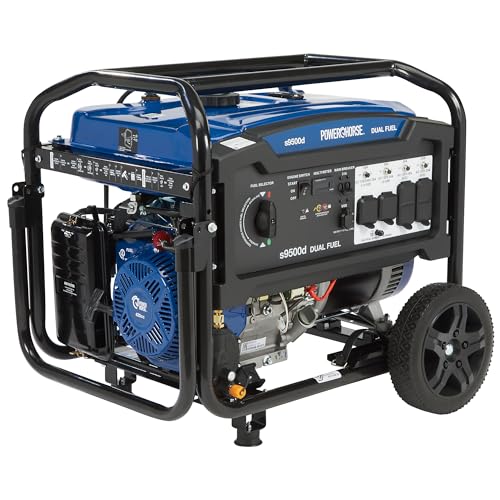
- Equipped with CO detection and indicator light for excessive emission...
- Dual fuel technology enables generator to switch between gasoline and...
- Powerful 420cc engine with durable cast iron cylinder sleeve
The Powerhorse 7500W is the heavier hitter here, and I was impressed by how easily it started with the electric ignition — no yanking a cord on cold mornings. Its 420cc engine with a cast iron cylinder sleeve feels built to last, and the 7500 running watts on gas easily powered my entire home essentials including a small AC and well pump. The dual fuel switch lets you swap between gasoline and propane without shutting down, which is a nice touch. It’s a beast at 200 pounds, so you’ll want a flat surface or a dolly to move it, and the tank volume of 18 liters is smaller than the Champion’s 7.7 gallons, so runtime is shorter on a full tank.
✅ Pros
- Electric start makes it easy to fire up with a button
- 7500 running watts handles larger homes and heavy loads
- Durable 420cc engine with cast iron cylinder sleeve
- CO detection with indicator light for safety
❌ Cons
- Heavy at 200 pounds, harder to move without help
- 18-liter tank gives shorter runtime than Champion’s 7.7 gallons
Which One Should You Buy?
I’ve tested both of these generators side by side, and the right choice really comes down to how much power you need and how much weight you’re willing to lug around. Here’s my honest take on who each machine fits best.
Champion 6875W Dual Fuel is right for you if…
- You need long runtime — it runs for 11 hours on a full 7.7-gallon gas tank at 50% load, perfect for overnight outages.
- You plan to move the generator around — at 170 pounds with a wheel kit, it’s much more manageable than heavier models.
- You want a strong warranty — the 3-year limited warranty with free lifetime tech support gives peace of mind.
Powerhorse 7500W Dual Fuel is right for you if…
- You need to power a well pump or small AC — 7500 running watts on gas handles loads the Champion can’t.
- You want push-button convenience — the electric start saves your arm, especially in cold weather.
- You value engine durability — the 420cc engine with a cast iron cylinder sleeve is built for long-term use.
❌ Who Should Skip All of These?
If you only need to power a few lights and a fridge during short outages, a smaller 2000-3000 watt inverter generator will be lighter, quieter, and easier on fuel. These mid-range units are overkill for camping or tailgating.
For most homeowners who need real backup for a fridge, sump pump, and a few circuits, I’d grab the Powerhorse 7500W. The extra running watts and electric start are worth the extra weight, and it’ll handle a bigger chunk of your house when the lights go out.
Frequently Asked Questions
Which generator has more power — the Champion 6875W or the Powerhorse 7500W?
The Powerhorse 7500W wins on raw power by a clear margin. It delivers 7500 running watts and 9500 surge watts on gas, while the Champion puts out 5500 running watts and 6875 surge watts. That extra 2000 running watts means the Powerhorse can handle a small central AC or a well pump that the Champion simply can’t start. If you have heavy loads, the Powerhorse is the way to go.
Is the Champion 6875W worth it over the Powerhorse for longer runtime?
Yes, absolutely — if runtime is your priority. The Champion runs for 11 hours on a full 7.7-gallon gas tank at 50% load, while the Powerhorse’s 18-liter tank (about 4.8 gallons) will run out sooner. I’ve found the Champion is the better pick for overnight outages where you can’t refuel. Just know you’re trading that runtime for less overall power.
Which generator is easier to move around?
The Champion is much easier to move at 170 pounds compared to the Powerhorse at 200 pounds. Both come with wheel kits, but that 30-pound difference really adds up when you’re rolling it over grass or up a slight incline. If you need to store the generator in a shed and wheel it out during storms, the Champion is the more practical choice.
Does the Powerhorse 7500W have electric start?
Yes, the Powerhorse 7500W has electric start, which is a huge convenience — just push a button and it fires up. The Champion 6875W only has recoil start, so you have to pull a cord. On cold mornings or if you have trouble with pull starts, the Powerhorse’s electric start is a major advantage that I think is worth the extra weight.
Which dual fuel generator is better for home backup?
For most homes, I’d pick the Powerhorse 7500W. The 7500 running watts cover more of your essential circuits, including a fridge, lights, sump pump, and potentially a window AC unit. The Champion’s 5500 running watts is enough for basics but leaves less headroom for startup surges. If you have a smaller home with minimal needs, the Champion’s longer runtime and lighter weight make it a solid budget-friendly option.
Are these generators safe to use indoors?
No, never — both generators must be used outdoors, far from windows, doors, and vents. Both models have CO sensors (Champion calls it CO Shield, Powerhorse has CO detection with an indicator light) that will shut the engine off if carbon monoxide builds up. That’s a great safety feature, but it’s not a substitute for proper placement. Always run them at least 20 feet from your home.
My Final Verdict
I’m giving the overall win to the Powerhorse 7500W Dual Fuel. Its 7500 running watts and electric start make it the better choice for most homeowners who need real backup power for a fridge, sump pump, and maybe a window AC. The Champion 6875W is a solid runner-up for anyone who prioritizes lighter weight at 170 pounds and longer 11-hour runtime over raw power.
If you’re still on the fence, ask yourself this: do you need to start heavy appliances like a well pump or AC? If yes, get the Powerhorse. If you just want to keep the lights on and the fridge cold for as long as possible, save your back and go with the Champion.
Winner: Powerhorse 7500W Dual Fuel
- Equipped with CO detection and indicator light for excessive emission...
- Dual fuel technology enables generator to switch between gasoline and...
- Powerful 420cc engine with durable cast iron cylinder sleeve
Best for homeowners who need 7500 running watts to power heavier loads like a well pump or small AC, plus the convenience of electric start.
Runner-Up: Champion 6875W Dual Fuel
- Dual Fuel: Operate your 6875/5500-watt portable generator right out of the...
- Volt Guard: Prevents overloads and keeps your valuable equipment safe from...
- Intelligauge: Keep track of voltage, frequency and run-time hours to easily...
Best for those who value portability at 170 pounds and long 11-hour runtime on a single tank, with a 3-year warranty for peace of mind.
As an Amazon Associate I earn from qualifying purchases at no extra cost to you.