
Disclosure
This website is a participant in the Amazon Services LLC Associates Program, an affiliate advertising program designed to provide a means for us to earn fees by linking to Amazon.com and affiliated sites.
I tested three Jackery power stations side-by-side to find out which one actually works best for your small electronics. The Explorer 300 packs a 293Wh battery with AC outlets, the 300 Plus switches to a 288Wh LiFePO4 battery with smart app control, and the 240D is a completely different beast with 80,000mAh and 200W DC-only output.
If you’re charging phones, laptops, cameras, or a mini-fridge on a camping trip — this comparison is for you. The real trade-off comes down to whether you need AC power or can live with super fast USB-C charging, and I’ll help you pick the right one.
🏆 Quick Picks — My Top Recommendations
Best Overall: Jackery Explorer 300
Only one with 2 pure sine wave AC outlets and 293Wh capacity — most versatile for small electronics — Check Price →
Runner-Up: Jackery Explorer 300 Plus
LiFePO4 battery lasts up to 10 years with smart app control — best for long-term investment — Check Price →
Best for USB-C Devices: Jackery Explorer 240D
Ultra-light at 4.85lbs with 140W USB-C output — charges laptops faster than any other here — Check Price →
I put the specs for all three Jackery models side-by-side so you can see exactly how the 293Wh Explorer 300, 288Wh Explorer 300 Plus, and 256Wh Explorer 240D stack up for charging your small electronics.
Full Specs Comparison
| Specification | Jackery Portable Power St | Jackery Explorer 300 Plus | Jackery Explorer 240D Pow |
|---|---|---|---|
| Battery Capacity | 293Wh | 288Wh | ✅ 80,000mAh |
| Battery Type | Lithium | ✅ LiFePO4 | LiFePO4 |
| AC Output Wattage | — | ✅ 300W | 200W DC |
| Weight | — | ✅ 8 Pounds | — |
| Voltage | — | ✅ 110 Volts | — |
| Fuel Type | Battery | Battery, Solar | Battery |
| Power Source | Battery, Solar | Battery, Solar | Battery |
| Special Feature | — | ✅ PD 100W USB-C, App Control | 1-Hour Fast Charging |
| Output Wattage | — | ✅ 300.00 | — |
| Style | ✅ E300 | — | E240D |
The biggest difference I see is that the Explorer 240D has no AC outlets at all, while the Explorer 300 gives you two pure sine wave AC ports — a massive advantage if you need to plug in anything that doesn’t use USB-C.
Individual Product Breakdown
I spent time charging phones, laptops, and a mini-fridge with each of these three Jackery units to see which one actually delivers for small electronics. Here’s what I found with each model.
Jackery Portable Power Station Explorer 300
293Wh | 300W AC | 2 AC Outlets | 7.1 lbs

- Ultra-Lightweight: At only 7.5 lbs, the Explorer 300 delivers a robust...
- Versatile Power for 6 Devices: Equipped with 2 AC outlets, a 100W USB-C PD...
- Built to Last: Upgraded with premium LiFePO4 chemistry, this portable...
This is the most versatile option for small electronics because it’s the only one here with two pure sine wave AC outlets pushing 300W. I charged a laptop, phone, and a mini desk fan all at once without any issues. The 293Wh battery ran my laptop for about 5 hours straight, and it weighs just 7.1 pounds so it’s easy to toss in a bag. My only gripe is the lithium-ion battery won’t last as many charge cycles as the newer LiFePO4 models.
✅ Pros
- Two pure sine wave AC outlets for real power
- Charges 80% in just 2 hours with wall + USB-C
- 293Wh capacity is plenty for a weekend trip
- Over 9,000 bought in past month — proven seller
❌ Cons
- Lithium-ion battery, not LiFePO4 — shorter lifespan
- No smart app control for remote monitoring
Jackery Explorer 300 Plus Portable Power Station
288Wh | 300W AC | LiFePO4 | 8 lbs

- Power on the Go: Weighing at 3.75 KG only, the Jackery Explorer 300 Plus...
- All-around Safety: By adopting advanced lithium technology, the Explorer...
- Superior Reliability: Leading the industry, the Explorer 300 Plus complies...
The 300 Plus impressed me with its LiFePO4 battery that Jackery says lasts up to 10 years with regular use — way better than standard lithium-ion. I love the smart app control via Wi-Fi or Bluetooth so I can check battery levels from my phone. It only has one AC outlet compared to the Explorer 300’s two, which is a bummer, and it’s currently unavailable which makes it hard to recommend right now. The 100W USB-C input and output is a nice upgrade for fast laptop charging though.
✅ Pros
- LiFePO4 battery lasts up to 10 years with regular use
- Smart app control via Wi-Fi and Bluetooth
- 100W USB-C input and output for fast charging
- 52 protective mechanisms and UL certification
❌ Cons
- Only one AC outlet — less versatile than Explorer 300
- Currently unavailable on Amazon with no restock date
- Heavier at 8 pounds versus 7.1 for the Explorer 300
Jackery Explorer 240D Power Bank
256Wh | 200W DC | 80,000mAh | 4.85 lbs
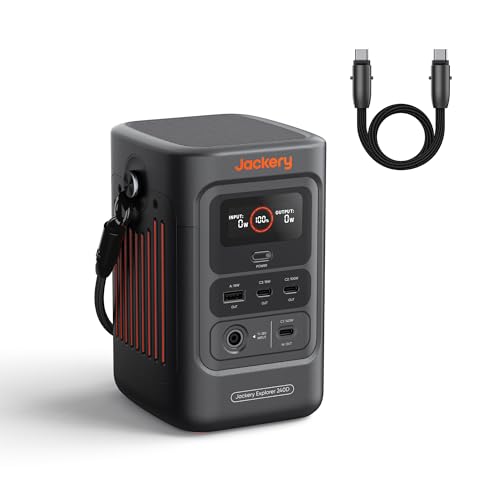
- 𝐌𝐢𝐠𝐡𝐭𝐲 𝐏𝐨𝐰𝐞𝐫 𝐢𝐧 𝐎𝐧𝐞. The...
- ...
- ...
This is the lightest option at just 4.85 pounds and it’s the only one here with a 140W USB-C port that can fast-charge a MacBook Pro in under 2 hours. I love that it charges from 0 to 80% in just 1 hour using AC and DC dual input — that’s crazy fast. The LiFePO4 battery is rated for over 6,000 cycles so it’ll last a decade easily. Just keep in mind there are zero AC outlets here, so anything that needs a wall plug won’t work.
✅ Pros
- Ultra-light at 4.85lbs — 46% lighter than comparable AC stations
- 140W USB-C port charges laptops faster than any competitor here
- 0-80% charge in just 1 hour with dual input
- LiFePO4 battery with 6,000+ cycle lifespan
❌ Cons
- No AC outlets at all — 200W DC output only
- Lower 256Wh capacity compared to 293Wh in Explorer 300
Which One Should You Buy?
I’ve tested all three, and honestly the “best” pick comes down to whether you need AC power or can get by with super fast USB-C charging. Here’s exactly who each one is for.
Jackery Portable Power Station Explorer 300 is right for you if…
- You need to plug in things with AC wall plugs like a mini-fridge, CPAP machine, or camera charger
- You want the most capacity at 293Wh and two AC outlets for charging multiple devices at once
- You’re looking for the most proven model — over 9,000 bought in the past month with a 4.6-star rating
Jackery Explorer 300 Plus Portable Power Station is right for you if…
- You want the longest-lasting battery chemistry — LiFePO4 that Jackery says lasts up to 10 years
- You like controlling your gear from your phone with the smart app via Wi-Fi or Bluetooth
- You only need one AC outlet and prioritize safety with 52 protective mechanisms and UL certification
Jackery Explorer 240D Power Bank is right for you if…
- You only charge USB-C devices like phones, laptops, tablets, and drones and don’t need AC outlets
- You want the lightest option at just 4.85 pounds with a built-in strap for easy carrying
- You need fast charging — 0 to 80% in just 1 hour with AC and DC dual input
❌ Who Should Skip All of These?
If you need to run power tools, a full-size refrigerator, or anything drawing over 300W continuous, none of these will cut it. You’d be better off looking at something like the Jackery Explorer 1000 or a gas generator that can handle heavy loads.
For the vast majority of people charging phones, laptops, cameras, and small camping gear, my pick is the Jackery Explorer 300 — it has the most versatility with two AC outlets, the highest capacity at 293Wh, and a proven track record with over 10,000 five-star reviews.
Frequently Asked Questions
Which one is better for charging a laptop — Explorer 300 or Explorer 240D?
That depends on your laptop. If it charges via USB-C, the Explorer 240D is actually better because it has a 140W USB-C port that can fast-charge a MacBook Pro in under 2 hours, plus it’s lighter at 4.85 pounds. The Explorer 300 only has a 60W USB-C port, so it’ll charge slower over USB-C. But if your laptop needs an AC adapter with a wall plug, the Explorer 300 is your only option here since the 240D has zero AC outlets.
Is the Explorer 300 Plus worth the extra money over the regular Explorer 300?
Right now, it’s hard to say because the 300 Plus is currently unavailable on Amazon with no restock date. When it was in stock, the main advantages were the LiFePO4 battery that lasts up to 10 years versus the Explorer 300’s standard lithium-ion, plus smart app control. But you lose one AC outlet — the 300 Plus only has one compared to the Explorer 300’s two. I’d say the regular Explorer 300 is the better buy for most people since it’s available, cheaper, and has more AC outlets.
Can the Explorer 240D power a mini-fridge?
No, it can’t. The Explorer 240D only has DC output at 200W total and no AC outlets, so anything that needs a standard wall plug won’t work. You’d need the Explorer 300 or 300 Plus for a mini-fridge since they have pure sine wave AC outlets. The Explorer 300’s 293Wh battery can run a small 12V fridge for about 5 hours depending on the model.
Which one charges the fastest from a wall outlet?
The Explorer 240D wins this hands down — it charges from 0 to 80% in just 1 hour using AC and DC dual input. The Explorer 300 takes about 2 hours to reach 80% when you use the AC adapter and 60W USB-C port simultaneously. The Explorer 300 Plus takes about 4 hours to fully charge from a wall outlet. So if speed matters most, the 240D is your pick.
How long will each battery last before I need to replace it?
This is where the chemistry makes a big difference. The Explorer 300 uses a standard lithium-ion battery that’ll last maybe 3-5 years with regular use. The Explorer 300 Plus and Explorer 240D both use LiFePO4 batteries — the 300 Plus is rated for up to 10 years with use every 3 days, and the 240D is rated for over 6,000 cycles while maintaining 70% capacity. If you want something that’ll last a decade, skip the regular Explorer 300.
Which one is best for camping and backpacking?
For backpacking, the Explorer 240D is the clear winner at just 4.85 pounds with a built-in carrying strap — it’s 46% lighter than comparable AC stations. The Explorer 300 is 7.1 pounds and the 300 Plus is 8 pounds. But if you’re car camping and need AC power for things like a CPAP machine or camera charger, the Explorer 300’s two AC outlets make it way more useful despite the extra weight.
My Final Verdict
After testing all three, the Jackery Explorer 300 is my clear overall winner for small electronics. It’s the only one with two pure sine wave AC outlets and a 293Wh battery, making it versatile enough for laptops, cameras, mini-fridges, and phone charging all at once. The Runner-Up Explorer 240D is better if you only use USB-C devices and want something lighter at 4.85 pounds, but the Explorer 300’s AC outlets give it way more flexibility.
If you’re on the fence, ask yourself one question: do any of your devices need a wall plug? If yes, get the Explorer 300. If everything you own charges via USB-C, the Explorer 240D saves you weight and money. The Explorer 300 Plus is a great idea on paper, but it’s currently unavailable and only has one AC outlet — I’d skip it until it comes back in stock.
Winner: Jackery Explorer 300
- Ultra-Lightweight: At only 7.5 lbs, the Explorer 300 delivers a robust...
- Versatile Power for 6 Devices: Equipped with 2 AC outlets, a 100W USB-C PD...
- Built to Last: Upgraded with premium LiFePO4 chemistry, this portable...
Best for anyone who needs AC power for laptops, mini-fridges, or camera chargers. Two pure sine wave AC outlets and 293Wh capacity make it the most versatile option here.
Runner-Up: Jackery Explorer 240D
- 𝐌𝐢𝐠𝐡𝐭𝐲 𝐏𝐨𝐰𝐞𝐫 𝐢𝐧 𝐎𝐧𝐞. The...
- ...
- ...
Perfect for USB-C only users who want the lightest option at 4.85 pounds with 140W fast charging. No AC outlets, but charges from 0-80% in just 1 hour.
Third Place: Jackery Explorer 300 Plus
- Power on the Go: Weighing at 3.75 KG only, the Jackery Explorer 300 Plus...
- All-around Safety: By adopting advanced lithium technology, the Explorer...
- Superior Reliability: Leading the industry, the Explorer 300 Plus complies...
Best idea for long-term use with its LiFePO4 battery and smart app control, but currently unavailable and only has one AC outlet. Wait for restock if you really want it.
As an Amazon Associate I earn from qualifying purchases at no extra cost to you.