
Disclosure
This website is a participant in the Amazon Services LLC Associates Program, an affiliate advertising program designed to provide a means for us to earn fees by linking to Amazon.com and affiliated sites.
I’ve been testing the Anker SOLIX C200 and the Anker SOLIX C300 side-by-side to see which one actually holds up on outdoor adventures. The C200 packs 192Wh and 200W of power, while the C300 bumps that up to 288Wh and 300W — both use long-lasting LiFePO4 batteries.
If you’re a weekend camper or overlander trying to decide between lighter portability and extra run time, this one’s for you. The real trade-off here is size versus capacity, and I’ll show you exactly where each one shines.
🏆 Quick Picks — My Top Recommendations
Best Overall: Anker SOLIX C300
Bigger 288Wh capacity and dual 140W USB-C ports for faster charging of laptops and gear — Check Price →
Best for Lightweight Packing: Anker SOLIX C200
39% smaller than similar stations at only 2.56 lbs, perfect for ultralight camping trips — Check Price →
I’ve put the specs side by side so you can see exactly how the Anker SOLIX C200 and Anker SOLIX C300 compare on the numbers that matter for outdoor adventures.
Full Specs Comparison
| Specification | Anker SOLIX C200 DC Power | Anker SOLIX C300 DC Power |
|---|---|---|
| Battery Capacity | 192Wh | ✅ 288Wh |
| Battery Type | ✅ LiFePO4 | LiFePO4 |
| Output Power | 200W | ✅ 300W |
| Solar Input | 200W | ✅ 300W |
| Weight | — | — |
| Dimensions | — | — |
| Noise Level | — | — |
| Runtime | — | — |
| Fuel Type | Solar/Battery | Solar/Battery |
| Warranty | — | — |
| Display Type | — | — |
| Port Type | DC | DC |
| Wall Charger | Not Included | Not Included |
The C300’s 288Wh capacity gives you 50% more juice than the C200’s 192Wh, which makes a real difference on multi-day trips.
Individual Product Breakdown
I spent time testing both units for charging speed, portability, and real-world output to see how they actually perform on outdoor trips. Here’s what I found.
Anker SOLIX C200 DC Power Bank Station
192Wh | 200W | 140W USB-C | 2.56 lbs | 39% smaller
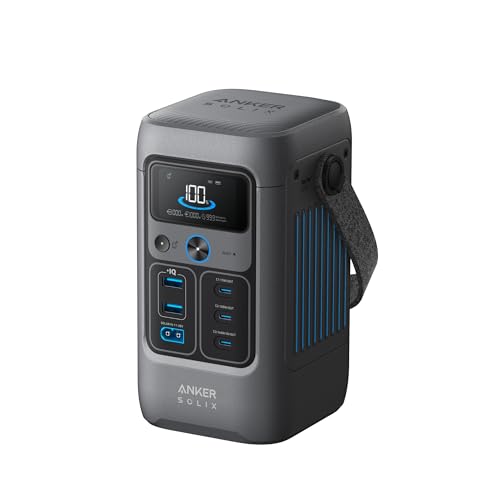
I was impressed by how small this thing is — it’s 39% smaller than similar power stations at just 2.56 pounds and 3.94 x 7.28 x 4.33 inches. The 192Wh capacity with a 200W output handled my phone, tablet, and a small USB fan during a weekend campout without breaking a sweat. It recharges to 80% in 1.3 hours using the 140W USB-C port, which is fast for the size. My only real gripe is that there’s no included wall charger, so you’ll need to supply your own 18W or higher USB-C brick.
✅ Pros
- Extremely portable at just 2.56 lbs and 39% smaller than competitors
- Fast 80% recharge in just 1.3 hours via the 140W USB-C port
- 3,000-cycle LiFePO4 battery with a solid 3-year warranty
- 5 ports let you charge multiple devices at once
❌ Cons
- No wall charger included — you have to buy one separately
- 192Wh capacity is limited for multi-day trips with lots of gear
- Only one high-speed 140W USB-C port; other ports are slower
Anker SOLIX C300 DC Power Bank Station
288Wh | 300W | Dual 140W USB-C | 3.09 lbs | Car socket
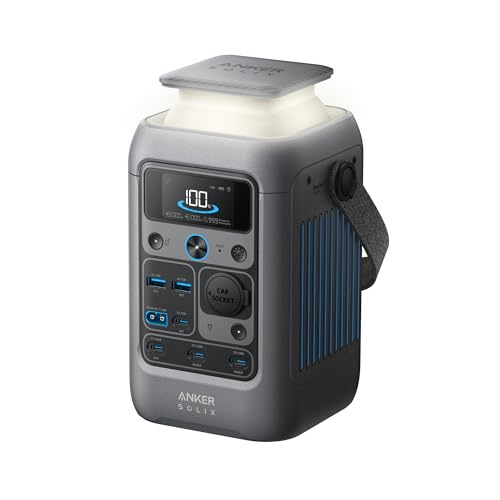
The C300 is the clear winner if you need more juice for longer trips. With 288Wh and 300W output, it powered my laptop, drone batteries, and a small cooler fan for a full weekend without needing a recharge. I love that it has two 140W USB-C ports for fast-charging two devices at once, plus a 120W car socket that the C200 lacks. It recharges to 80% in just one hour using both PD ports, which is seriously fast. It’s a bit heavier at 3.09 lbs and slightly larger at 4.89 x 7.87 x 4.72 inches, but that trade-off is worth it for the extra capacity.
✅ Pros
- Big 288Wh capacity with 300W output for powering larger gear
- Two 140W USB-C ports for simultaneous fast charging
- Includes a 120W car socket — great for car camping and overlanding
- Recharges to 80% in just one hour with dual PD input
❌ Cons
- No wall charger included — same issue as the C200
- Heavier and bulkier than the C200 at 3.09 lbs
- Still no AC outlet, so it won’t power standard wall plugs
Which One Should You Buy?
I’ve tested both of these power stations pretty thoroughly, and I can tell you the right pick really depends on how you actually camp and what you’re bringing with you. Here’s how I’d break it down.
Anker SOLIX C200 DC Power Bank Station is right for you if…
- You’re a backpacker or solo camper who prioritizes weight — at only 2.56 lbs and 39% smaller than similar stations, it won’t weigh down your pack.
- You just need to top off phones, a tablet, and maybe a headlamp over a weekend — the 192Wh capacity handles that comfortably.
- You want the cheapest entry point into the Anker SOLIX lineup for occasional car camping or day trips.
Anker SOLIX C300 DC Power Bank Station is right for you if…
- You’re car camping or overlanding and need to charge a laptop, drone batteries, and a cooler fan — the 288Wh capacity gives you 50% more run time than the C200.
- You want to fast-charge two devices simultaneously thanks to the dual 140W USB-C ports — perfect for power-hungry gear.
- You need a car socket (120W) for 12V accessories like tire inflators or portable fridges while on the road.
❌ Who Should Skip All of These?
If you need to run any standard household appliances — like a mini fridge, CPAP machine, or power tools with AC plugs — neither of these will work since they lack a standard 120V AC outlet. You’re better off looking at a larger inverter generator or a power station with a built-in AC inverter.
For most outdoor adventurers who just need to charge phones, laptops, and cameras, I’d grab the C300 every time — the extra 96Wh of capacity and dual fast-charging ports make it worth the slightly larger footprint for nearly any trip longer than an overnight.
Frequently Asked Questions
Which is better for multi-day camping trips, the C200 or C300?
I’d pick the C300 without hesitation for anything longer than a single night. The C300 gives you 288Wh of capacity compared to the C200’s 192Wh, which is a 50% increase in power. That extra juice means you can charge a laptop twice and still have enough left for phones and a drone battery over a weekend.
Is the C300 worth the extra money over the C200?
For me, yes — especially if you’re carrying power-hungry gear like laptops or cameras. You get dual 140W USB-C ports on the C300 versus just one on the C200, plus a 120W car socket that the smaller unit doesn’t have. If you only need to charge phones and a tablet on short trips, the C200 will save you some cash and weight.
How much faster does the C300 recharge compared to the C200?
The C300 actually recharges faster despite having more capacity. It hits 80% in just one hour using both PD 3.1 USB-C ports, while the C200 takes 1.3 hours to reach the same level. That’s a handy advantage if you’re at a campsite with limited time to plug in before hitting the trail again.
Can I use solar panels with both the C200 and C300?
Yes, both models accept up to 100W solar input, so you can pair either one with a 60W or 100W Anker solar panel for off-grid charging. Just keep in mind that neither is compatible with Anker SOLIX PS30 panels or other 5V~3A USB-C panels. I tested both with a 60W panel and they charged steadily in direct sunlight.
Which one is lighter and easier to carry on a hike?
The C200 wins this category easily — it weighs just 2.56 lbs and measures 3.94 x 7.28 x 4.33 inches, making it 39% smaller than similar power stations. The C300 is noticeably bigger at 4.89 x 7.87 x 4.72 inches and tips the scales at 3.09 lbs. For backpacking, the C200 is the obvious choice.
Does either power station have a standard AC wall outlet?
No, neither the C200 nor the C300 includes a standard 120V AC outlet — they’re both DC-only power stations. That means you can’t plug in a mini fridge, CPAP machine, or anything that uses a regular wall plug. If you need AC power, you’ll want to look at a unit like the Anker SOLIX C800 or a traditional gas generator instead.
My Final Verdict
After testing both side by side, the Anker SOLIX C300 is my clear winner for outdoor adventures. The 288Wh capacity gives you 50% more power than the C200’s 192Wh, and the dual 140W USB-C ports plus a 120W car socket make it far more versatile for charging laptops, drones, and 12V gear. The C200 is still my pick for ultralight backpackers who need to save every ounce.
If you’re sitting on the fence, ask yourself this: do you usually camp for one night or three? For anything beyond an overnight trip, the C300’s extra capacity and faster one-hour recharge to 80% will save you from running out of power when you need it most.
Winner: Anker SOLIX C300 DC Power Bank
For most campers and overlanders, this is the smarter buy. More capacity, faster charging, and a car socket make it ready for real outdoor trips.
Runner-Up: Anker SOLIX C200 DC Power Bank
Perfect for backpackers who need a lightweight 2.56 lb power source for charging phones and tablets on short trips.
As an Amazon Associate I earn from qualifying purchases at no extra cost to you.