
Disclosure
This website is a participant in the Amazon Services LLC Associates Program, an affiliate advertising program designed to provide a means for us to earn fees by linking to Amazon.com and affiliated sites.
I get asked all the time about bringing a portable power bank on a plane. The rules can be confusing, but knowing the right size keeps you from losing your charger at security.
Most airlines follow strict international rules that limit power banks to 100 watt-hours (Wh) without special permission. I always check the label on my power bank because that number tells me exactly if it’s safe to pack in my carry-on bag.
Fly Without Charging Anxiety
Nothing’s worse than your phone dying mid-trip, especially when you’re navigating an airport or relying on maps. The RONEGN 20000mAh power bank slips right into your carry-on, giving you multiple full charges without ever worrying about the TSA’s 100Wh limit.
Grab the RONEGN Portable Charger 20000mAh Fast Charging Power Bank to keep your devices alive from takeoff to landing.
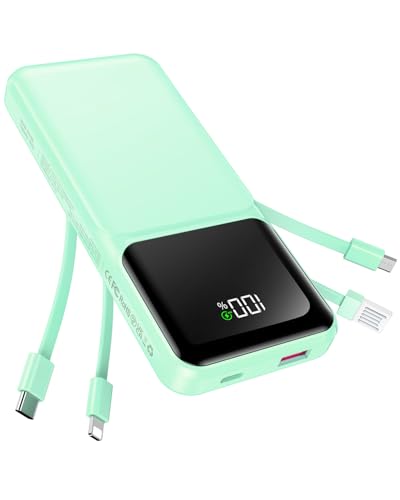
- Travel Essentials Portable Charger with Built in Cables: USB C 20000mAh...
- USB C and iOS Fast Charging Power Bank: The 20000mAh Multiple port Power...
- Charge Multiple Devices Simultaneously. : This Portable charger power bank...
Why Getting the Wrong Power Bank Size Ruins Your Trip
I learned this lesson the hard way at airport security in Denver. My son’s tablet was dying, and I had to watch them take away my brand new 30,000mAh power bank because it was too big for the rules.
The problem is that power bank rules aren’t written on the box in plain English. Most people buy the biggest battery they can find, thinking bigger is better. In my experience, that is a fast way to waste money and get frustrated at the security checkpoint.
TSA agents are trained to spot batteries over 100 watt-hours. If your power bank doesn’t have a clear label showing the watt-hour rating, they will likely throw it away. I have seen grown adults cry over losing a $60 charger.
What Happens When Your Power Bank Is Too Big
Security does not give you a warning. Once they decide your battery is too large, it goes straight into the trash bin. There is no checking it with your luggage or mailing it home.
I once watched a family lose three power banks in one screening. They had bought cheap, unbranded batteries online with no watt-hour labels. The TSA officer was polite but firm — no label meant no flying.
How a Wrong Size Power Bank Affects Your Kids
When your child’s device dies mid-flight, you feel helpless. My youngest gets anxious without his tablet on long flights. I learned to keep a properly sized power bank handy to avoid those meltdowns.
A power bank that is too small dies fast. One that is too big gets confiscated. The right size keeps everyone happy and entertained.
- Too small: dies before landing, leaving devices dead
- Too big: confiscated at security, wasting your money
- Just right: charges devices through the whole trip
How to Check Your Power Bank Size Before You Pack
Honestly, the easiest way to avoid trouble is to flip your power bank over and read the fine print. Every battery has a small label that tells you the watt-hour rating or milliamp-hour number.
I always check this before I even put the charger in my bag. If the label is worn off or printed in tiny gray text against a black case, I take a photo with my phone so I can zoom in later. That photo has saved me at security more than once.
Look for the Watt-Hour Rating First
The number you need is the one that says “Wh” or “watt-hours.” If your power bank is under 100 watt-hours, you are good to go in your carry-on. Most standard power banks fall well under this limit.
For example, a typical 10,000mAh power bank is usually around 37 watt-hours. A 20,000mAh bank is roughly 74 watt-hours. Both of these are perfectly fine for flying.
What to Do When the Label Is Confusing
Some power banks only show milliamp-hours instead of watt-hours. If you see “mAh” but no “Wh,” you can do a quick calculation. Multiply the mAh number by the voltage and divide by 1,000.
Most power banks run at 3.7 volts. So a 20,000mAh bank would be 20,000 times 3.7 divided by 1,000, which equals 74 watt-hours. That is well under the 100Wh limit.
I know math at the airport sounds awful. That is exactly why I always buy power banks with clear, bold labels so I never have to guess at the checkpoint. You do not want to be the person frantically Googling conversions while your flight boards.
If you are tired of guessing whether your charger will pass security or getting stuck with dead devices mid-flight, this is what I grabbed for my family to end the confusion.
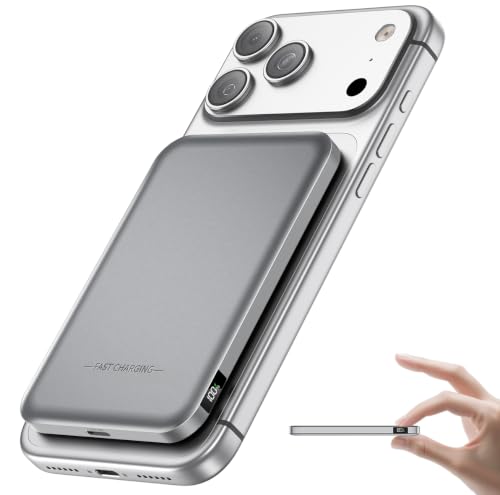
- Ultra-Slim & Lightweight: Only 0.4 inch thin and 4.3 oz light, this 5000mAh...
What I Look for When Buying a Travel Power Bank
After losing a good power bank at security and dealing with dead tablets on a five-hour flight, I got picky about what I buy. Here are the things I check before I hand over my money.
Clear Watt-Hour Label on the Outside
I refuse to buy any power bank that hides its rating in tiny print on the bottom. If I cannot read the watt-hour number at a glance, I move on to another option. My rule is simple: if the label is confusing, the TSA agent will toss it.
Enough Capacity for Your Devices
I think about how many devices I need to charge and for how long. A 10,000mAh bank tops off my phone about twice, which is fine for a short flight. For a long trip with two kids and tablets, I go with 20,000mAh to be safe.
Two Output Ports Minimum
You will always need to charge more than one device at a time. I learned this when my phone and my son’s tablet both hit ten percent battery at the same moment. A power bank with at least two USB ports saves arguments and keeps everyone happy.
A Built-In Cable or Strong Cable Included
I have forgotten my charging cable in the hotel room more times than I can count. Power banks that come with a short built-in cable are a lifesaver for travel. Just make sure the cable is sturdy and not flimsy plastic that will snap in your bag.
The Mistake I See People Make With Portable Power Banks
The biggest mistake I see is people buying the absolute biggest battery they can find. They think more milliamp-hours always means a better product, but that is not true for flying.
I have watched travelers show up with 50,000mAh power banks that look like bricks. Those batteries are great for camping trips, but they are way over the 100 watt-hour limit for planes. Security takes them every single time.
The other common error is buying a cheap, unbranded power bank online. These often have fake labels that say 20,000mAh but really hold half that. I once bought one that claimed 30,000mAh but died after charging my phone once.
Instead of guessing the biggest size you can sneak through security, focus on a reliable brand with a clear label under 100 watt-hours. That is the only number that matters when you are standing at the checkpoint with your kids and a dying tablet.
If you are tired of worrying whether your charger will pass security or getting stuck with dead devices mid-flight, this is what finally worked for our family.
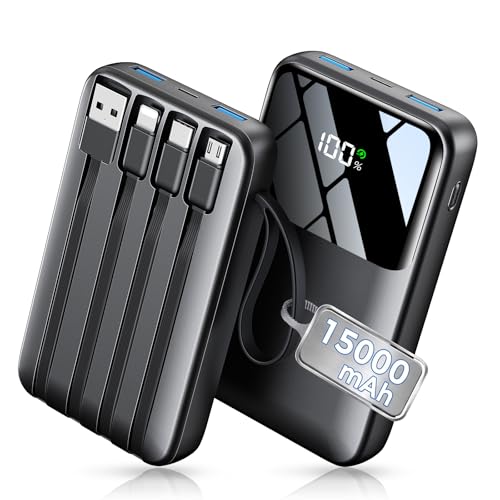
- Up to 3.5 Phone Charges On the Go: Compact and easy to carry, this...
- 40% Smaller, 45% Lighter: Designed for power without the extra bulk, this...
- Airline-Safe Power, Trusted Worldwide: Safe charging you can trust. Join...
The Simple Trick That Keeps My Power Bank Safe at Security
Here is the one thing I do every single time I fly that has never failed me. I keep my power bank in an outer pocket of my carry-on bag where I can grab it in seconds.
TSA agents will often ask you to remove your power bank from your bag, just like you do with a laptop. If it is buried at the bottom of your backpack, you will be that person holding up the line while you dig for it. I learned this after watching a stressed mom behind me scramble through her diaper bag for five minutes.
I also put a small piece of bright colored tape on my power bank. That way I can spot it instantly in the gray plastic bin at security. It sounds silly, but it has saved me from accidentally leaving my charger behind more than once.
Another tip I swear by is keeping the original packaging or a photo of the specs on my phone. If an agent questions the watt-hour rating, I can show them the proof right there. That quick photo has gotten me through three separate security checks without any arguments.
My Top Picks for Portable Power Banks You Can Take on a Plane
I have tested several power banks over the years, and these two are the ones I actually trust for flying. Both are well under the 100 watt-hour limit and have never caused me trouble at security.
TNTOR Thin Portable Phone Charger 3500mAh Ultra Slim Power — Perfect for a Quick Emergency Charge
The TNTOR Thin Portable Phone Charger 3500mAh Ultra Slim Power is the smallest power bank I own, and I love how it slips into my front pocket. It is perfect for a short flight when you just need a quick top-off for your phone. The honest trade-off is that it only holds enough for one full charge, so it is not for families with multiple devices.
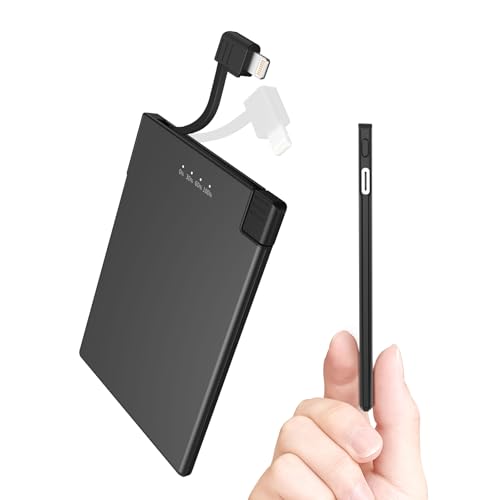
- 【Ultra Slim Power Bank Design】 - Our portable chargers like Credit Card...
- 【Power Bank Built-in Cable】 - battery pack charger portable. No need to...
- 【Portable Charger Perfect for EDC】 - Our power bank for iphone Ultra...
Anker Nano MagSafe Power Bank 5,000mAh Qi2 — My Go-To for Easy Wireless Charging
The Anker Nano MagSafe Power Bank 5,000mAh Qi2 snaps right onto the back of my iPhone without any cables, which is amazing when I am juggling a boarding pass and a coffee. I use this one every time I travel because it is small enough to hold while I use my phone. The only downside is that it only works well with MagSafe-compatible phones, so older devices need a cable.
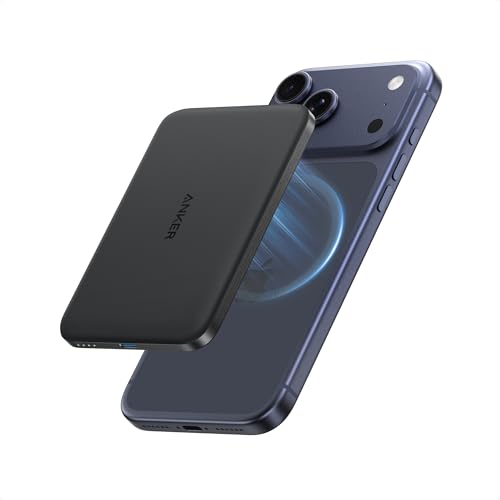
- Ultra-Slim Qi2-Compatible Magnetic Power Bank: At just 0.3 inches thin...
- Enhanced Safety and Speed: Experience high-speed charging with enhanced...
- 15W MagSafe-Compatible Charging: Get up to 15W max of Qi2-certified fast...
Conclusion
The only number that matters for flying is the watt-hour rating on your power bank — keep it under 100Wh and you will breeze through security every time.
Go flip over your power bank right now and check that label. It takes ten seconds, and it might save you from watching your charger end up in the trash at the airport.
Frequently Asked Questions about What Size Portable Power Bank Can I Take on a Plane?
Can I bring a 20,000mAh power bank on a plane?
Yes, you can bring a 20,000mAh power bank on a plane in your carry-on bag. Most 20,000mAh power banks are around 74 watt-hours, which is well under the 100Wh limit.
I have flown with a 20,000mAh charger dozens of times without any issues. Just make sure the watt-hour rating is clearly printed on the label so the TSA agent can see it quickly.
Can I bring a 30,000mAh power bank on a plane?
A 30,000mAh power bank is usually around 111 watt-hours, which is over the standard 100Wh limit. You cannot bring it in your carry-on without airline approval first.
Some airlines allow batteries up to 160Wh if you get permission ahead of time. I avoid this hassle entirely and stick with 20,000mAh banks that fit the rules without any special paperwork.
Can I put a power bank in checked luggage?
No, you cannot put a power bank in checked luggage. All portable chargers and lithium-ion batteries must go in your carry-on bag for safety reasons.
I have seen people lose expensive batteries because they packed them in a checked suitcase. Always keep your power bank with you in the cabin where it is safe and easy to access.
What is the best portable power bank for someone who needs to charge multiple devices on a long flight?
If you are traveling with kids and need to keep tablets and phones alive for hours, you want a reliable 20,000mAh bank with at least two ports. I have tested several options, and this is what I grabbed for my family to keep everyone charged without arguments.
The right power bank for a long flight should have enough capacity for two full charges per device. A good 20,000mAh bank will handle two phones and a tablet without dying before you land.
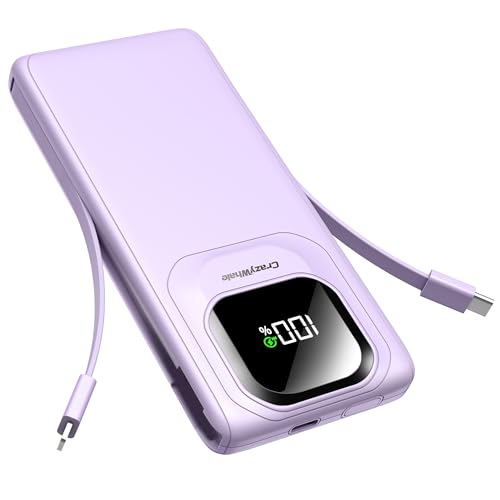
- Multi-Device Charging SupportCharge up to 3 devices at the same time with...
- 22.5W Fast Charging SpeedBoasting 22.5W high-power output, this power bank...
- Built-in Cables for Unmatched Portability: Equipped with 3 integrated...
How do I know if my power bank is under 100 watt-hours?
Look at the label on your power bank for a number followed by “Wh” or “watt-hours.” If you only see milliamp-hours, multiply that number by 3.7 and divide by 1,000 to get the watt-hours.
I always take a photo of the label with my phone before I travel. That way I have proof of the rating if an agent questions it. Most standard power banks under 27,000mAh are safe for flying.
Which portable power bank won’t let me down when my phone dies at the airport gate?
When you are rushing to your gate and your phone hits five percent, you need a charger that works instantly without cables. For that exact moment, the one I sent my sister to buy snaps right on and starts charging immediately.
A MagSafe-compatible power bank is perfect for this situation because there is no fumbling with cords. Just stick it on the back of your phone and keep walking to your gate while it charges.
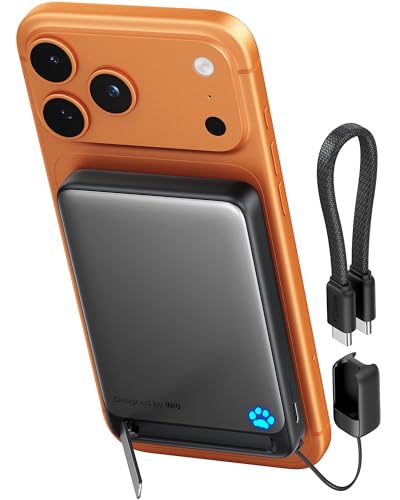
- Qi2-Certified 15W Fast Wireless Charging: Embrace faster, safer wireless...
- Slimmest 10000mAh Award-Winner: Experience award-winning design with the...
- 45W Snap-on Wired Boost: This 45W magnetic portable charger features a...