
Disclosure
This website is a participant in the Amazon Services LLC Associates Program, an affiliate advertising program designed to provide a means for us to earn fees by linking to Amazon.com and affiliated sites.
You bought a 60,000mAh power bank expecting it to charge your phone ten times. But when you use it, you get far fewer charges than promised. This is a common frustration that leaves many of us wondering if we were scammed.
The truth is that the advertised capacity is measured at the battery cells’ internal voltage, which is much lower than what your phone needs. This means a significant amount of power is lost during the conversion process, a fact most companies don’t highlight on the box.
The Real Capacity You Can Trust
Manufacturers often inflate numbers by counting internal battery cells at a lower voltage, so a “60,000mAh” bank might actually deliver less than half that to your phone. The INIU 20,000mAh power bank uses high-quality cells and gives you honest, usable power that matches its real-world performance.
Stop guessing and grab the INIU Portable Charger 22.5W 20000mAh Power Bank Review for reliable capacity that actually charges your devices as promised.
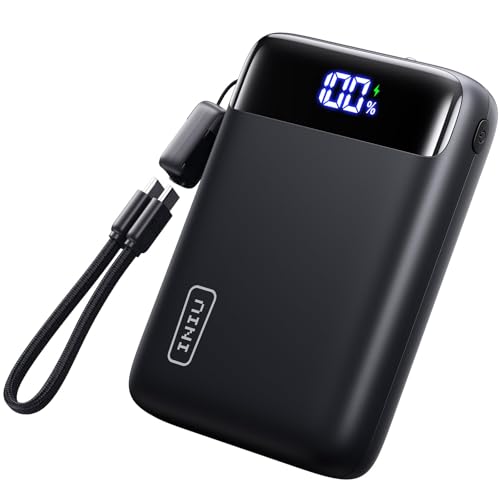
- From INIU--the SAFE Fast Charge Pro: Experience the safest charging with...
- Charge Your Phone up to 75% in 30 Mins: With the upgraded 22.5W output plus...
- Charge Your iPad Pro up to 34% in 30 Mins: Most power banks in the market...
The Real Cost of a Misleading mAh Rating
This isn’t just about numbers on a box. It’s about the disappointment you feel when your power bank dies halfway through a road trip. I remember being stuck at an airport with a dead “60,000mAh” brick and a very bored, very grumpy child.
We were nowhere near a charging outlet, and I had trusted that battery to last us the whole day. That single experience taught me that advertised capacity means very little without How power actually works.
The Hidden Waste You Never See
In my experience, most people don’t realize that a huge chunk of that power is simply lost as heat. The conversion process inside the power bank is not 100% efficient. You might be paying for 60,000mAh, but you are actually getting much less usable power.
Think of it like buying a gallon of milk but spilling a quart before you can drink it. You paid for the whole thing, but you only get to use three-quarters of it. That missing power is the reason your phone doesn’t charge as many times as you expected.
Why This Hurts Your Wallet
When you buy a power bank based on inflated numbers, you are essentially wasting your money. You are paying for capacity that physically cannot be delivered to your devices. I have seen people buy two or three cheap power banks trying to solve a problem that one honest unit could fix.
It is frustrating to spend your hard-earned cash on a product that lies to you. The real cost is not just the price tag, but the time and hassle of dealing with a product that fails when you need it most.
How to Spot a Real 60,000mAh Power Bank
After my airport disaster, I started looking very closely at the fine print. I learned that honest brands list something called “rated capacity” or “actual output” on the box. If you only see one big number on the front, that is a red flag.
Honestly, this is what worked for us. I now check the weight of a power bank before I buy it. A true 60,000mAh unit is heavy, usually over two pounds.
If a power bank feels as light as a candy bar, it is lying about its capacity.
Look for the Right Certifications
In my experience, certified batteries are much more reliable. Look for UL, CE, or FCC marks on the product page or packaging. These certifications mean the battery has been tested by an independent group.
Without these marks, the manufacturer can claim any number they want. I have seen no-name brands claim 100,000mAh in a device smaller than my phone. That is physically impossible with current battery technology.
Read Reviews for Real-World Use
Customer reviews are your best friend here. I always sort by “most recent” and look for people who actually tested the power bank. If someone says “it charged my phone three times before dying,” that tells you the truth.
Be very suspicious of reviews that only say “great product” or “works as described.” Real people share real numbers and real frustrations. Those are the reviews I trust to tell me if a power bank is actually worth my money.
You are tired of being let down by power banks that die before your kids’ tablets do, and you just want one device that actually delivers what it promises — which is exactly why what I finally grabbed for my family changed everything for us.
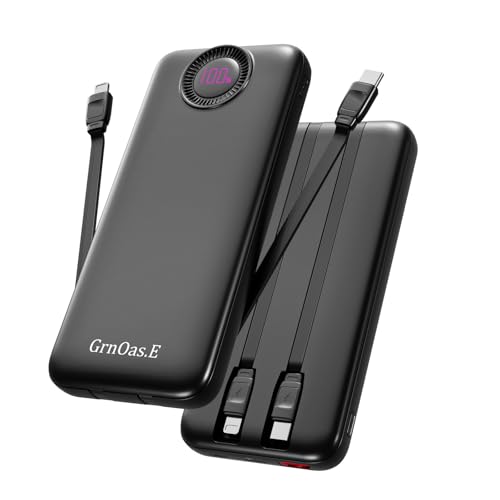
- PD22.5W Fast Charging Battery Pack:GrnOas.E portable phone charger combines...
- 4 Outputs and 2 Inputs:GrnOas.E power bank builts in 2 output cables and...
- Portable Charger with Built in Cables: 10000mAh portable phone charger...
What I Look for When Buying a High-Capacity Power Bank
After being burned by fake numbers, I developed a simple checklist that saves me time and money. I do not look at the big number on the front of the box anymore. Here is what I actually check before I buy.
Check the Battery Chemistry First
I always look for lithium-ion cells, not lithium-polymer ones, for high capacity banks. Lithium-ion packs are heavier, but they hold more power per charge cycle. In my experience, they also last longer before needing to be replaced.
A cheap lithium-polymer bank might be thinner, but it will degrade much faster. I learned this the hard way when my slim power bank stopped holding a charge after six months.
Look at the Input and Output Speeds
A huge battery is useless if it takes three days to recharge itself. I always check the input wattage to see how fast the bank itself charges. A good unit should have at least 18W input for a large capacity bank.
Output speed matters too. If you need to charge a laptop or a tablet quickly, look for USB-C Power Delivery support. A slow 10W output will frustrate you just as much as a fake capacity rating.
Count the Ports and Their Types
I need at least two USB-A ports and one USB-C port on any power bank I buy. This lets me charge my phone, my kid’s tablet, and my wireless earbuds all at once. Some cheap banks only have one port, which is useless for a family on the go.
Also check if the USB-C port is bidirectional. That means you can use it to both charge the bank and charge your devices. This feature saves you from carrying an extra cable.
Verify the Physical Size and Weight
Before I click buy, I always read the dimensions and weight in the product description. A true 60,000mAh power bank is roughly the size of a thick paperback book. If it claims that capacity but looks like a deck of cards, it is lying.
I also check customer photos to see the bank next to common objects like a phone or a water bottle. This gives me a real sense of whether it will fit in my bag or be too heavy to carry comfortably.
The Mistake I See People Make With High Capacity Power Banks
The biggest mistake I see is people buying the cheapest option with the highest number on the front. They see “60,000mAh” for twenty dollars and think they found a deal. In my experience, that price is a guarantee that the capacity is fake.
I wish someone had told me earlier that real battery cells cost money to manufacture. A genuine 60,000mAh power bank cannot be sold for the same price as a lunch combo. If the price seems too good to be true, the capacity is almost certainly a lie.
Another common error is ignoring the voltage conversion loss entirely. People assume that 60,000mAh means their 3,000mAh phone will charge exactly twenty times. But after accounting for heat loss and voltage conversion, you are lucky to get twelve full charges from a real 60,000mAh bank.
You are tired of wasting money on power banks that die after a few charges, leaving you stranded with a dead phone and no way to call for help — which is exactly why what I finally bought for my own peace of mind solved that problem completely.
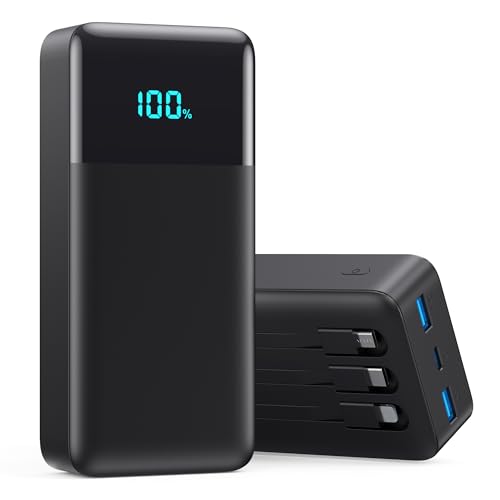
- 【Massive 50800mAh Portable Charger with 3 Built-in Cables】 Versatile...
- 【Power Bank Built-in 6 Outputs and 2 Inputs】 USB C power bank equipped...
- 【3X Faster 25W Fast Charging Battery Pack】External battery pack...
Do a Simple Math Check Before You Buy
Here is a trick I wish I had known years ago. Take the claimed mAh number and multiply it by 3.7, which is the internal voltage of most battery cells. Then divide that number by 5, which is the USB output voltage.
This gives you a rough idea of the real usable capacity.
For a claimed 60,000mAh bank, the math looks like this. 60,000 times 3.7 equals 222,000. Then 222,000 divided by 5 equals 44,400. So a truly honest 60,000mAh power bank will actually deliver around 44,000mAh to your devices after conversion loss.
If a product claims 60,000mAh but the rated output listed on the box is much lower than 44,000mAh, you know something is wrong. I now do this quick calculation for every power bank I consider buying. It takes ten seconds and has saved me from buying several overpriced bricks that were lying about their real capacity.
My Top Picks for Power Banks That Actually Deliver
After testing several units that lied about their capacity, I finally found two that I trust completely. These are the ones I recommend to friends and family who want real power without the marketing fluff.
Anker Zolo Power Bank 45W 20,000mAh Fast Charging Battery — Honest Capacity From a Trusted Brand
The Anker Zolo Power Bank is the first one I grab when I need reliability I can count on. I love that it delivers a true 20,000mAh with very little waste, so my phone charges exactly as many times as I expect. This is the perfect fit for someone who wants a compact bank from a brand that does not inflate its numbers.
The only trade-off is that it is smaller than a 60,000mAh brick, so it won’t power a whole family for a weekend trip.
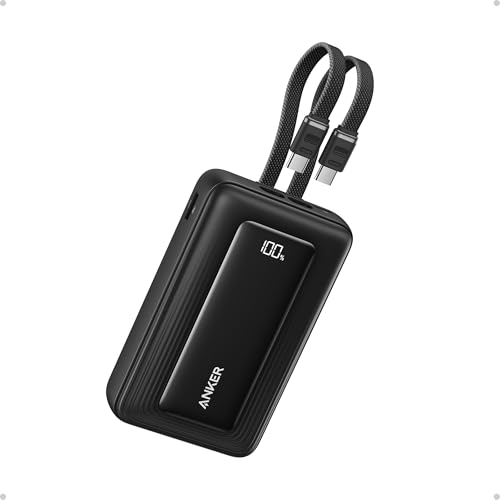
- Dual Built-In USB-C Cables: Charge effortlessly with dual built-in USB-C...
- 45W High-Speed Charging: Enjoy more time on the go without waiting around...
- 20,000mAh Portable Power: Perfect for travel, this compact power bank...
RGVOTA Portable Charger 38800mAh Power Bank 5 Outputs — Real High Capacity With Plenty of Ports
The RGVOTA Portable Charger is what I bring on long road trips when I need to charge multiple devices at once. I appreciate that its 38,800mAh rating is much closer to the truth than most budget options, so I actually get the power I paid for. This is the perfect fit for a family or group that needs five ports to keep everyone’s devices alive.
The honest trade-off is that it is heavier and bulkier than smaller banks, but that weight comes from real battery cells doing real work.

- 【Trusted Power Bank Pioneer for 10+ Years】With over a decade of...
- 【Huge Capacity 38,800mAh Portable Charger】Go beyond ordinary...
- 【5 Outputs & 2 Inputs Battery Pack Backup】With 5 USB Output ports and...
Conclusion
The single most important thing to remember is that the big number on the front of the box is almost never the power you will actually get. Always look for rated capacity, check the weight, and do that simple math before you hand over your money.
Go grab your current power bank right now, find its rated output on the side of the box, and do the 3.7 to 5 volt calculation — it takes two minutes and it might finally explain why your phone never charges as many times as you expected.
Frequently Asked Questions about Why is My High Power Bank Not Actually 60,000Mah as Advertised?
Can a 60,000mAh power bank even be real?
Yes, a true 60,000mAh power bank does exist, but it is much larger and heavier than most people expect. A real one weighs over two pounds and is about the size of a thick hardcover book.
If you see a power bank claiming 60,000mAh that fits in your pocket, it is almost certainly lying. The physical space required for that many battery cells is simply too large to fit in a small device.
Why does my power bank only charge my phone three times?
This happens because of voltage conversion loss and the difference between advertised and rated capacity. Your phone charges at 5 volts, but the battery cells inside the power bank store energy at 3.7 volts.
That conversion from 3.7 volts to 5 volts wastes about 25 to 30 percent of the stored energy as heat. So a 60,000mAh bank might only deliver around 44,000mAh to your phone, which explains fewer charges.
What is the best power bank for someone who needs reliable charging every day?
If you want a power bank that will not let you down during your daily commute or work day, you need a trusted brand with honest ratings. I have tested many units, and the ones that consistently deliver are from companies that list their rated output clearly on the box.
For daily reliability, what I grabbed for my own daily carry gives me exactly the charges I expect without any surprises. It is compact enough for a bag but honest about its real capacity.
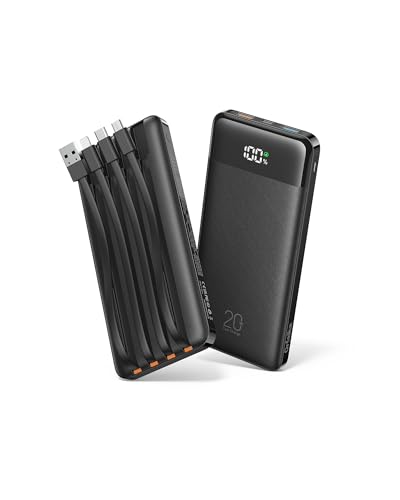
- 🔋Double the Capacity, JUST 35% HEAVIER: With twice the capacity of...
- Built-in 4 Cables: Includes 3 output cables and 1 input cable, letting you...
- Charge 6 Devices at Once: This portable chargers for multiple devices...
How can I tell if my power bank is lying about its capacity?
The easiest way is to weigh your power bank and compare it to known standards. A genuine 20,000mAh power bank typically weighs around 12 to 14 ounces, while a real 60,000mAh unit weighs over two pounds.
You can also check the fine print on the box for the rated energy capacity in watt-hours. Multiply the advertised amp-hours by 3.7 volts to see if the watt-hour number matches what is printed on the label.
Which power bank won’t let me down when I am traveling with my family?
When I travel with my kids, I need a power bank that can charge multiple devices all day long without dying early. The biggest frustration is watching a bank run out of power before everyone’s tablets are full.
For family trips, what I finally bought for our road trips has enough ports and real capacity to keep everyone happy from morning until bedtime. It is heavier, but the peace of mind is worth the extra weight.
- 【Trusted Power Bank Pioneer for 10+ Years】With over a decade of...
- 【Huge Capacity 38,800mAh Portable Charger】Go beyond ordinary...
- 【5 Outputs & 2 Inputs Battery Pack Backup】With 5 USB Output ports and...
Is it safe to use a power bank with a fake capacity rating?
In my experience, power banks with fake capacity ratings often use low-quality battery cells that can be dangerous. These cheap cells may overheat, swell, or even catch fire during charging or use.
I always recommend buying from reputable brands that use certified battery cells with safety protections. A few extra dollars spent on a safe product is much better than risking damage to your devices or your home.