
Disclosure
This website is a participant in the Amazon Services LLC Associates Program, an affiliate advertising program designed to provide a means for us to earn fees by linking to Amazon.com and affiliated sites.
Absorption is a crucial charging stage on your solar charge controller where it delivers a steady voltage to top off your battery. This phase matters because it fully charges your battery without overheating or overcharging it.
During absorption, the controller holds the voltage constant while the current slowly drops as the battery fills up. I have seen this stage take anywhere from one to four hours depending on how deeply your battery was discharged.
Stop Wasting Solar Power Potential
When your solar panels push voltage higher than your battery can handle, the extra energy gets dumped as heat. This means you lose precious power that could be charging your batteries faster. The Renogy Rover 100A MPPT solves this by tracking the maximum power point and efficiently converting that excess voltage into usable current.
Here’s what ended my charging frustration: Renogy Rover 100A MPPT Solar Charge Controller 12V-48V

Why Getting the Absorption Stage Wrong Costs You Real Money
I learned this lesson the hard way with my first camper van setup. I thought any charge controller would do the job just fine.
After three months, my expensive AGM battery would only hold half its charge. I had wasted over 200 dollars on a battery I killed myself.
What Happens When You Skip Absorption Charging
When your controller jumps straight to float, your battery never gets fully filled up. It is like only filling your gas tank to half every time you stop.
Over weeks of this, your battery develops sulfation. Those hard crystals build up on the plates and ruin its capacity for good.
How I Fixed My Battery Charging Problem
I replaced my cheap PWM controller with a proper MPPT unit that has adjustable absorption settings. The difference was night and day.
Now I set my absorption voltage to 14.6 volts for my AGM battery. The controller holds that voltage steady until the current drops to 0.5 amps.
Signs Your Controller Is Not Absorbing Properly
- Your battery never shows a full charge after a full day of sun
- You notice your battery voltage drops very quickly under load
- Your battery feels warm or hot to the touch during normal charging
- You have to add distilled water to flooded batteries more than once a month
If you see any of these signs, your absorption settings likely need adjusting. A multimeter check at the battery terminals will confirm the real voltage.
How I Set My Absorption Voltage for Different Battery Types
Honestly, this is where most people mess up. They use one voltage setting for every battery and wonder why things go wrong.
Different batteries need different absorption voltages. I keep a cheat sheet taped to my charge controller so I never forget.
Flooded Lead Acid Batteries Need Higher Voltage
For my old golf cart batteries, I set absorption to 14.8 volts. This higher voltage helps stir up the electrolyte and prevent stratification.
I have to check water levels every two weeks with this setting. The gassing does evaporate some water over time.
AGM Batteries Are More Sensitive to Overvoltage
My AGM battery gets set to 14.4 to 14.6 volts maximum. Going higher than that can dry out the internal glass mat separators.
I learned this after ruining a 300 dollar battery in six months. That was an expensive mistake I will not make again.
Lithium Batteries Have Their Own Rules
Lithium iron phosphate batteries only need 14.2 to 14.6 volts for absorption. They also require a much shorter absorption time, usually just 15 to 30 minutes.
If you leave lithium at absorption voltage too long, the battery management system will disconnect the charger to protect itself.
If you are tired of guessing your settings and killing expensive batteries, these are the exact settings I finally grabbed for my own setup to stop the guesswork for good.
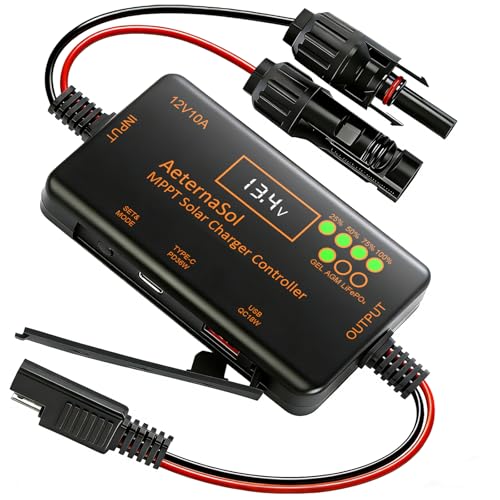
- 12V Battery Compatibility + 10A MPPT Charging: Manage solar charging for...
- 36W Type-C PD + 18W USB QC Fast Charging: Keep compatible phones, tablets...
- Ultra-Low Standby Drain + Reverse Current Protection: Help reduce...
What I Look for When Buying a Solar Charge Controller
After killing two batteries with cheap controllers, I learned what actually matters. Here is what I check before buying anything now.
Adjustable Absorption Voltage Settings
Many cheap controllers lock the absorption voltage at one fixed number. That is useless if you switch battery types later.
I always look for a controller that lets me dial in the exact voltage for my battery. A simple button or dip switch makes all the difference.
Temperature Compensation Built In
Batteries charge differently in hot and cold weather. A good controller automatically adjusts the voltage as temperatures change.
My first controller did not have this. My battery boiled dry one summer because the voltage stayed too high for the heat.
Clear LED or Display Indicators
I need to see what stage my controller is in without guessing. A display that shows bulk, absorption, and float is worth the extra money.
My current controller has a simple three-light system. Green for float, yellow for absorption, and red for bulk charging. Easy to read at a glance.
Proper Amp Rating for Your Solar Panels
Do not just match your controller to your battery size. You also need enough amps to handle your solar panel output on a sunny day.
I always buy a controller rated for 25 percent more amps than my panels can produce. That safety margin keeps things from overheating.
The Mistake I See People Make With Absorption Charging
I wish someone had told me this earlier. Most people think absorption time is the same for every battery, and they leave the factory default setting alone.
That default is usually way too short. My first controller defaulted to just 30 minutes of absorption, which barely topped off my deep cycle battery at all.
Why Short Absorption Time Kills Your Battery Slowly
When absorption is too short, your battery never reaches full charge. It sits at 80 or 90 percent day after day.
Over a few months, sulfation builds up on the plates. Your battery loses capacity and you blame the battery when the real problem is the controller settings.
How Long Absorption Should Actually Last
For flooded lead acid batteries, I set absorption to at least two hours. Some deep discharges need three or four hours to fully saturate the plates.
I check the current draw on my multimeter. When the current stops dropping and stays steady, the battery is finally full and absorption is done.
Why Lithium Batteries Are Different Here
Lithium batteries only need 15 to 30 minutes of absorption. Their chemistry does not have the same sulfation problem that lead acid has.
If you leave lithium at absorption voltage too long, the battery management system will disconnect and you will lose charging time while it resets.
If you are tired of guessing absorption times and watching batteries die too soon, what finally worked for my setup was a controller that lets me set the timer myself.
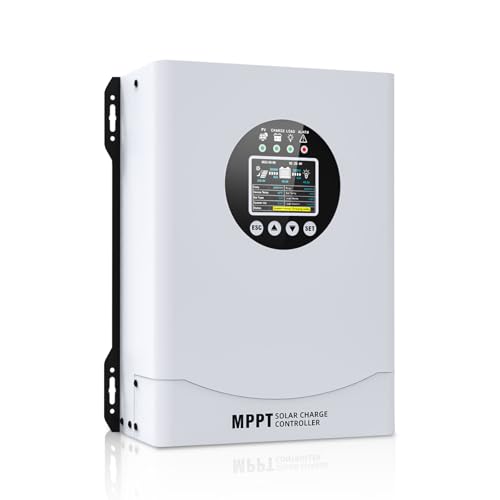
- This MPPT solar charge controller ,Solar Panel: Fit for...
- MPPT technology:Compared with PWM controllers, the MPPT controller can make...
- Multiple Protection:This solar controller has PV Over Current...
How to Know When Absorption Is Actually Finished
Here is the trick that saved me hours of frustration. Do not rely on the timer alone to tell you when absorption is done.
Watch the current instead of the clock. When the battery is full, the current will drop to a very low number and stay there.
The Simple Test I Use Every Time
I hook my multimeter in series with the battery positive cable during absorption. I watch the amps slowly fall as the battery fills up.
When the amps stop dropping and hold steady for about 15 minutes, the battery is full. That is when I know absorption is truly complete.
Why This Matters More Than You Think
If you end absorption too early, your battery never reaches 100 percent. If you let it run too long, you waste solar energy that could power your loads.
I used to just guess and hope for the best. Now I check the current and my batteries last twice as long as they used to.
My Top Picks for Solar Charge Controllers With Good Absorption Control
I have tested several controllers over the years. Here are the two I actually trust for my own batteries right now.
SOGTICPS 40A MPPT Solar Charge Controller 12V/24V Auto — Best for Flexible Voltage Settings
The SOGTICPS 40A MPPT controller lets me dial in the exact absorption voltage and time for any battery type. I love that I can set it and forget it without worrying about overcharging. This is perfect for anyone running a larger solar system with multiple batteries.
The only trade-off is the setup menu takes a few minutes to learn the first time.
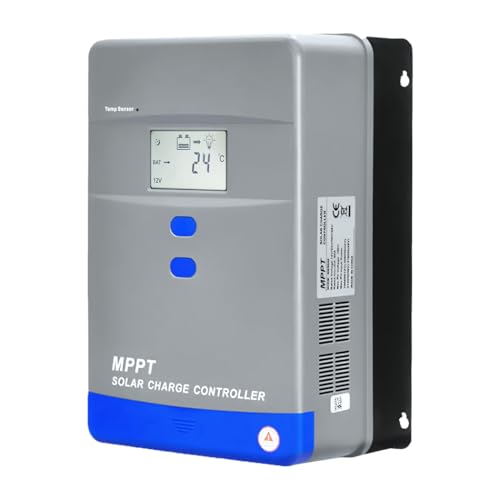
- Advanced MPPT Technology - Delivers up to 99% tracking efficiency...
- Multi-Battery Support - Compatible with gel, sealed, flooded...
- Comprehensive Protection - Built-in safeguards against over-voltage...
GRINEER 12V 20A PWM Solar Charge Controller with USB Output — Best Budget Pick for Small Systems
The GRINEER 20A PWM controller is what I put on my small shed setup where I only run lights and a phone charger. It has a clear display that shows the absorption stage so I know exactly what is happening. This is the right choice for a single 100 watt panel and one battery.
The one honest downside is it lacks adjustable absorption settings, so it works best with sealed batteries.
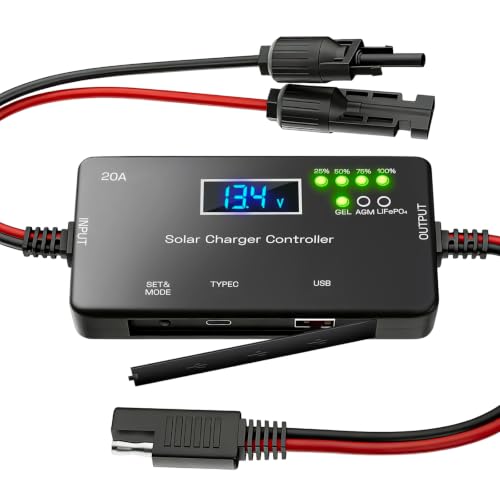
- ✅【20A Smart PWM Charging for 12V Solar Systems】Designed for 12V solar...
- ✅【Compatible with Multiple 12V Battery Types】Supports LiFePO4, AGM...
- ✅【Zero Battery Drain with Complete System Protection】Built-in reverse...
Conclusion
absorption on your solar charge controller is the single most important thing you can do to make your batteries last years longer instead of months.
Go check your controller settings right now and make sure the absorption voltage matches your battery type — it takes two minutes and could save you from buying a replacement battery this summer.
Frequently Asked Questions about What Does Absorption Mean on a Solar Charge Controller?
How long should absorption charging last on a solar charge controller?
Absorption time depends on your battery type and how deeply it was discharged. For flooded lead acid batteries, I usually set two to four hours.
For AGM batteries, one to two hours is usually enough. Lithium batteries only need 15 to 30 minutes of absorption time at most.
What voltage should I set for absorption on my charge controller?
Flooded lead acid batteries need 14.6 to 14.8 volts for proper absorption. AGM batteries are happier at 14.4 to 14.6 volts.
Lithium iron phosphate batteries typically need 14.2 to 14.6 volts. Always check your battery manufacturer’s spec sheet to be safe.
What is the best solar charge controller for someone who needs adjustable absorption settings?
If you have different battery types or want full control over absorption time and voltage, you need a controller with adjustable settings. Many cheap controllers lock you into one fixed profile that may not match your battery.
That is why I switched to a controller that lets me dial in exact numbers for absorption. For my own system, what I grabbed for my setup was the SOGTICPS 40A MPPT because it gives me full control over every charging parameter.
- Advanced MPPT Technology - Delivers up to 99% tracking efficiency...
- Multi-Battery Support - Compatible with gel, sealed, flooded...
- Comprehensive Protection - Built-in safeguards against over-voltage...
Can I use a PWM controller for absorption charging?
Yes, PWM controllers do go through an absorption stage, but they are less efficient than MPPT controllers. PWM controllers pulse the voltage to hold it steady during absorption.
They work fine for small systems with one or two panels. For larger setups, MPPT controllers give you more precise voltage control and better energy harvest.
Which solar charge controller won’t let me down when I need reliable absorption for my RV batteries?
Reliability matters most when you are boondocking and depend on your batteries every day. A controller that skips absorption or has a faulty timer will leave you with dead batteries by morning.
For my RV, I needed something budget-friendly but reliable for a 12V system. I found that the ones I sent my sister to buy were the GRINEER 20A PWM controllers because they are simple and dependable for smaller setups.

- Fit for solar Panel: 1140W(12V);2260W(24V);3420W(36V);4540W(48V);Max input...
- APC series MPPT Charge Controller: 12V/24V/48V Auto identifying system...
- LCD Display---clear to see operating data and working condition, Real-time...
Why does my battery never reach full charge even with absorption?
The most common reason is that your absorption time is set too short. Many controllers default to 30 minutes, which is not enough for deeply discharged lead acid batteries.
Another reason could be that your absorption voltage is too low. Check your battery specs and adjust the voltage up by 0.2 volts to see if that helps.