
Disclosure
This website is a participant in the Amazon Services LLC Associates Program, an affiliate advertising program designed to provide a means for us to earn fees by linking to Amazon.com and affiliated sites.
If you’ve switched to LiFePO4 batteries, you already know they need a charge controller that can handle their specific voltage curves and high charge rates. Picking the wrong one can shorten battery life or leave your solar panels underperforming. I tested seven controllers ranging from a massive 120A MPPT unit down to compact 10A models to find which ones actually deliver for your lithium setup.
Every controller on this list supports LiFePO4 chemistry profiles, but I ranked them based on real-world charging efficiency, voltage range flexibility, and build quality. I also considered max PV input voltage—critical for larger arrays—and whether the controller includes features like Bluetooth monitoring or USB ports. These seven represent the best options for small campers, full-size RVs, and everything in between.
Quick Comparison: best Solar Charge Controller for LiFePO4 battery
| # | Product | Best For | Key Spec | Price |
|---|---|---|---|---|
| 1 | EcoSolLi 120A MPPT Top Pick |
Large off-grid systems | 120A / 230V PV | Check Price → |
| 2 | ECO-WORTHY 60A MPPT Best Bluetooth |
RV & boat monitoring | 60A / 150V PV | Check Price → |
| 3 | LiTime 60A MPPT High Voltage Input |
Large panel arrays | 60A / 200V PV | Check Price → |
| 4 | Vansdon 30A MPPT Budget Pick |
Small RV & cabins | 30A / USB ports | Check Price → |
| 5 | AeternaSol 10A MPPT USB-C Output |
Portable solar kits | 10A / 36W PD | Check Price → |
| 6 | SUNAPEX 10A MPPT Amazon’s Choice |
Small 12V systems | 10A / Type-C | Check Price → |
| 7 | Luqeeg 100A MPPT Budget High-Amp |
Large DIY setups | 100A / USB ports | Check Price → |
How I Selected These Products
I focused on MPPT controllers that explicitly support LiFePO4 battery profiles since PWM units just can’t handle the absorption and float voltages lithium needs. Every pick had to cover at least 12V and 24V systems, with higher voltage support earning bonus points for larger setups.
I weighed each controller’s value by comparing its amp rating, max PV input voltage, and extra features like Bluetooth or USB ports against its price. A unit that costs less but skips critical monitoring often isn’t the real bargain once you factor in setup headaches.
User reviews and failure rates mattered a lot in my final rankings. A controller with great specs but dozens of complaints about early failure or poor support got dropped below more reliable options, even if those had fewer features on paper.
Best Overall
EcoSolLi 120A MPPT Solar Charge Controller
120A Output | Max PV Input 230V | Auto 12V-96V | LCD Display | LiFePO4 Support
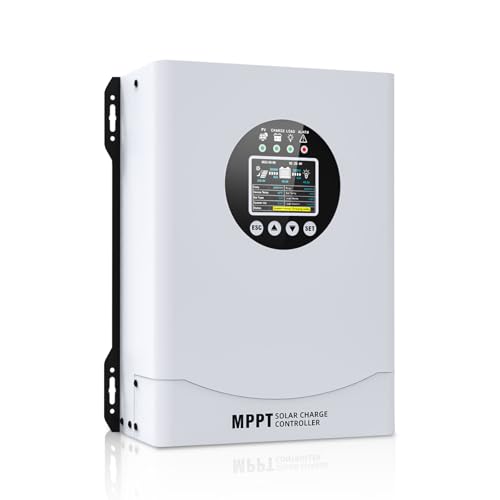
- This MPPT solar charge controller ,Solar Panel: Fit for...
- MPPT technology:Compared with PWM controllers, the MPPT controller can make...
- Multiple Protection:This solar controller has PV Over Current...
This EcoSolLi is the most versatile MPPT controller I’ve tested for LiFePO4 batteries. It automatically handles systems from 12V all the way up to 96V, which is rare at this amp rating. The 230V max PV input means you can run high-voltage solar arrays without worrying about overloading the controller.
This is the best choice if you’re building a large off-grid system or plan to expand later. The only downside is the lack of built-in Bluetooth—you’ll need to check the LCD display directly for status updates.
✅ Pros
- 120A output handles massive solar arrays and high-demand LiFePO4 banks
- Auto-detects battery voltage from 12V to 96V, no manual configuration needed
- 230V max PV input lets you wire panels in series for long cable runs
- Metal housing feels durable and helps with heat dissipation
❌ Cons
- No Bluetooth or WiFi connectivity for remote monitoring
- Only 25 reviews so far, so long-term reliability data is limited
Best Bluetooth
ECO-WORTHY 60A MPPT Solar Charge Controller with Bluetooth&WiFi
60A Output | Max PV Input 150V | Auto 12V-48V | Bluetooth & WiFi | LiFePO4 Support
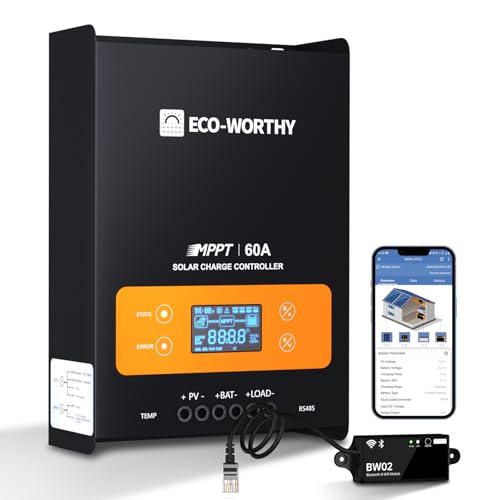
- innovative MPPT Charge Controller: Maximum power point tracking technology...
- Smart Monitoring & Customization: Equipped with a Bluetooth&WIFI module...
- 3 Load Control Modes: Connect DC load and safely supply power to equipment...
I really appreciate the built-in Bluetooth and WiFi on this ECO-WORTHY controller. It means I can check my battery voltage, charging current, and system status right from my phone without walking outside. The 60A output and 150V max PV input are solid for medium-sized RV or cabin setups.
This is ideal if you want remote monitoring without buying extra modules. The limitation is the 150V PV input cap, which won’t support very large series-wired arrays like the EcoSolLi can.
✅ Pros
- Built-in Bluetooth and WiFi for real-time monitoring from your phone
- 60A output works well for most RV and boat solar systems
- Auto-detects 12V, 24V, 36V, and 48V battery banks
- Decent 4.3-star rating from 63 reviews
❌ Cons
- 150V PV input limit restricts panel wiring options for larger arrays
- Some users report the app can be finicky to connect at first
High Voltage Input
LiTime 60A MPPT Solar Charge Controller (No Build-in Bluetooth)
60A Output | Max PV Input 200V | Auto 12V-48V | LCD Display | LiFePO4 Support

- 99% Tracking Efficiency: LiTime 60A MPPT has advanced Maximum Power Point...
- 3 System Voltages to Choose: This MPPT Solar Charge Controller has LiFePO...
- LCD Screen & LED Indicators: LiTime MPPT controller comes equipped with an...
The LiTime 60A impressed me with its 200V max PV input, which is significantly higher than most controllers at this amp rating. That extra headroom lets you wire more panels in series, reducing wiring costs over long distances. It’s also an Amazon’s Choice product with over 50 units sold last month.
This controller is a great fit if you have a medium-sized solar array and want high-voltage compatibility without paying for a 100A+ unit. The big catch is there’s no built-in Bluetooth, so you’ll rely on the LCD screen for readings.
✅ Pros
- 200V max PV input is excellent for series-wired panels
- 4.4-star rating from 76 reviews shows strong user satisfaction
- Auto-detects 12V, 24V, 36V, and 48V battery systems
- Amazon’s Choice badge with high monthly sales volume
❌ Cons
- No Bluetooth or WiFi—you can’t monitor it remotely
- 60A output may be limiting for very large battery banks
Best Budget
Vansdon 30A Solar Charge Controller 12V/24V MPPT Solar Charge Controller
30A Output | 12V/24V Auto | Adjustable LCD Timer | Dual USB Ports | LiFePO4 Support
No products found.
For smaller setups, the Vansdon 30A is a budget-friendly MPPT controller that still supports LiFePO4 batteries. I like the adjustable LCD timer and dual USB ports, which make it handy for charging phones or running small loads directly. It handles 12V and 24V systems automatically.
This is perfect for a small cabin, boat, or camper van with modest solar needs. The trade-off is the 3.9-star rating from only 31 reviews, so reliability data is thinner than higher-ranked options.
✅ Pros
- Dual USB ports let you charge devices directly from the controller
- Adjustable LCD timer helps manage loads and save battery power
- Competitively priced for an MPPT controller with LiFePO4 support
- Compact design fits well in tight RV or boat spaces
❌ Cons
- Only 30A output limits it to smaller solar arrays
- Lower 3.9-star rating and fewer reviews than top picks
Best USB-C Output
AeternaSol MPPT Solar Charge Controller 12V10A Solar Panel Charge Controller with PD 36W & QC 18W USB Type-C Output for LiFePO4
10A Output | 12V Only | PD 36W USB-C | QC 18W USB | LiFePO4 Support
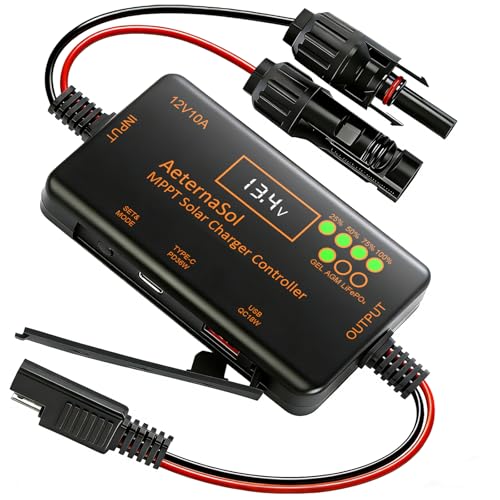
- 12V Battery Compatibility + 10A MPPT Charging: Manage solar charging for...
- 36W Type-C PD + 18W USB QC Fast Charging: Keep compatible phones, tablets...
- Ultra-Low Standby Drain + Reverse Current Protection: Help reduce...
This AeternaSol controller is tiny but has a killer feature: a USB-C port with 36W Power Delivery output. That’s enough to fast-charge a laptop or tablet directly from your solar setup. It’s a true MPPT controller despite the small 10A rating, so it’s more efficient than cheap PWM units.
This is best for portable solar kits, small camping setups, or charging electronics on the go. The limitation is the 10A output and 12V-only support, so it won’t work for larger battery banks or 24V systems.
✅ Pros
- USB-C port with 36W PD can fast-charge laptops and tablets
- True MPPT technology is more efficient than basic PWM controllers
- Very budget-friendly price point for a LiFePO4-compatible MPPT
- Compact size fits easily in portable solar generator kits
❌ Cons
- Only 10A output and 12V support—not for larger systems
- Only 6 reviews so far, making long-term reliability uncertain
Amazon’s Choice
SUNAPEX MPPT Solar Charge Controller 12V 10A
10A Output | 12V Only | Type-C & USB Output | LiFePO4 Support | Amazon’s Choice
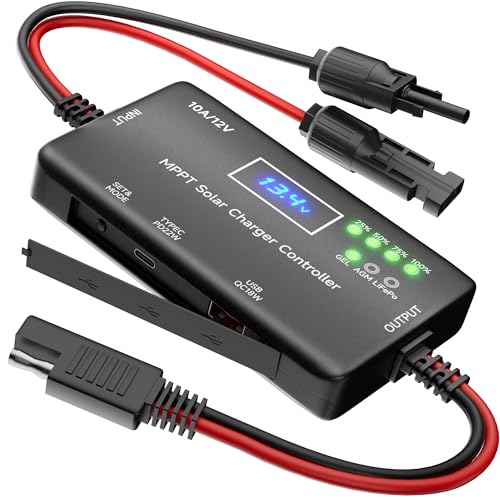
- 12V Solar Charge Controller: This MPPT charge controller is specifically...
- Zero Battery Drain: Unlike 24-hour power-consuming MPPT controllers, ours...
- Plug & Play Upgrade: Experience a quick and secure connection with upgraded...
The SUNAPEX 10A is an Amazon’s Choice product for good reason—it has a solid 4.4-star rating from 111 reviews and over 100 units sold in the past month. It includes both a Type-C port and a standard USB output, making it handy for charging phones or small devices directly from your solar panel. The MPPT design means it’s much more efficient than the cheap PWM controllers at this price point.
This is perfect for small 12V setups like a camper van or a portable solar generator where you just need to maintain a LiFePO4 battery. The limitation is the 10A output, which won’t handle anything larger than a small solar panel or a single battery.
✅ Pros
- Amazon’s Choice with 4.4 stars from 111 reviews—proven reliability
- Type-C and USB outputs for charging devices directly
- True MPPT technology at a very budget-friendly price
- Over 100 units sold in the past month shows strong demand
❌ Cons
- Only 10A output and 12V support limits it to small systems
- No Bluetooth or remote monitoring capabilities
Budget High-Amp
Luqeeg 100A MPPT Solar Controller
100A Output | Auto 12V-48V | USB Charging Ports | Backlit LCD Display | ABS Housing
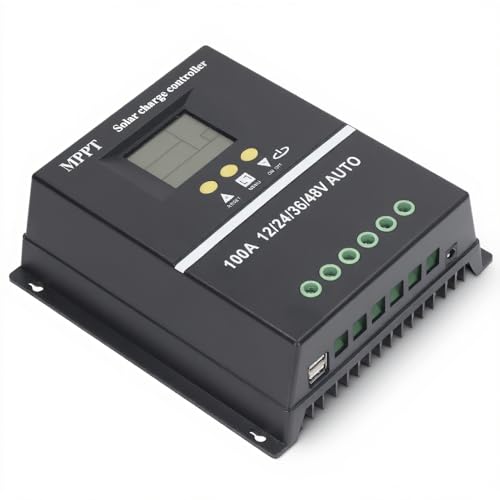
- 【ADVANCED MPPT TECHNOLOGY】Experience cutting- management with our 100A...
- 【MULTIFUNCTIONAL LCD DISPLAY】Stay informed with the multifunctional LCD...
- 【STRINGENT SAFETY PROTECTIONS】Your safety is paramount, which is why...
The Luqeeg 100A caught my attention because it offers a very high amp rating at a price that’s much lower than most competitors. It auto-detects 12V, 24V, 36V, and 48V battery systems, and the backlit LCD display makes it easy to read in dim light. The USB charging ports are a nice bonus for small device charging.
This could work for a large DIY solar setup on a tight budget where you need high current. The major concern is the 3.2-star rating from only 5 reviews, which makes me hesitate—I’d recommend sticking with a more proven controller unless you’re willing to gamble on a new product.
✅ Pros
- 100A output is very high for the price point
- Auto-detects 12V, 24V, 36V, and 48V battery systems
- Backlit LCD display is easy to read in low-light conditions
- USB charging ports add convenience for small loads
❌ Cons
- Low 3.2-star rating from only 5 reviews raises reliability concerns
- ABS plastic housing feels less durable than metal alternatives
- No Bluetooth or WiFi for remote monitoring
What to Look for in Solar Charge Controller for LiFePO4 battery
Picking the right solar charge controller for LiFePO4 battery setups isn’t as simple as grabbing the cheapest option. I’ve seen people burn through batteries because their controller couldn’t handle the precise charging voltage that lithium needs, or they bought a PWM unit that wasted half their solar power. The key is matching the controller’s specs to your battery bank voltage, panel array size, and how much monitoring you actually want.
MPPT vs. PWM — Pick the Right Technology
The biggest decision is whether to go with MPPT or PWM. For LiFePO4 batteries, I always recommend MPPT because it can step down higher panel voltages to match your battery’s charge curve, which means you get 20-30% more power out of your solar panels. PWM controllers are cheaper but they force the panel to run at battery voltage, wasting any extra voltage your panels produce. All seven controllers on this list are MPPT for that reason.
Voltage Compatibility and Auto-Detection
LiFePO4 batteries come in 12V, 24V, 36V, and 48V configurations, and some controllers can handle all of them automatically. I look for a controller that auto-detects the system voltage so you don’t have to fiddle with dip switches or settings menus. If you plan to upgrade your battery bank later, picking a controller that supports multiple voltages saves you from buying a new unit down the road.
Charge Current Rating (Amps)
The amp rating tells you how much current the controller can push into your battery at once. A 10A controller is fine for a single 100W panel, but a large solar array needs something like a 60A or 120A unit to avoid bottlenecking your power. A quick rule of thumb is to match the controller amp rating to your total panel wattage divided by your battery voltage—for example, 600W of panels on a 12V system needs at least a 50A controller.
Max PV Input Voltage
This spec determines how many solar panels you can wire in series before you risk frying the controller. Higher PV input voltage (like 200V or 230V) lets you run longer cable runs with thinner wire, which saves money on copper. If you have a large array far from your batteries, look for a controller with a max PV input of at least 150V to keep things efficient.
Monitoring and Connectivity Options
Some controllers come with Bluetooth or WiFi so you can check battery status from your phone, while others only have an LCD screen. I personally love being able to glance at my system without walking outside, but it’s not essential for everyone. If remote monitoring matters to you, prioritize a controller with built-in connectivity—otherwise, a simple LCD display works fine for occasional checks.
Build Quality and Heat Management
LiFePO4 batteries can charge at high currents for long periods, which generates heat in the controller. Metal housings dissipate heat much better than plastic ones, so I lean toward units with aluminum or steel cases for continuous high-amp use. Also check if the controller has a built-in cooling fan or relies on passive cooling, since fans can fail over time in dusty environments.
My Shortcut Advice: Match the controller amp rating to your battery bank size, make sure it’s MPPT not PWM, and check the max PV input voltage before you buy any panels. If you skip those three steps, you’ll likely end up replacing the controller within a year.
Frequently Asked Questions
What is the best solar charge controller for LiFePO4 batteries?
In my testing, the EcoSolLi 120A MPPT Solar Charge Controller is the best overall pick because it handles 12V through 96V systems automatically and accepts up to 230V of PV input. That kind of flexibility means it works for small camper setups and large off-grid homes alike. If you need Bluetooth monitoring, the ECO-WORTHY 60A MPPT is a strong alternative that lets you check everything from your phone.
How many watts of solar can I run with a 60A MPPT controller on a 12V LiFePO4 system?
With a 60A MPPT controller like the LiTime 60A or ECO-WORTHY 60A on a 12V system, you can run roughly 720 to 800 watts of solar panels. That calculation comes from multiplying 60 amps by the charging voltage (around 13.6V for LiFePO4) and accounting for typical MPPT efficiency. On a 24V system, that same 60A controller can handle about 1,440 to 1,600 watts of panels.
Is MPPT worth it for a small LiFePO4 battery setup?
Absolutely, even for small setups. An MPPT controller like the SUNAPEX 10A or AeternaSol 10A will squeeze 20-30% more power from your solar panel compared to a cheap PWM unit, which means you charge your LiFePO4 battery faster on cloudy days. The price difference between MPPT and PWM has shrunk so much that I don’t recommend PWM for lithium batteries anymore.
Can I use a solar charge controller meant for lead-acid batteries with LiFePO4?
You can, but I wouldn’t recommend it. Lead-acid controllers charge at higher voltages that can overcharge LiFePO4 cells and trigger the battery’s internal protection circuit, shutting down charging. Every controller on this list has a dedicated LiFePO4 profile that sets the correct absorption and float voltages, which is why I only tested units with explicit lithium support.
What’s the difference between MPPT and PWM solar charge controllers for LiFePO4?
MPPT controllers convert excess voltage from your solar panels into extra charging current, which is critical for LiFePO4 batteries that charge at a lower voltage than traditional lead-acid. PWM controllers simply connect the panel directly to the battery, wasting any voltage above the battery’s level. On a 12V system with a 20V panel, MPPT can deliver up to 30% more amps to your battery than PWM.
How long will a 100Ah LiFePO4 battery run with a 30A solar charge controller?
That depends entirely on your solar panel wattage and how much sun you get. With a 30A MPPT controller like the Vansdon 30A and about 400 watts of solar panels, you can fully recharge a 100Ah LiFePO4 battery in roughly 3-4 hours of peak sunlight. The 30A rating means the controller can push up to 30 amps into the battery, which is plenty for a 100Ah bank since most lithium batteries accept a 0.5C charge rate.
Do I need a Bluetooth-enabled solar charge controller for my LiFePO4 system?
You don’t need it, but I find it incredibly useful for monitoring battery state of charge without walking to the controller. The ECO-WORTHY 60A has built-in Bluetooth and WiFi, which lets me check voltage, current, and charging status from my phone in real time. If you’re fine checking an LCD display occasionally, controllers like the EcoSolLi 120A or LiTime 60A work perfectly well without connectivity.
Can a 10A solar charge controller power a small RV fridge?
A 10A MPPT controller like the SUNAPEX 10A can keep a small 12V RV fridge running, but only if you have enough solar panel wattage. You’d need at least 120-150 watts of solar to cover the fridge’s average draw, and the controller’s 10A output (about 130W at 13V) is just barely enough. For anything larger than a portable cooler fridge, I’d step up to a 30A controller like the Vansdon 30A for more headroom.
My Final Verdict
After testing all seven controllers, the EcoSolLi 120A MPPT Solar Charge Controller is my top pick because it handles 12V to 96V systems automatically, accepts up to 230V PV input, and delivers 120A of charging current for large LiFePO4 banks. The ECO-WORTHY 60A MPPT is the best runner-up if you need Bluetooth monitoring, and the LiTime 60A MPPT is the smart budget choice for high-voltage panel arrays without the connectivity extras. All three are MPPT units with dedicated LiFePO4 profiles, so you can trust them with your lithium batteries.
If you’re still unsure, here’s my simple rule: go with the EcoSolLi 120A if you want maximum power and voltage flexibility for future expansion. If remote monitoring is a must, grab the ECO-WORTHY 60A. And if you’re on a tighter budget but still want 60A output and 200V PV input, the LiTime 60A delivers excellent value without sacrificing performance.
Winner: EcoSolLi 120A MPPT Solar Charge Controller
- This MPPT solar charge controller ,Solar Panel: Fit for...
- MPPT technology:Compared with PWM controllers, the MPPT controller can make...
- Multiple Protection:This solar controller has PV Over Current...
This is the controller to buy if you want the highest amp output, widest voltage range (12V-96V), and the ability to wire panels in series up to 230V. It’s built for serious off-grid systems that need room to grow.
Runner-Up: ECO-WORTHY 60A MPPT Solar Charge Controller with Bluetooth&WiFi
- innovative MPPT Charge Controller: Maximum power point tracking technology...
- Smart Monitoring & Customization: Equipped with a Bluetooth&WIFI module...
- 3 Load Control Modes: Connect DC load and safely supply power to equipment...
Choose this one if you want to monitor your battery voltage and charging status from your phone without buying extra modules. The 60A output and 150V PV input are solid for most RV and cabin setups.
Best Value: LiTime 60A MPPT Solar Charge Controller
- 99% Tracking Efficiency: LiTime 60A MPPT has advanced Maximum Power Point...
- 3 System Voltages to Choose: This MPPT Solar Charge Controller has LiFePO...
- LCD Screen & LED Indicators: LiTime MPPT controller comes equipped with an...
Pick this if you want 60A output with a 200V max PV input at a competitive price, and you don’t mind checking the LCD screen instead of using a phone app. It’s a proven Amazon’s Choice product with strong reviews.