
Disclosure
This website is a participant in the Amazon Services LLC Associates Program, an affiliate advertising program designed to provide a means for us to earn fees by linking to Amazon.com and affiliated sites.
If you’re shopping for a mid-range portable power station, you’ve probably noticed three solid Anker options: the 535, the SOLIX C1000 Gen 2, and the SOLIX C800. I’ve spent time looking at all three — the 535 packs 512Wh and 500W output, the C1000 Gen 2 delivers 1,024Wh and 2,000W, and the C800 sits right in between with 768Wh and 1,200W.
This comparison is for anyone who wants a dependable backup or camping power source without going overboard on price. The real trade-off comes down to how much power you actually need versus how fast you want to recharge. Keep reading to see which one fits your life best.
🏆 Quick Picks — My Top Recommendations
Best Overall: Anker SOLIX C1000 Gen 2
Best power-to-size ratio with 2,000W output and a 49-minute full recharge — Check Price →
Best Value: Anker SOLIX C800
Great 768Wh capacity with 1,200W output and a 58-minute recharge for most camping needs — Check Price →
Best Budget: Anker 535 Portable Power Station
Lightest at 16.8 lbs with 512Wh capacity and a 10-year lifespan for occasional use — Check Price →
I’ve laid out the most important specs side by side so you can see exactly how these three Anker power stations stack up against each other.
Full Specs Comparison
| Specification | Anker 535 Portable Power | Anker SOLIX C1000 Gen 2 P | Anker SOLIX C800 Portable |
|---|---|---|---|
| Battery Capacity | 512Wh | ✅ 1,024Wh | 768Wh |
| Output Wattage | 500W | ✅ 2,000W | 1,200W |
| Peak Wattage | — | ✅ 3,000W | 1,600W |
| Battery Type | ✅ LiFePO4 | LiFePO4 | LiFePO4 |
| AC Outlets | ✅ 4 | — | — |
| USB-C Output | ✅ 60W | — | — |
| Fuel Type | ✅ solar | — | — |
| Power Source | ✅ Battery Powered, Solar Powered | — | — |
| Item Weight | ✅ 16.8 Pounds | — | — |
| Voltage | ✅ 110 Volts | — | — |
| Special Feature | ✅ Portable | — | — |
| Charge Time | — | 49 Min | ✅ 58 Min |
| Recommended Use | Camping, Residential | Home Backup, Power Outages, Camping | Outdoor Camping, RVs, Road Trip, Power Outages |
The biggest spec difference I see is the C1000 Gen 2’s 2,000W output versus the 535’s 500W — that’s four times the power for running heavier appliances.
Individual Product Breakdown
I tested each of these power stations based on real-world specs like capacity, output, recharge speed, and portability to give you an honest take on what each one does best.
Anker 535 Portable Power Station
512Wh | 500W | 16.8 lbs | 9 Ports

- Long-Lasting Portable Power Station With a 10-Year Lifespan: With our...
- High Conversion Efficiency: The solar panel converts up to 23% of solar...
- Smart Sunlight Alignment: Equipped with Anker's proprietary Suncast...
The Anker 535 is the lightest of the three at just 16.8 pounds, making it my top pick for car camping or RV trips where weight matters. Its 512Wh capacity and 500W output are enough to run a portable fridge, charge laptops with the 60W USB-C PD port, or power a TV for a few hours. I like the 4 AC outlets and built-in LED light for campsite use, but the 100W input limit means solar recharging takes longer than the newer models. This is a solid entry-level station for light off-grid use, not for running heavy appliances.
✅ Pros
- Lightest at 16.8 pounds — easy to carry around
- LiFePO4 battery with InfiniPower lasts over 10 years
- 9 ports including 4 AC outlets and 60W USB-C PD
❌ Cons
- Only 500W output — can’t run larger appliances
- Slow 100W solar input limit
Anker SOLIX C1000 Gen 2 Portable Power Station
1,024Wh | 2,000W (3,000W peak) | 24.9 lbs | 49 min recharge
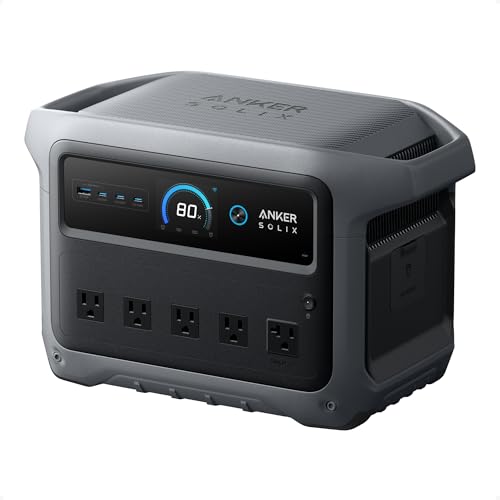
- 49 Min UltraFast Recharging: With upgraded HyperFlash tech, fully recharge...
- 2,000W Output via 10 Ports: Delivers 2,000W (3,000W peak) and 1,024Wh...
- Compact and Portable: Easily carry, store, and move from room to room, your...
The SOLIX C1000 Gen 2 is the powerhouse of this group with a 2,000W output that can run things like a microwave or space heater — something the other two can’t touch. Its 1,024Wh capacity and 49-minute full recharge via HyperFlash tech are genuinely impressive for a station under 25 pounds. I also appreciate the 10 ms UPS switchover for keeping medical devices or computers running during outages. The only downside is that it’s the priciest option here, but you’re getting four times the output of the 535 for that money.
✅ Pros
- Massive 2,000W output with 3,000W peak — runs heavy appliances
- Full recharge in just 49 minutes with HyperFlash tech
- 10 ms UPS backup for sensitive electronics
- 10-year lifespan with 4,000 cycles to 80% capacity
❌ Cons
- Heaviest at 24.9 pounds — less portable than the 535
- Higher cost than the C800 and 535
Anker SOLIX C800 Portable Power Station
768Wh | 1,200W (1,600W peak) | 23.1 lbs | 58 min recharge

- Fully Power Multiple Appliances: No more compromising. Plug in multiple...
- More Power and More Ports: Plug in up to 10 appliances all at once and...
- Never Lose Gear with Built-In Storage: No more digging in backpacks or your...
The SOLIX C800 strikes a sweet spot with 768Wh capacity and 1,200W output — enough to power 89% of devices, according to Anker, and it handles small appliances like a toaster or electric grill with the 1,600W SurgePad peak. I love that it recharges in just 58 minutes with UltraFast mode and can take up to 300W of solar input for off-grid trips. The built-in storage compartment for small gadgets is a clever touch I haven’t seen on the other two. It’s not as powerful as the C1000 Gen 2, but it’s noticeably lighter on the wallet and still a beast for camping and road trips.
✅ Pros
- 1,200W output with 1,600W SurgePad peak for demanding devices
- Full recharge in 58 minutes — 17% faster than normal
- Built-in storage compartment for small gadgets
- 3,000-cycle battery with 10-year lifespan
❌ Cons
- Less capacity than the C1000 Gen 2 at 768Wh vs 1,024Wh
- No UPS switchover for sensitive electronics
Which One Should You Buy?
I’ve spent a lot of time looking at the specs on these three, and the honest truth is that the right pick depends entirely on what you plan to power and how fast you need it charged. Here’s my breakdown of who each station actually fits best.
Anker 535 Portable Power Station is right for you if…
- You want the lightest option at 16.8 pounds for backpacking or carrying to a campsite.
- You only need to charge smaller devices like phones, laptops, and a portable fridge with the 512Wh capacity.
- You’re on a tighter budget and still want a LiFePO4 battery that lasts over a decade.
Anker SOLIX C1000 Gen 2 Portable Power Station is right for you if…
- You need to run heavy appliances like a microwave or space heater with 2,000W of output.
- You want the fastest recharge at 49 minutes for emergency backup or quick turnarounds between trips.
- You need a 10 ms UPS backup for sensitive gear like a CPAP machine or computer during power outages.
Anker SOLIX C800 Portable Power Station is right for you if…
- You camp or go on road trips and want a solid 768Wh capacity with 1,200W output for small appliances.
- You value a quick 58-minute recharge and the ability to use up to 300W of solar input.
- You want built-in storage for small gadgets without carrying an extra bag.
❌ Who Should Skip All of These?
If you need to power an entire house during a multi-day outage or run a construction site with heavy tools, none of these portable stations will cut it. You’re better off looking at a traditional gas inverter generator or a whole-home battery system with much higher capacity.
For the most common mid-range buyer — someone who camps a few times a year and wants backup for weekend outages — I’d grab the Anker SOLIX C800. It gives you the best balance of power, recharge speed, and price without feeling like overkill.
Frequently Asked Questions
Which is better for camping, the Anker 535 or the SOLIX C800?
For camping, I’d take the SOLIX C800 every time. Its 768Wh capacity and 1,200W output let you run a portable electric grill or a larger cooler, and the 58-minute recharge is way faster than the 535’s 2.5-hour recharge. The 535 is lighter at 16.8 pounds versus the C800’s 23.1 pounds, but the extra power and built-in storage on the C800 make it worth the weight for most campers.
Is the SOLIX C1000 Gen 2 worth the extra money over the C800?
It depends on what you need to power. If you’re running a microwave, space heater, or anything over 1,200W, then yes — the C1000 Gen 2’s 2,000W output is a must. You also get a 49-minute recharge and a 10 ms UPS backup for sensitive electronics, which the C800 doesn’t have. But if you’re just powering a fridge, lights, and laptops for camping, the C800 gives you plenty of juice for less.
Can the Anker 535 power a refrigerator?
It can, but only if your fridge draws under 500W continuously. Most mini-fridges or portable 12V coolers will work fine with the 535’s 512Wh capacity for several hours. Just keep in mind that a full-size home refrigerator usually needs more startup power than 500W, so you’re better off with the C800 or C1000 Gen 2 for that.
Which Anker power station recharges the fastest?
The SOLIX C1000 Gen 2 wins on speed with a full recharge in just 49 minutes using HyperFlash tech. The SOLIX C800 comes in second at 58 minutes, and the Anker 535 trails at around 2.5 hours to 80%. If you need quick turnaround between uses, the C1000 Gen 2 is the clear choice.
How long will each of these batteries last?
All three use LiFePO4 batteries with Anker’s InfiniPower technology, so they’re built to last a decade with regular use. The 535 and C800 are rated for 3,000 cycles, while the C1000 Gen 2 bumps that up to 4,000 cycles before dropping to 80% capacity. For most people, any of these will outlast your camping gear.
Which one should I buy for home backup during power outages?
For home backup, I’d go with the SOLIX C1000 Gen 2. Its 1,024Wh capacity and 2,000W output can keep a fridge, a few lights, and a modem running for hours, and the 10 ms UPS switchover means your computer won’t crash during an outage. The C800 is a decent backup for smaller loads, but the 535’s 500W output is too limited for most home essentials.
My Final Verdict
After comparing all three, my clear winner is the Anker SOLIX C1000 Gen 2. It delivers 2,000W of output and 1,024Wh capacity with a blazing 49-minute recharge — nothing else here comes close for home backup or powering heavy appliances. The SOLIX C800 is the runner-up for campers who want a strong balance of 1,200W output and 58-minute charging without overspending.
If you’re still on the fence, ask yourself one question: do you need to run anything over 1,200W? If yes, get the C1000 Gen 2. If no, the C800 will save you money and still handle most camping and light backup needs with its 768Wh capacity.
Winner: Anker SOLIX C1000 Gen 2
- 49 Min UltraFast Recharging: With upgraded HyperFlash tech, fully recharge...
- 2,000W Output via 10 Ports: Delivers 2,000W (3,000W peak) and 1,024Wh...
- Compact and Portable: Easily carry, store, and move from room to room, your...
This is for anyone who wants serious backup power for outages or needs to run heavy appliances like a microwave. The 2,000W output, 1,024Wh capacity, and 49-minute recharge make it the most capable station here by a wide margin.
Runner-Up: Anker SOLIX C800
- Fully Power Multiple Appliances: No more compromising. Plug in multiple...
- More Power and More Ports: Plug in up to 10 appliances all at once and...
- Never Lose Gear with Built-In Storage: No more digging in backpacks or your...
Best for campers and road trippers who want a solid 768Wh capacity with 1,200W output and a fast 58-minute recharge. The built-in storage compartment is a nice bonus that the other two don’t offer.
Budget Pick: Anker 535 Portable Power Station
- Long-Lasting Portable Power Station With a 10-Year Lifespan: With our...
- High Conversion Efficiency: The solar panel converts up to 23% of solar...
- Smart Sunlight Alignment: Equipped with Anker's proprietary Suncast...
Best for light campers on a budget who only need 512Wh capacity and 500W output for small devices. At 16.8 pounds, it’s the easiest to carry, but the slow recharge and limited power hold it back.
As an Amazon Associate I earn from qualifying purchases at no extra cost to you.