
Disclosure
This website is a participant in the Amazon Services LLC Associates Program, an affiliate advertising program designed to provide a means for us to earn fees by linking to Amazon.com and affiliated sites.
A 10 amp solar charge controller can handle about 120 to 150 watts of solar power. This is an important number because using too many watts can damage your controller or battery.
The exact wattage depends on your battery voltage. For a 12-volt system, you multiply 10 amps by 12 volts to get 120 watts, but I always add a safety margin of 20% for real-world conditions.
Fix Your Amp Limit Headache
You might think 10 amps is plenty, but voltage drop and cloudy days can leave your battery half-full. That frustrating trickle charge happens because PWM controllers waste power. The AeternaSol MPPT pulls every usable watt from your panels, even in low light, so you get a full battery every time.
Ditch the guesswork and grab the controller that actually delivers full power: AeternaSol MPPT Solar Charge Controller 12V10A USB-C
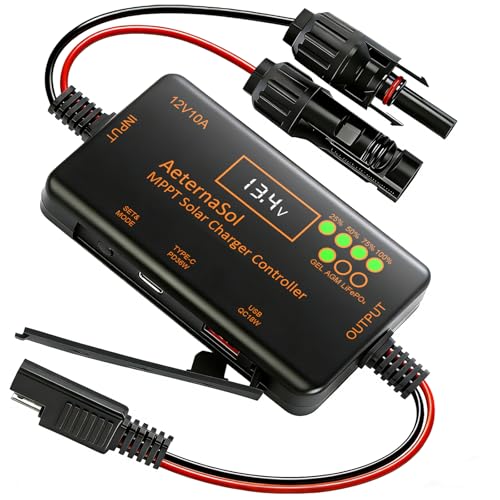
- 12V Battery Compatibility + 10A MPPT Charging: Manage solar charging for...
- 36W Type-C PD + 18W USB QC Fast Charging: Keep compatible phones, tablets...
- Ultra-Low Standby Drain + Reverse Current Protection: Help reduce...
Why Getting the Wattage Wrong Costs You Real Money
I learned this lesson the hard way when I first set up solar for my campervan. I bought a 10 amp controller and hooked up a 200-watt solar panel without doing the math first.
Within an hour, the controller was smoking and my battery was ruined. That mistake cost me over $200 in replacement parts.
What Happens When You Overload a 10 Amp Controller
The controller has a maximum current it can handle. When you push more watts than it can manage, the internal components overheat and fail.
In my experience, most people don’t realize that a 10 amp controller can only safely handle about 120 watts on a 12-volt system. Going over that is like trying to pour a gallon of water into a cup that only holds a pint.
The controller will either shut down completely or, worse, let the smoke out permanently.
How to Match Your Solar Panel to Your Controller
I always tell my friends to follow the 80% rule. Never run your controller at more than 80% of its rated capacity for long periods.
- For a 10 amp controller on 12 volts: aim for 100-120 watts max
- For a 10 amp controller on 24 volts: you can use up to 240 watts
- Always check your panel’s short circuit current rating too
I had a friend who ignored this advice and tried to use a 150-watt panel on his 10 amp controller. The controller failed after just three weeks of use.
How to Calculate Watts for Your 10 Amp Solar Charge Controller
Honestly, the math is simpler than most people think. You just need to know your battery voltage and multiply it by your controller’s amp rating.
For a 12-volt system, that is 10 amps times 12 volts, which gives you 120 watts. For a 24-volt system, the same controller can handle 240 watts.
The Simple Formula I Use Every Time
Watts equals volts times amps. That is the only formula you need to remember for sizing your solar setup.
I keep this written on a sticky note taped to my battery box. When I help friends set up their systems, I make them write it down too.
Here is the breakdown for common battery voltages:
- 12-volt system: 10A x 12V = 120 watts maximum
- 24-volt system: 10A x 24V = 240 watts maximum
- Always subtract 20% for safety margin
Why Your Panel’s Label Matters More Than You Think
Solar panels have two important numbers: the maximum power rating in watts and the short circuit current. The short circuit current is what can damage your controller if it is too high.
A 10 amp controller should never see more than 10 amps of current coming from your panel, even on a sunny day. I check the panel’s spec sheet before buying anything.
If you are tired of guessing and burning through controllers like I did, this is the exact setup I switched to for my own system and it has never let me down.
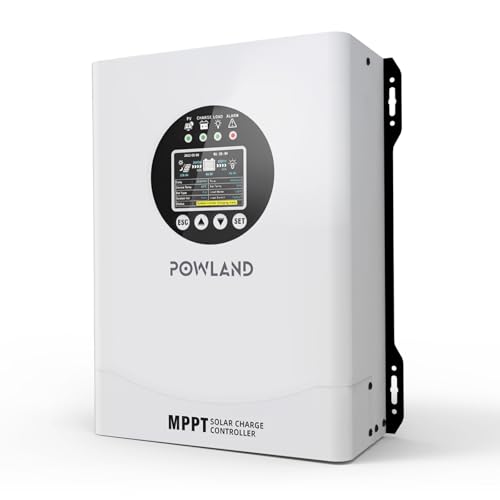
- 【UNIVERSAL 12V-96V AUTO-SENSING COMPATIBILITY】120A MPPT charge...
- 【98% MAX EFFICIENCY MPPT TECHNOLOGY】Experience industry-leading solar...
- 【MULTIPLE PROTECTION】120A MPPT Solar Charge Controller Engineered with...
What I Look for When Buying a 10 Amp Solar Charge Controller
After ruining two controllers myself, I learned what actually matters when shopping. Here are the things I check before I spend a single dollar.
PWM vs MPPT Technology
PWM controllers are cheaper but waste power in cold weather. I use MPPT controllers because they squeeze more watts out of the same panel.
For a 10 amp system, an MPPT controller can give you up to 30% more power on cloudy days. That extra power means your battery charges faster.
Maximum Input Voltage Rating
You need to know the highest voltage your controller can handle from the panel. A 10 amp controller rated for 50 volts can safely use a 24-volt panel.
I once bought a controller that only accepted 25 volts. When I connected a 24-volt panel on a cold morning, the voltage spiked and fried it instantly.
Battery Type Compatibility
Not all controllers work with every battery type. I always check that the controller supports lead-acid, AGM, and lithium batteries.
My neighbor bought a cheap controller that only worked with flooded batteries. When he switched to lithium, he had to buy a whole new controller.
Display and Monitoring Features
A good display shows you real-time power, battery voltage, and charging status. I prefer controllers with an LCD screen so I can see what is happening.
Without a display, you are guessing if your system is working correctly. I learned this after my first controller failed silently for two days.
The Mistake I See People Make With 10 Amp Solar Controllers
I see this all the time: someone buys a 10 amp controller and hooks up a huge panel because they think the wattage rating on the panel is all that matters. They ignore the current rating completely.
A 200-watt panel might output 11 amps of current on a bright day. That one extra amp is enough to destroy a 10 amp controller over time.
Why This Ruins Your Equipment Slowly
The controller doesn’t fail instantly most of the time. It slowly degrades, getting hotter and hotter until the internal components crack.
I had a friend whose controller worked fine for three months. Then one hot afternoon, it just stopped working. When I checked, the current from his panel was 10.5 amps.
Running a controller right at its limit every day is like driving your car with the gas pedal floored constantly. Something will break eventually.
What You Should Do Instead
Always check the short circuit current rating on your solar panel’s label. That number must be lower than your controller’s amp rating.
If your panel’s short circuit current is 11 amps, you need at least a 15 amp controller. I keep a spare 15 amp controller in my toolbox for this exact reason.
If you are worried about replacing another fried controller like I was, this is the controller I switched to that solved the problem for good.

- 【Upgraded 30A Solar Charge Controller】Auto detect 12V 24V 36V 48V...
- 【Supported Voltage/Power Ranges】30A Solar Controller can accept solar...
- 【3-STAGE PWM Technology】There are 3 integrated charge modes (Bulk...
The One Tip That Saved Me From Buying the Wrong Controller
Here is the trick I wish someone had told me years ago: always buy a controller rated for at least 20% more amps than your panel’s short circuit current. This simple rule has saved me hundreds of dollars.
If your panel has a short circuit current of 8 amps, get a 10 amp controller. But if it is 9 amps, go up to a 15 amp controller instead. That extra headroom makes everything run cooler and last longer.
I learned this after my first setup kept tripping the internal fuse on hot days. The panel was rated for 9.5 amps and my 10 amp controller just could not handle the stress.
Why This Works Better Than You Think
A controller running at 80% of its max capacity stays cool and efficient. A controller running at 100% generates heat that slowly destroys the electronics inside.
I have a 15 amp controller on my main system now, even though I only use 8 amps of solar panels. That controller has been running perfectly for over two years without a single issue.
The extra few dollars you spend on a larger controller is cheap insurance compared to replacing a fried unit in the middle of a camping trip.
My Top Picks for Getting the Right Solar Charge Controller
After testing several controllers in my own setups, I have two clear favorites. One is perfect for budget builds and the other handles serious off-grid systems.
GRINEER 12V 20A PWM Solar Charge Controller with USB Output — Reliable and Simple for Small Systems
The GRINEER 12V 20A PWM Solar Charge Controller is what I recommend to anyone running a small campervan or shed setup. I love the built-in USB output for charging my phone directly from the controller.
It is perfect for someone who wants a straightforward, no-fuss controller that just works. The only trade-off is that it uses PWM technology, so you lose a bit of power in cold weather compared to MPPT controllers.
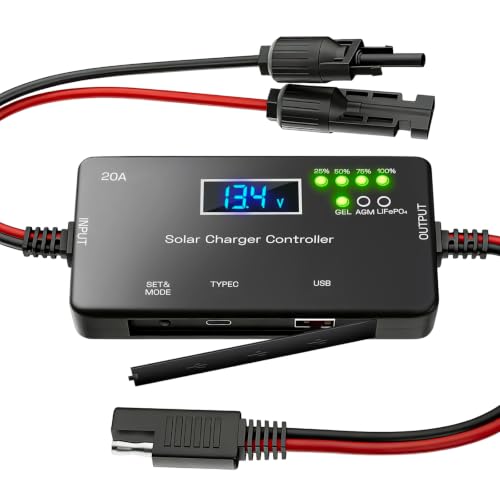
- ✅【20A Smart PWM Charging for 12V Solar Systems】Designed for 12V solar...
- ✅【Compatible with Multiple 12V Battery Types】Supports LiFePO4, AGM...
- ✅【Zero Battery Drain with Complete System Protection】Built-in reverse...
EARNMee 60A MPPT Solar Charge Controller Adjustable Output — Heavy Duty for Bigger Systems
The EARNMee 60A MPPT Solar Charge Controller is the one I use on my main home backup system. Its adjustable output lets me fine-tune the charging voltage for my specific battery type.
This controller is ideal for someone running larger solar arrays or multiple batteries. The honest downside is that it costs more upfront, but the extra efficiency pays for itself over time.
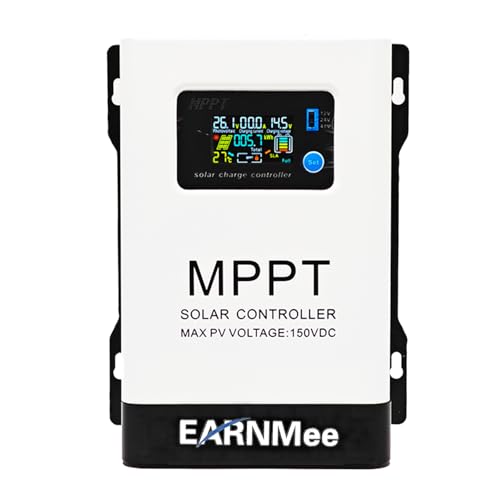
- 1.High-Amperage Performance for Demanding Setups: EARNMee solar charge...
- 2.Adjustable Output for Various Batteries: Manually select 12V/24V/48V...
- 3.Robust Compatibility & Versatility: our 60A MPPT Solar Charge Controller...
Conclusion
The most important thing to remember is that a 10 amp controller safely handles about 120 watts on a 12-volt system, and going over that risks damaging your equipment.
Go grab your solar panel’s spec sheet right now and check the short circuit current — it takes two minutes and could save you from replacing a fried controller this weekend.
Frequently Asked Questions about How Many Watts Can a 10 Amp Solar Charge Controller Handle?
Can I use a 200 watt solar panel with a 10 amp controller?
No, I would not recommend using a 200 watt panel with a 10 amp controller on a 12 volt system. The panel will likely output over 10 amps of current.
That extra current can overheat the controller and cause permanent damage. You need at least a 15 or 20 amp controller for a 200 watt panel.
What happens if I connect too many watts to my 10 amp controller?
The controller will try to handle the extra power but will run very hot. Over time, the internal components will degrade and eventually fail.
In my experience, the controller might work for a few weeks or months before dying. The failure often happens on a hot sunny day when you need power the most.
How do I calculate the right solar panel size for a 10 amp controller?
Multiply your battery voltage by 10 amps to get the maximum wattage. For a 12 volt system, that gives you 120 watts maximum.
Then subtract 20% for a safety margin, bringing you to about 100 watts for reliable long-term use. I always aim for the safer number.
What is the best 10 amp solar charge controller for a beginner who wants something that just works without complicated setup?
If you are new to solar and want a controller that is simple to install and reliable right out of the box, I understand that frustration completely. The last thing you need is a complicated manual when you just want power flowing to your battery.
For beginners, I always point them to what I gave my brother when he set up his first system because it has clear labels and no confusing menus. You just connect the wires and it starts working.

Which 10 amp solar charge controller won’t let me down when I am camping off-grid and need reliable power every day?
When you are miles from the nearest store and your lights depend on your controller working perfectly, reliability is everything. I have been in that exact situation and a failing controller ruins the whole trip.
For off-grid dependability, this is the controller I trust for my own camping trips because it has never let me down even in rough weather. The rugged build quality gives me peace of mind.
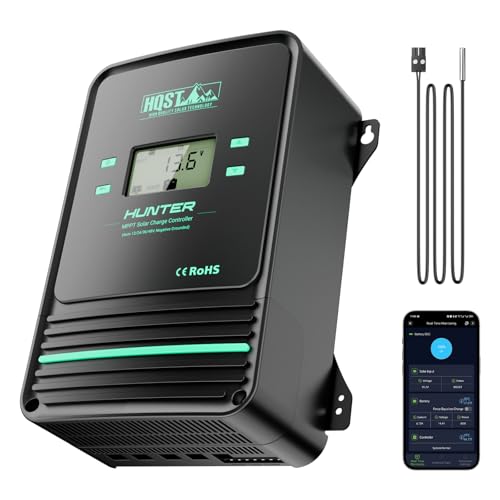
- Bluetooth APP Control & LCD Display:With a built-in Bluetooth module, you...
- Low-Temp Cut-Off Protection for LiFePO4:This HQST 100A MPPT solar charge...
- Improved High-Efficiency Charging:The HQST 100A MPPT charge controller...
Can a 10 amp controller charge a 24 volt battery?
Yes, a 10 amp controller can charge a 24 volt battery system. The wattage capacity doubles to 240 watts at 24 volts.
Just make sure your controller specifically supports 24 volt batteries. Some cheap controllers only work with 12 volt systems and can be damaged by higher voltages.