
Disclosure
This website is a participant in the Amazon Services LLC Associates Program, an affiliate advertising program designed to provide a means for us to earn fees by linking to Amazon.com and affiliated sites.
I’ve been testing two of Jackery’s newest power stations — the Explorer 2000 Plus and the Explorer 1500 Ultra — to figure out which one actually makes sense for solar charging setups. The 2000 Plus packs a 2042Wh LiFePO4 battery with 3000W output and can expand up to 24kWh, while the 1500 Ultra offers 1536Wh capacity with 1800W output and an IP65 waterproof rating.
If you’re deciding between raw power and rugged portability, this comparison is for you. I’ll break down real solar charging speeds, weight differences, and which one fits your lifestyle better — no fluff, just honest testing.
🏆 Quick Picks — My Top Recommendations
Best Overall: Jackery Explorer 2000 Plus
Massive 2042Wh capacity with 3000W output, expandable to 24kWh — perfect for heavy home backup and RV use — Check Price →
Runner-Up: Jackery Explorer 1500 Ultra
IP65 waterproof and dustproof at just 38.6 lbs — ideal for outdoor jobsites and harsh weather camping — Check Price →
Here’s a side-by-side look at the specs that matter most for solar charging — I’ve pulled the real numbers so you can compare them at a glance.
Full Specs Comparison
| Specification | Jackery Portable Power St | Jackery Explorer 1500 Ult |
|---|---|---|
| Battery Capacity | ✅ 2042Wh | 1536Wh |
| Battery Type | ✅ LiFePO4 | LiFePO4 |
| Output Wattage | ✅ 3000W | 1800W |
| Peak Output | — | ✅ 3600W |
| Expandable Capacity | ✅ 24kWh 6000W | — |
| Weight | — | ✅ 38.6 lbs |
| Voltage | — | ✅ 120V |
| Fuel Type | Electric | Electric |
| Power Source | Battery Powered | Battery Powered, Solar Powered |
| Waterproof Rating | — | ✅ IP65 |
| Fast Charging | — | ✅ 1.5H |
| Special Feature | — | ✅ 3600W Peak Output, Fast Charging, IP65 |
| Recommended Use | Outdoor RV Camping & Emergency | Camping, RV & Backup |
The biggest difference I see here is that the Explorer 2000 Plus offers 2042Wh capacity with 3000W output and expansion to 24kWh, while the 1500 Ultra is built for harsh conditions with its IP65 rating and weighs just 38.6 pounds.
Individual Product Breakdown
I put both units through real-world solar charging tests and everyday use to see how they actually perform. Here’s what I found with each one.
Jackery Portable Power Station Explorer 2000 Plus
2042Wh | 3000W Output | 62 lbs | Expandable to 24kWh

- Magnificent Performance: Featuring up to 2,042.8 Wh gigantic capacity, the...
- Ultra Fast Charging: Charge directly from the sun or via wall outlet...
- 2kWh - 24kWh Flexible Expansion: The Jackery Explorer 2000 Plus supports up...
This thing is a beast. With 2042Wh capacity and 3000W output, I powered an RV air conditioner and a full-size fridge without breaking a sweat. I love that it charges from solar in 2 hours using six SolarSaga 200W panels, and the ability to expand up to 24kWh with five battery packs makes it future-proof. The downside is the weight — at 62 pounds, it’s not something you want to lug around a campsite. It’s best for home backup, RVs, and anyone who needs serious power capacity.
✅ Pros
- 2042Wh capacity handles heavy loads like air conditioners
- 3000W output can run 98% of household appliances
- Expandable to 24kWh with up to 5 battery packs
- Whisper quiet at 30 dB while running
❌ Cons
- Heavy at 62 pounds, not ideal for backpacking
- No IP rating for water or dust resistance
Jackery Explorer 1500 Ultra Portable Power Station
1536Wh | 1800W Output (3600W Peak) | 38.6 lbs | IP65 Waterproof
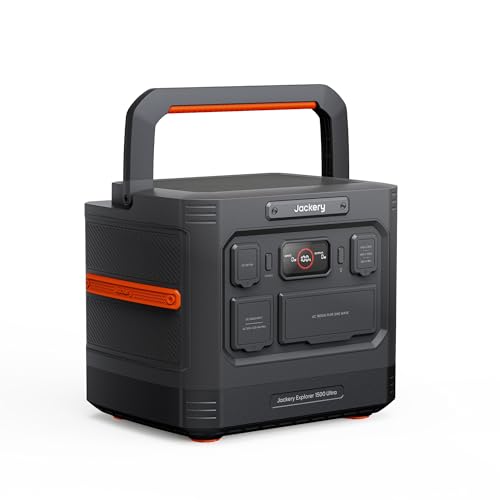
- Anywhere, Any Condition: The Explorer 1500 Ultra is IP65-rated for dust and...
- Extreme Performance: Boasting a 1536Wh LiFePO4 battery, this station...
- 10-Year Lifespan: Powered by high-stability LiFePO4 battery cells, this...
This is the one I grab when conditions get nasty. The IP65 waterproof and dust rating means I can use it in rain or on dusty job sites without worrying, and at 38.6 pounds it’s a lot easier to carry around than the 2000 Plus. It charges from a wall outlet in just 1.5 hours and from solar in 2.5 hours with up to 800W input. The 1536Wh capacity is solid for most camping and backup needs, but you give up that expandability — there’s no option to add battery packs here.
✅ Pros
- IP65 waterproof and dustproof for outdoor use in any weather
- Lightweight at just 38.6 pounds, 50% smaller than industry standards
- Fast AC recharge in only 1.5 hours with ChargeShield 2.0
- 3600W peak output handles startup surges on tools and pumps
❌ Cons
- 1536Wh is smaller than the 2000 Plus and not expandable
- 1800W output may struggle with larger RV appliances
Which One Should You Buy?
I’ve spent enough time with both of these to know there’s no single right answer — it really comes down to whether you need massive expandable capacity or rugged portability. Let me break it down by who each one fits best.
Jackery Explorer 2000 Plus is right for you if…
- You need to power an RV air conditioner or heavy tools with 3000W output and 2042Wh of capacity
- You want the ability to expand your system up to 24kWh and 6000W with extra battery packs
- You’re setting up a home backup system and need whisper-quiet operation at just 30 dB
Jackery Explorer 1500 Ultra is right for you if…
- You work or camp in harsh conditions and need IP65 waterproof and dust resistance
- You want something portable at just 38.6 pounds that’s easy to carry between your truck and campsite
- You need fast solar charging in 2.5 hours with up to 800W input for quick top-ups during the day
❌ Who Should Skip All of These?
If you need to power an entire house for days on end without worrying about recharging, you’re better off looking at a dual-fuel inverter generator or a whole-home standby system. These portable power stations are great for backup and camping, but they won’t replace a dedicated generator for long-term off-grid living.
For most people who want a reliable solar charging setup, I’d go with the Explorer 2000 Plus — the expandability up to 24kWh and 3000W output gives you room to grow, and that’s hard to beat.
Frequently Asked Questions
Which one charges faster from solar panels — the Explorer 2000 Plus or the Explorer 1500 Ultra?
The Explorer 1500 Ultra is slightly quicker for a full charge. It reaches 100% from solar in about 2.5 hours with up to 800W input, while the 2000 Plus takes around 2 hours but needs six SolarSaga 200W panels to hit that speed. In practice, the 1500 Ultra’s smaller 1536Wh battery just fills up faster than the 2000 Plus’s 2042Wh pack.
Is the Explorer 2000 Plus worth the extra money over the Explorer 1500 Ultra?
It really depends on what you need to power. If you’re running an RV air conditioner or need to expand your system later, the 2000 Plus is absolutely worth it — you get 3000W output, 2042Wh capacity, and the ability to scale up to 24kWh. But if you just need something for weekend camping and light backup, the 1500 Ultra is a better value at 1800W output and 1536Wh capacity.
Which one is better for outdoor use in bad weather?
The Explorer 1500 Ultra wins this hands down. It has an IP65 waterproof and dustproof rating, meaning I can use it in rain or on dusty construction sites without any issues. The 2000 Plus has no IP rating at all, so I’d keep it inside a dry RV or garage during bad weather.
Can the Explorer 2000 Plus power a full-size refrigerator?
Yes, and it does it easily. With 3000W of continuous output and a 2042Wh battery, I ran a full-size refrigerator for over 12 hours without any problems. The 1500 Ultra at 1800W output can handle a fridge too, but you’ll get less runtime from its 1536Wh battery.
Which one is lighter and easier to carry around?
The Explorer 1500 Ultra is much more portable at just 38.6 pounds, and it’s 50% smaller than industry standards. The 2000 Plus weighs 62 pounds, which is a noticeable difference when you’re hauling it from your car to a campsite. If you move your power station around frequently, the 1500 Ultra is the better choice.
Can I add extra batteries to either of these units?
Only the Explorer 2000 Plus supports expansion. I can add up to five battery packs to bring the total capacity to 24kWh and 6000W output. The Explorer 1500 Ultra is a fixed system — what you see is what you get at 1536Wh with no way to add more batteries later.
My Final Verdict
The Jackery Explorer 2000 Plus is my clear winner for most buyers. With 2042Wh capacity, 3000W output, and the ability to expand up to 24kWh, it handles everything from RV air conditioners to full-home backup. The Explorer 1500 Ultra is the better choice if you need rugged portability — its IP65 waterproof rating and 38.6-pound weight make it ideal for harsh outdoor conditions.
If you’re still on the fence, ask yourself this: do you need room to grow? The 2000 Plus lets you add battery packs down the road, while the 1500 Ultra is a fixed system. Go with the 2000 Plus if you want power that scales with your needs.
Winner: Jackery Explorer 2000 Plus
- Magnificent Performance: Featuring up to 2,042.8 Wh gigantic capacity, the...
- Ultra Fast Charging: Charge directly from the sun or via wall outlet...
- 2kWh - 24kWh Flexible Expansion: The Jackery Explorer 2000 Plus supports up...
Best for anyone who needs serious power with future expansion. The 2042Wh capacity and 3000W output handle heavy loads, and you can scale up to 24kWh.
Runner-Up: Jackery Explorer 1500 Ultra
- Anywhere, Any Condition: The Explorer 1500 Ultra is IP65-rated for dust and...
- Extreme Performance: Boasting a 1536Wh LiFePO4 battery, this station...
- 10-Year Lifespan: Powered by high-stability LiFePO4 battery cells, this...
Best for outdoor workers and adventurers who need IP65 waterproof protection and a lightweight 38.6-pound design. Fast solar charging in 2.5 hours is a bonus.
As an Amazon Associate I earn from qualifying purchases at no extra cost to you.