
Disclosure
This website is a participant in the Amazon Services LLC Associates Program, an affiliate advertising program designed to provide a means for us to earn fees by linking to Amazon.com and affiliated sites.
Choosing between a PWM and MPPT solar charge controller can feel overwhelming. I remember staring at the specs, unsure which one would actually save me money and work best for my setup.
This article will break down the real differences so you can make a confident choice. By the end, you will know exactly which controller fits your solar system and your budget.
Why This Comparison Matters
Picking the wrong charge controller can cost you real power and real money. I have seen folks buy a cheap PWM controller only to discover their expensive solar panels are wasting half their potential energy.
We will judge these controllers on three key factors: efficiency, cost over time, and how they handle different battery voltages. You need to know how much power you are actually losing before you buy.
ACEIRMC 30A Solar Charge Controller 12V 24V LCD Display: Full Breakdown
Best for: Budget-conscious beginners with small 12V or 24V systems who want basic PWM reliability.
This is a classic PWM controller that works well for small setups like a shed or RV. The 30 amp rating handles moderate loads, and the LCD display lets you see battery voltage and charging status at a glance. It is simple to install and requires no programming.
PWM technology means you lose power when your solar panels have higher voltage than your battery bank. I found this unit works best when your panel voltage closely matches your battery voltage, otherwise you waste a lot of potential energy. It lacks advanced tracking features found on MPPT units.
Pros
- Very affordable price point for a 30A controller
- Easy to read LCD display with clear voltage readings
- Simple plug-and-play setup with no complex configuration
- Works reliably for small 12V and 24V battery systems
Cons
- PWM technology wastes excess panel voltage as heat
- Not suitable for large solar arrays or 48V battery banks
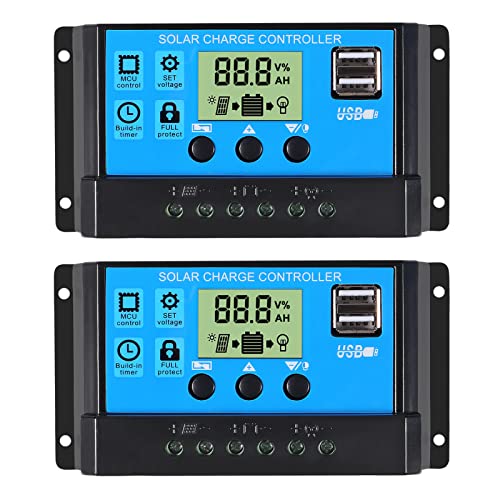
- 30A SOLAR CHARGE CONTRALLER Compatibility with 12V and 24V system...
- Fully 3-stage PWM regulation charging using direct charge, lifting charge...
- Easy to install and operate, Intuitive LCD display that can clearly...
AeternaSol MPPT Solar Charge Controller 12V10A USB-C: Full Breakdown
Best for: Portable solar users who need a compact, modern MPPT controller with USB-C charging for devices.
This MPPT controller is surprisingly small but packs a punch for its size. The 10 amp rating is perfect for a single 100W to 200W panel, and the USB-C port lets you charge phones or tablets directly from the controller. It tracks maximum power point efficiently in changing light.
The low amperage limits you to very small systems, so it is not for powering a cabin or large RV. I also noticed the USB-C output is limited to standard charging speeds, not fast charging. The small form factor means fewer connection terminals for larger wires.
Pros
- True MPPT tracking improves efficiency by up to 30% over PWM
- Built-in USB-C port for charging devices directly from solar
- Compact and lightweight design for portable or travel setups
- Excellent performance in partial shade or cloudy conditions
Cons
- Only 10A capacity limits you to very small solar arrays
- USB-C output is not fast charging capable
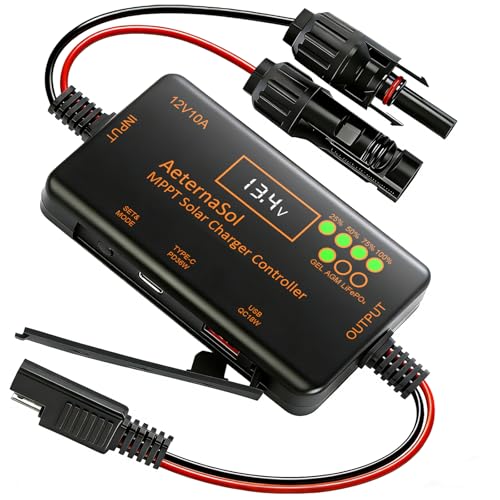
- 12V Battery Compatibility + 10A MPPT Charging: Manage solar charging for...
- 36W Type-C PD + 18W USB QC Fast Charging: Keep compatible phones, tablets...
- Ultra-Low Standby Drain + Reverse Current Protection: Help reduce...
Ampinvt 80 Amp MPPT Solar Charge Controller Auto 48V: Full Breakdown
Best for: Large off-grid systems with 48V battery banks that need serious power handling and high efficiency.
This is a heavy-duty 80 amp MPPT controller built for big solar arrays. It automatically detects 12V, 24V, or 48V battery systems, which makes it flexible for expanding your setup later. The high amperage can handle over 4000 watts of solar panels on a 48V system.
This unit is physically large and requires substantial wiring and fusing. I found the display interface a bit clunky compared to modern touchscreen controllers. The price is also significantly higher than smaller MPPT units, so it is only worth it for large systems.
Pros
- Massive 80A capacity handles large solar arrays up to 4000W
- Auto-detects 12V, 24V, and 48V battery systems for flexibility
- High MPPT efficiency recovers power lost from voltage mismatch
- Built for serious off-grid homes, cabins, and workshops
Cons
- Large and heavy physical footprint requires ample mounting space
- Higher price point than smaller or PWM alternatives

- Fit for solar Panel: 1140W(12V);2260W(24V);3420W(36V);4540W(48V);Max input...
- APC series MPPT Charge Controller: 12V/24V/48V Auto identifying system...
- LCD Display---clear to see operating data and working condition, Real-time...
Anern 30A Solar Charge Controller PWM LCD Display: Full Breakdown
Best for: DIY solar enthusiasts who want a reliable, no-frills PWM controller for small 12V or 24V systems.
This 30 amp PWM controller is a workhorse for basic solar setups like camping, small trailers, or backup battery charging. The LCD display shows battery percentage and charging current clearly. It includes multiple load control modes for running lights or pumps directly from the controller.
Being a PWM unit, it struggles when your solar panel voltage is much higher than your battery voltage. I noticed it gets warm during extended high-current charging, so good ventilation is important. It does not have any remote monitoring or Bluetooth features.
Pros
- Reliable PWM charging with clear LCD display for monitoring
- Multiple load control modes for direct device management
- Very affordable entry point for small solar projects
- Simple wiring with labeled terminals for easy installation
Cons
- PWM technology wastes excess solar panel voltage as heat
- No remote monitoring, Bluetooth, or advanced programming options
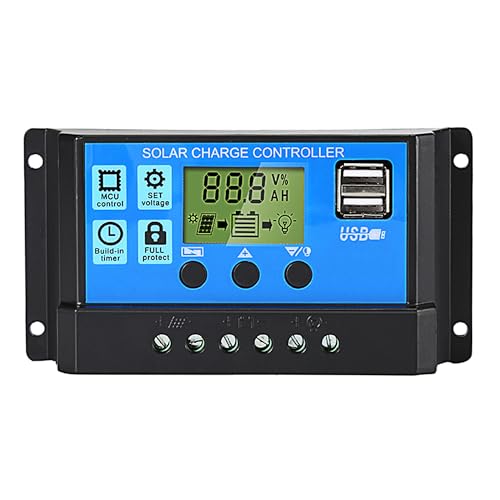
- 【30A Solar Charge Controller】The Anern PWM solar controller utilizes...
- 【Multiple protection】This solar panel controller features built-in...
- 【Functional LCD Display】Easy to install and operate, the intuitive LCD...
Head-to-Head Comparison: pwm vs mppt solar charge controller which is better
This table puts all four controllers side by side so you can see their differences at a glance.
| Feature | ACEIRMC 30A PWM | AeternaSol MPPT 10A | Ampinvt 80A MPPT | Anern 30A PWM |
|---|---|---|---|---|
| Best for | Small 12V/24V systems | Portable solar setups | Large off-grid homes | DIY basic projects |
| Key Strength | Affordable LCD display | USB-C charging port | High 80A capacity | Multiple load modes |
| Biggest Weakness | PWM voltage waste | Only 10A limit | Large and expensive | PWM voltage waste |
| Skill Level Required | Beginner | Beginner to Intermediate | Intermediate to Advanced | Beginner |
| Durability | Good | Good | Excellent | Good |
| Value for Money | Excellent for small systems | Good for portable use | Fair for large systems | Excellent for small systems |
Category Winners: Which One Wins Where
After looking at all the specs and real-world use, clear winners emerge for different needs. Here is my honest take on which controller takes each category.
Best Overall Value
The AeternaSol MPPT 10A wins here because it gives you true MPPT efficiency at a price that does not break the bank. You get modern features like USB-C charging while saving up to 30% more power than a PWM controller. For small to medium portable systems, this is the sweet spot between cost and performance.
Best for Beginners
The ACEIRMC 30A PWM wins here because it is dead simple to install and requires zero programming knowledge. The LCD display shows you exactly what is happening without confusing menus. You literally connect your panel and battery, and it starts working immediately.
Best for Performance
The Ampinvt 80A MPPT wins here because it handles massive solar arrays with professional-grade efficiency. It automatically detects your system voltage and tracks the maximum power point even in changing light conditions. This is the controller you want if you need to squeeze every watt from a large off-grid setup.
Best for Budget Buyers
The Anern 30A PWM wins here because it is one of the cheapest reliable controllers you can buy for small projects. It includes multiple load control modes that add functionality without extra cost. For a camping trailer or small shed, this controller gets the job done for very little money.
Best Long-Term Investment
The Ampinvt 80A MPPT wins here because its high efficiency pays for itself over time by harvesting more power from your panels. The Strong build quality means it will last for years in a permanent installation. If you are building a system you plan to keep for a decade, this is the smart choice.
Our Final Verdict
For the majority of buyers asking which controller is better, the AeternaSol MPPT Solar Charge Controller 12V10A USB-C takes the crown. It delivers true MPPT efficiency that recovers up to 30% more power than PWM controllers, yet remains affordable for small and medium solar setups. The built-in USB-C port also adds modern convenience that competing units lack at this price point.
The Ampinvt 80 Amp MPPT Solar Charge Controller Auto 48V is the runner-up, and it is the better choice if you are building a large off-grid system. Its massive 80A capacity and automatic voltage detection make it ideal for powering a cabin or workshop where every watt matters. You can check the Ampinvt 80A here if you need that serious power handling.
If you are still unsure, ask yourself one question: do you want the highest efficiency or the lowest upfront cost? That answer will point you to the right controller every time.
Frequently Asked Questions
What is the main difference between PWM and MPPT controllers?
The main difference is how they handle extra voltage from your solar panels. PWM controllers simply reduce the panel voltage to match your battery voltage, wasting the excess as heat. MPPT controllers convert that extra voltage into additional current, giving you more charging power.
This means MPPT controllers can be 20 to 30 percent more efficient than PWM controllers, especially when your solar panels have a much higher voltage than your battery bank. For example, a 36-volt panel charging a 12-volt battery will see huge losses with a PWM controller.
Can I use an MPPT controller with any solar panel?
Yes, MPPT controllers work with most solar panels, but they work best when the panel voltage is significantly higher than the battery voltage. You want your panel’s maximum power voltage (Vmp) to be at least 5 to 10 volts above your battery voltage for the MPPT to operate efficiently.
Most modern 12-volt panels have a Vmp around 18 volts, which works well with MPPT controllers charging 12-volt batteries. Just make sure your controller’s maximum input voltage rating is higher than your panel’s open-circuit voltage (Voc), especially in cold weather when voltage rises.
Is an MPPT controller worth the extra money for a small system?
For a very small system like a single 50-watt panel charging a battery, the extra cost of an MPPT controller is often not worth it. A cheap PWM controller will work fine because the power losses are small in absolute terms. You might only lose 5 to 10 watts, which is not a big deal.
However, for any system over 200 watts, I strongly recommend spending the extra money on an MPPT controller. The efficiency gains will pay for the price difference within a year or two by harvesting significantly more energy from your panels every day.
Which controller is easier to install for a beginner?
PWM controllers are definitely easier to install for a complete beginner. They usually have simple labeled terminals for panel, battery, and load, and they require no programming or configuration. You connect the battery first, then the panel, and the controller starts working automatically.
MPPT controllers often require you to set the battery type and voltage during initial setup. Some also need you to enter the system voltage manually. If you are not comfortable with basic programming, a PWM controller like the ACEIRMC 30A is a much simpler starting point.
How do I know if my system needs a PWM or MPPT controller?
Look at the voltage of your solar panels compared to your battery bank. If your panel voltage is very close to your battery voltage, like a 12-volt panel charging a 12-volt battery, a PWM controller will work fine and save you money. The voltage mismatch is small, so losses are minimal.
If your panel voltage is much higher than your battery voltage, like using 24-volt or 36-volt panels to charge a 12-volt battery, you absolutely need an MPPT controller. Without it, you will waste over 30 percent of your panel’s potential power as heat in the PWM controller.