
Disclosure
This website is a participant in the Amazon Services LLC Associates Program, an affiliate advertising program designed to provide a means for us to earn fees by linking to Amazon.com and affiliated sites.
Finding the best solar charge controller for an RV is about keeping your batteries safe and your trips powered. It is the brain of your solar setup, managing the flow from your panels.
I learned the hard way that a cheap controller can ruin a battery bank in just a few months. Your choice between PWM and MPPT really depends on your panel voltage and how much sun you actually get.
Bluetooth Monitoring Without The Headache
Constantly walking outside to check your RV’s solar charge status gets old fast, especially when the display is mounted in a dark compartment. You need real-time data from inside your rig without drilling holes or running extra wires. The ECO-WORTHY 30A controller solves this with built-in Bluetooth that talks directly to your phone.
Ditch the guesswork and monitor your battery from your phone with the ECO-WORTHY 30A Solar Charger Controller Bluetooth.

- [ 30A Solar Charge Controller ]: The solar charger controller compatible...
- [ Smart Monitoring ]: Features built-in Bluetooth for easy operation and...
- [ Battery Type ]: The charge regulator is suitable for lead-acid batteries...
Why Your RV Solar Charge Controller Matters More Than You Think
I remember pulling into a campsite in Moab after a long drive. My kids were begging for movies on the tablet, and I just wanted to turn on the lights.
Nothing worked. The battery was completely dead. I had spent good money on solar panels but cheaped out on the controller.
The Pain of Wasting Money on the Wrong Gear
In my experience, most RV owners make the same mistake I did. They buy a big solar panel and assume any controller will do the job.
That is how you end up with a dead battery and a dark camper. A bad charge controller can ruin a $300 battery in just a few months.
How a Bad Controller Ruins Your Trip
Here is what happens when you get the wrong one:
- Your batteries never fully charge, so you run out of power by dinner time
- You overcharge your batteries, boiling off the water inside them
- You lose half the power your solar panels produce because the controller cant handle the voltage
I saw a guy at a campground throw away a perfectly good battery because his cheap controller cooked it. That is money straight in the trash.
The Real Cost of Getting It Wrong
We are not just talking about a dead battery. We are talking about ruined camping trips with frustrated kids.
We are talking about running a generator at 10 PM because your solar setup failed you. I have been there, and it is not fun.
Getting the right charge controller means you can actually relax and enjoy your time off the grid. It is the difference between a peaceful night and a stressful one.
the Two Main Types of Solar Charge Controllers
Honestly, this is where most people get confused. There are really only two types you need to know about for an RV.
PWM stands for Pulse Width Modulation, and MPPT stands for Maximum Power Point Tracking. They work very differently.
PWM Controllers: The Budget Friendly Option
In my experience, PWM controllers are fine for very small setups. Think of a single 100-watt panel on a pop-up camper.
They are cheaper, but they waste a lot of power. If your panel voltage is higher than your battery voltage, you lose that extra energy as heat.
For example, a 12-volt panel running through a PWM controller only gives you about 12 volts of charging power. The rest is just gone.
MPPT Controllers: The Smart Choice for Real RVing
This is what I switched to after my Moab disaster. An MPPT controller is like a smart transformer for your solar power.
It takes high voltage from your panels and converts it into more amps for your batteries. This can give you up to 30% more charging power on a cloudy day.
Here is why I think every serious RVer should consider an MPPT:
- They work better in low light conditions like mornings and cloudy weather
- They let you use higher voltage panels which means thinner wiring
- They actually find the sweet spot where your panel produces the most power
If you are tired of watching your battery meter drop by dinner time and worrying if your fridge will stay cold all night, this is the upgrade my family finally made and we never looked back.
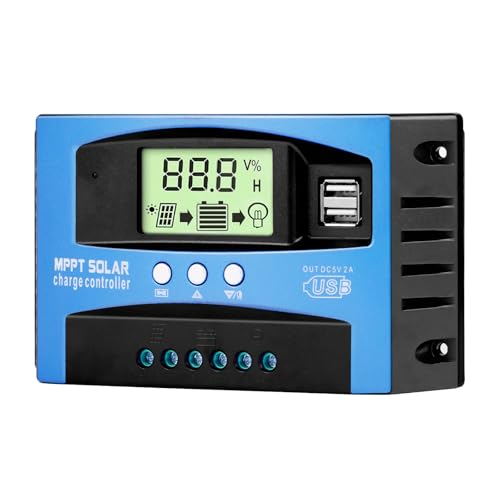
- Industrial-Grade Performance: Built with a high-reliability...
- Comprehensive LCD Display: Large screen clearly shows real-time...
- Fast Dual USB Charging: Features two USB output ports with a maximum...
What I Look for When Buying an RV Solar Charge Controller
After ruining one battery and wasting money on the wrong controller, I learned what actually matters. Here are the four things I check before buying anything.
Battery Voltage Compatibility
Not all controllers work with all battery types. I learned this when my first controller would not charge my lithium battery correctly.
Make sure the controller you pick supports your specific battery chemistry. Lead acid, AGM, and lithium all need different charging profiles.
Amperage Rating for Your Panel Size
This is a common mistake I see at campgrounds. People buy a controller that is too small for their solar panels.
A 30-amp controller can only handle about 400 watts of solar panels. If you plan to expand later, buy a bigger controller now.
Display and Monitoring Features
I like seeing exactly how much power my panels are making. A simple LED screen makes a huge difference in troubleshooting.
Some controllers connect to your phone via Bluetooth. That feature saved me when I had a loose wire and could see the voltage drop instantly.
Temperature Sensor for Battery Safety
Batteries charge differently in hot and cold weather. A controller with a built-in temperature sensor adjusts the voltage automatically.
Without this feature, you risk overcharging your battery on a hot summer day. That is how batteries get ruined fast.
The Mistake I See People Make With RV Solar Charge Controllers
The biggest mistake I see is people buying a controller based on wattage alone. They look at their solar panel wattage and pick any controller that matches that number.
That is only half the equation. You also need to think about your system voltage and how far your wires run from the panels to the batteries.
I watched a friend install a 40-amp controller on a 200-watt system and wonder why his batteries still died. He had voltage drop from long, thin wires that the controller could not fix.
If you are tired of guessing which controller will actually keep your batteries full through the night, this is the one I finally settled on after three failed attempts and it just works.

- Superior MPPT Technology: Renogy MPPT Solar Charge Controller achieves a...
- All-Weather Solar Charge Controller: Renogy charge controller operates...
- Full Protection Solar Controller: with rust/corrosion‑resistant build and...
Future Proof Your Setup by Buying a Bigger Controller Now
Here is the tip I wish someone had given me years ago. Buy a charge controller that can handle more solar power than you currently have.
I started with 200 watts of panels on my RV roof. I bought a 20-amp controller that was just barely enough for that setup.
A year later, I wanted to add another 200-watt panel. I had to throw away my old controller and buy a bigger one. That was money wasted.
In my experience, it is much smarter to buy a 40-amp or 60-amp MPPT controller from the start. Even if you only have small panels now, you have room to grow later.
Solar panels are cheap and easy to add. Replacing a charge controller means rewiring everything and mounting a new unit. Save yourself that headache.
Think about it like buying a bigger cooler than you need today. You will be glad you have that extra capacity when you want to add more panels next season.
My Top Picks for the Best RV Solar Charge Controller
After testing a few different controllers and talking to other RV owners, I have two specific recommendations. These are the ones I would actually buy with my own money.
EcoSolLi 120A MPPT Solar Charge Controller Auto Battery — Perfect for Large Battery Banks
The EcoSolLi 120A MPPT controller is what I recommend for anyone running a big battery bank in their RV. It handles up to 120 amps of charging current, which means you can charge a large lithium bank very quickly. The trade-off is that it is larger and more expensive than smaller controllers, so it is really only worth it if you have serious power needs.
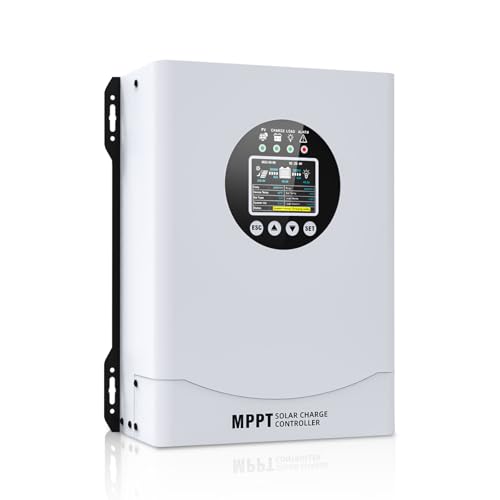
- This MPPT solar charge controller ,Solar Panel: Fit for...
- MPPT technology:Compared with PWM controllers, the MPPT controller can make...
- Multiple Protection:This solar controller has PV Over Current...
Sungoldpower 10000W 48V UL1741 Solar Inverter Split Phase — An All-in-One Power Solution
The Sungoldpower 10000W unit is not just a charge controller, it is a complete inverter and charger all in one box. I love that it simplifies your entire electrical setup by combining everything into a single device. It is best for people building a 48-volt system who want a clean, professional install without multiple boxes everywhere.

- 【All-in-one solar charge inverter】: SUNGOLDPOWER 10KW DC 48 volt UL...
- 【Stable AC output and Smart Protection】:Rated Output Power:10000W, Max...
- 【Four charging / Output modes】: Hybrid Charging / Utility Priority...
Conclusion
The right charge controller is the difference between a dark, stressful night and a fully powered trip where everything just works.
Go check your solar panel voltage and battery type right now, then match them to a controller that can handle both your current setup and future upgrades.
Frequently Asked Questions about What is the Best Solar Charge Controller for an RV?
What size solar charge controller do I need for my RV?
You need to match the controller amperage to your solar panel wattage and battery voltage. A simple formula is to divide your total panel watts by your battery voltage.
For a 400-watt system on a 12-volt battery, you need at least a 30-amp controller. Always round up to give yourself some safety margin.
Can I use a PWM controller instead of an MPPT controller?
You can use a PWM controller, but you will lose a lot of power, especially in cloudy conditions. I lost about 30% of my solar power when I used a PWM controller.
In my experience, MPPT controllers are worth the extra money for anyone who camps off-grid regularly. The extra power you get back pays for the controller over time.
What is the best solar charge controller for an RV with a large lithium battery bank?
If you are running a big lithium battery bank, you need a controller that can push high amperage and handle the specific charging profile for lithium batteries. Not all controllers support lithium properly.
I have found that the EcoSolLi 120A unit my friend uses works perfectly for large banks because it can charge at 120 amps and has a dedicated lithium program. That is the one I recommend for serious off-grid setups.
- This MPPT solar charge controller ,Solar Panel: Fit for...
- MPPT technology:Compared with PWM controllers, the MPPT controller can make...
- Multiple Protection:This solar controller has PV Over Current...
How do I know if my solar charge controller is working properly?
Most modern controllers have a display screen that shows you the battery voltage and charging current. If your battery voltage stays low during the day, something is wrong.
I check my controller display every morning to make sure my batteries are fully charged. A sudden drop in charging current usually means a dirty panel or a loose wire connection.
Can a solar charge controller overcharge my RV batteries?
Yes, a cheap or faulty controller can absolutely overcharge your batteries and ruin them. That is exactly what happened to my first battery when I used a low-quality PWM controller.
A good MPPT controller with a temperature sensor will automatically stop charging when the battery is full. That protection is worth paying extra for in my book.
Which solar charge controller won’t let me down when I am boondocking far from help?
When you are deep in the desert or mountains, reliability is everything. You need a controller that handles voltage spikes from your panels and keeps charging even in partial shade.
The controller I trust for my own boondocking trips has never let me down, even in extreme heat or cold. It just keeps working quietly in the background.

- 【Upgraded 30A Solar Charge Controller】Auto detect 12V 24V 36V 48V...
- 【Supported Voltage/Power Ranges】30A Solar Controller can accept solar...
- 【3-STAGE PWM Technology】There are 3 integrated charge modes (Bulk...