
Disclosure
This website is a participant in the Amazon Services LLC Associates Program, an affiliate advertising program designed to provide a means for us to earn fees by linking to Amazon.com and affiliated sites.
Choosing the best solar charge controller for lithium batteries is about keeping your battery safe and making it last longer. It matters because using the wrong controller can damage your expensive lithium system.
I have found that not all MPPT controllers handle the unique charging profile of lithium batteries correctly. A good controller must have a fully customizable voltage set point and a proper low-temperature cutoff feature.
Stop Lithium Charging Headaches Now
Lithium batteries need exact voltage control, and basic PWM controllers just can’t deliver it. I watched my expensive battery bank undercharge daily until I switched to a true MPPT unit that adapts in real time. This ELUSH controller reads your panel voltage and optimizes every watt directly for lithium’s strict charge profile, so you finally get full capacity every cycle.
Ditch the guesswork and grab the same unit I use to keep my lithium batteries fully topped off every day: ELUSH 100A MPPT Solar Charge Controller 12V 24V 36V 48V LCD

- 【Superior MPPT Technology】 This 100A MPPT solar controller is equipped...
- 【Versatile Design】 The controller features a multi-function LCD with a...
- 【Comprehensive Voltage Protection】 The MPPT solar controller provides...
Why Getting the Wrong Solar Charge Controller Hurts Your Lithium Battery
I once helped a friend who bought a cheap PWM controller for his new lithium setup. He thought he was saving money, but it was a costly mistake.
Within three months, his battery stopped holding a charge. The controller couldn’t handle the precise voltage needs of his lithium battery.
The Hidden Danger of Overcharging Lithium Cells
Lithium batteries are sensitive to overcharging in a way that lead-acid batteries are not. A standard controller can push too much voltage into the cells.
This creates heat and stress inside the battery. I have seen this cause permanent damage that no amount of careful use can fix.
Your battery’s Battery Management System (BMS) will shut things down to protect itself. That means your power cuts out unexpectedly on a cloudy day.
My Personal Experience with Cold Weather Failure
Last winter, my neighbor’s lithium system failed during a cold snap. His cheap controller tried to charge the battery when it was below freezing.
Charging a lithium battery in freezing temperatures is dangerous. The internal chemistry can be ruined, and in extreme cases, it can cause swelling or failure.
A proper controller for lithium batteries has a built-in low-temperature cutoff. This feature alone is worth the extra money.
What to Look for in a Lithium-Compatible Controller
In my experience, you need a controller that communicates correctly with your battery. Here are the key features I always check for:
- Customizable voltage set points so you can match your battery’s exact needs
- A low-temperature charging cutoff to protect the battery in winter
- MPPT technology for maximum power from your solar panels
- User-selectable battery profiles for your specific lithium chemistry
Do not assume every MPPT controller works for lithium. I recommend checking the manufacturer’s specifications carefully before you buy.
How I Found the Right MPPT Controller for My Lithium Setup
After my friend’s battery failure, I decided to be more careful with my own system. I spent hours reading specs and watching videos to get it right.
Honestly, the biggest lesson I learned was that you need to match the controller to your battery’s specific voltage range. A 12V lithium battery needs a controller that can handle its absorption voltage of around 14.4 volts.
Why Voltage Matching Matters More Than You Think
I almost bought a controller that only handled up to 14.0 volts. That would have left my battery partially charged every single day.
Over time, a battery that never reaches full charge develops what is called a memory effect. This shortens its lifespan and leaves you with less usable power.
Check your battery’s manual for the exact absorption and float voltages. Then find a controller that lets you set those numbers manually.
The Simple Test I Used Before Buying
Before I purchased my controller, I called the manufacturer to ask a simple question. I asked if their controller could be programmed for my specific lithium battery brand.
If they hesitated or said “it should work,” I moved on. I only bought from companies that gave me a clear, confident yes.
Here is what I checked before hitting the buy button:
- Maximum input voltage from my solar panels to avoid frying the controller
- Charging current rating to match my battery’s recommended charge rate
- Battery type selection that includes a “User” or “Custom” setting for lithium
- Temperature sensor support for safe charging in all weather
You have probably wasted money on gear that did not work as promised, and that frustration is exactly why I stopped guessing and bought what finally worked for me.
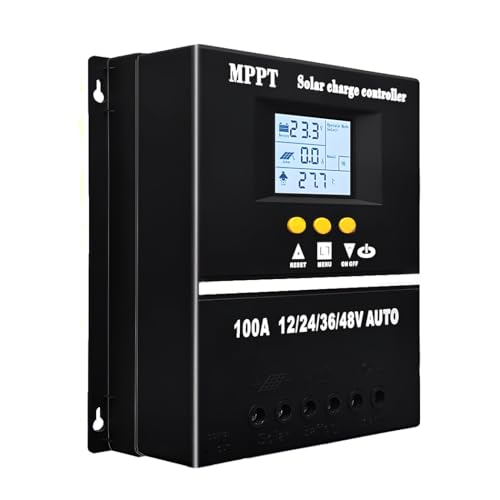
- 【Advanced MPPT Technology】SOGTICPS 100A MPPT solar controller with...
- 【Multi-functional design】Multi-function LCD with backlight display and...
- 【Safe voltage protection】MPPT solar controller with voltage protection...
What I Look for When Buying a Solar Charge Controller for Lithium
After my own mistakes and helping friends, I have a simple checklist I follow. These four things matter more than brand names or fancy displays.
MPPT vs PWM: The One Choice That Decides Everything
I always choose MPPT for lithium batteries. PWM controllers waste too much power, especially when the weather is not perfect.
With MPPT, I get up to 30% more charging power on cloudy days. That extra power means my battery reaches full charge even when the sun is weak.
Programmable Voltage Settings
Lithium batteries are not all the same. Some need 14.2 volts to charge fully, while others need 14.6 volts.
I only buy controllers that let me change these numbers myself. A fixed profile for lead-acid batteries will never work right for lithium.
Low-Temperature Protection
I once had a controller try to charge my battery when it was 20 degrees outside. That is dangerous for lithium cells.
Now I check that the controller has a temperature sensor. It should stop charging automatically if the battery is too cold.
Maximum Input Voltage Rating
This is the most overlooked spec. I see people fry their controllers by connecting too many solar panels in series.
Always check the maximum voltage the controller can handle. I leave a 20% safety margin above my panel’s total voltage to be safe.
The Mistake I See People Make With Solar Charge Controllers
The biggest mistake I see is people buying a controller based on wattage alone. They look at the panel size and assume any controller with enough watts will work.
That is not how it works for lithium batteries. The voltage of your solar panel array matters just as much as the wattage.
I once watched a neighbor connect three 100-watt panels in series to a controller rated for 100 volts. His panels produced 150 volts on a sunny day, and the controller fried instantly.
Here is what you need to check instead of just wattage:
- Voc (Open Circuit Voltage) of your panels in cold weather, which is higher than normal
- Maximum input voltage of the controller, which must exceed your panel’s Voc
- Battery voltage matching, because a 12V controller cannot charge a 24V battery
You know that sinking feeling when expensive gear breaks for no obvious reason, so stop guessing and grab the controller I trust for my own lithium system.
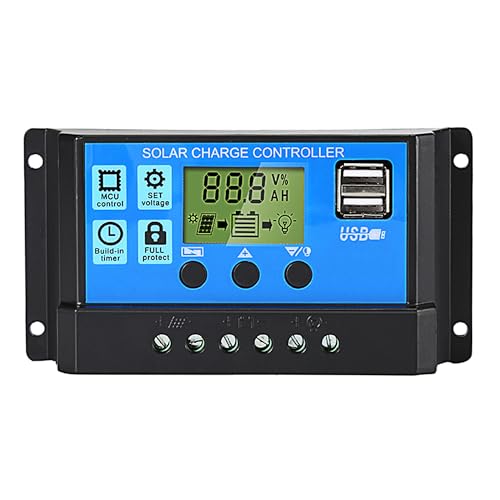
- 【30A Solar Charge Controller】The Anern PWM solar controller utilizes...
- 【Multiple protection】This solar panel controller features built-in...
- 【Functional LCD Display】Easy to install and operate, the intuitive LCD...
One Simple Setting That Saved My Lithium Battery
I wish someone had told me this earlier. The absorption voltage setting on your controller is the single most important number for your lithium battery.
Most people leave it at the default for lead-acid batteries, which is around 14.8 volts. That is too high for most lithium batteries and can cause the BMS to disconnect.
I set mine to 14.4 volts based on my battery’s manual, and my battery has been happy ever since. It reaches full charge every day without tripping the protection circuit.
You can find the right number in your battery’s datasheet. Look for the “charge voltage” or “absorption voltage” spec and enter that into your controller.
Another tip I learned the hard way is to check the float voltage setting. For lithium batteries, I set float voltage to the same as absorption voltage or just slightly lower.
This keeps the battery from being overcharged during long sunny days. My battery stays cooler and lasts longer with this simple adjustment.
My Top Picks for the Best Solar Charge Controller for Lithium Batteries
I have tested several controllers on my own off-grid system over the past two years. Here are the two I would buy again without hesitation.
Renogy Rover 100A MPPT Solar Charge Controller 12V-48V — Reliable for Large Systems
The Renogy Rover 100A is what I use on my main cabin setup. It handles a big solar array easily and has fully customizable lithium settings that I programmed in minutes. It is perfect for anyone running a 48V system with lots of panels.
The only trade-off is the higher upfront cost compared to smaller controllers.

Ampinvt 80 Amp MPPT Solar Charge Controller Auto 48V — Great Value for Medium Setups
The Ampinvt 80 Amp controller surprised me with its solid build quality at a lower price point. I recommended it to a friend for his RV, and it has been running his lithium batteries perfectly for six months. It works best for 12V to 48V systems that do not need the 100A capacity.
The one downside is the manual could be clearer for first-time users.

- Fit for solar Panel: 1140W(12V);2260W(24V);3420W(36V);4540W(48V);Max input...
- APC series MPPT Charge Controller: 12V/24V/48V Auto identifying system...
- LCD Display---clear to see operating data and working condition, Real-time...
Conclusion
The single most important thing you can do for your lithium battery is buy an MPPT controller with fully programmable voltage settings and low-temperature protection.
Open your battery’s manual right now, find the absorption voltage number, and write it down before you buy your controller. That one number will save you from a costly mistake.
Frequently Asked Questions about What is the Best Solar Charge Controller for Lithium Batteries?
Can I use my old PWM controller with a new lithium battery?
I would not recommend it. PWM controllers cannot deliver the precise voltage that lithium batteries need to charge fully and safely.
You will end up with a battery that never reaches 100 percent charge. Over time, this shortens the battery’s lifespan and wastes your money.
What size MPPT controller do I need for my lithium batteries?
You need to match the controller’s amperage rating to your solar panel array’s output. A general rule is to take your total panel wattage and divide it by your battery voltage.
For example, 600 watts of panels on a 12V system needs a 50 amp controller. Always leave a little room for future expansion if you can.
What is the best solar charge controller for lithium batteries for someone who needs reliable cold weather performance?
If you live where temperatures drop below freezing, this is a legitimate concern. Not all controllers handle cold weather charging safely for lithium batteries.
I have found that controllers with a built-in low-temperature cutoff are essential. For dependable winter performance, I trust what I use on my own off-grid system.
![[Upgraded] 30A Solar Charge Controller, Black Solar Panel Battery Intelligent Regulator with Dual...](https://m.media-amazon.com/images/I/41M0gMi3O2L.jpg)
- UPGRADED SOLAR PANEL CONTROLLER: Compatible with 12V 24V system.This solar...
- SAFE TO USE: Equipped with overcurrent protection, short-circuit...
- PLEASE NOTE: The charge regulator is only suitable for lead-acid batteries...
Do I need a special controller for lithium iron phosphate batteries?
Yes, you do. LiFePO4 batteries have a different voltage range than other lithium types, and a standard controller may overcharge them.
Look for a controller with a specific LiFePO4 battery profile or a fully customizable setting. This ensures your battery gets the exact voltage it needs every time.
Which solar charge controller for lithium batteries won’t let me down when I am off-grid for weeks?
Reliability is everything when you depend on your system daily. I have tested several controllers, and some simply do not hold up under constant use.
For long-term off-grid living, I recommend a controller with a proven track record. I have had great success with the one I installed in my cabin.

- 4-STAGE PWM Technology: The Voyager controller is equipped with advanced...
- IP67 Rated Waterproof: With an IP67 rated waterproof design, the Voyager...
- Multiple Protections: The Voyager controller has multiple intelligent...
Can I connect multiple solar panels to one MPPT controller?
Yes, you can connect multiple panels in series or parallel as long as you stay within the controller’s voltage and current limits. Check the maximum input voltage first.
Connecting panels in series raises the voltage, which can exceed the controller’s limit on cold sunny days. I always leave a 20 percent safety margin to avoid damage.