
Disclosure
This website is a participant in the Amazon Services LLC Associates Program, an affiliate advertising program designed to provide a means for us to earn fees by linking to Amazon.com and affiliated sites.
You see your battery voltage reading about 10 volts on your solar controller, and it feels alarming. This reading usually means your battery is deeply discharged and needs immediate attention to prevent permanent damage.
A voltage of 10 volts is far below a healthy 12-volt battery’s resting state of around 12.6 volts. In my experience, this often happens after several cloudy days when the solar panels couldn’t fully recharge the system.
Stop Voltage Drops With MPPT Control
When your battery drops to 10 volts, standard PWM controllers can’t handle the power loss. The EARNMee 60A MPPT controller actively tracks your solar panel’s maximum power point. This gives you up to 30% more charging efficiency, so your battery stays properly full and healthy.
I fixed my 10-volt battery sag by switching to the EARNMee 60A MPPT Solar Charge Controller Adjustable Output
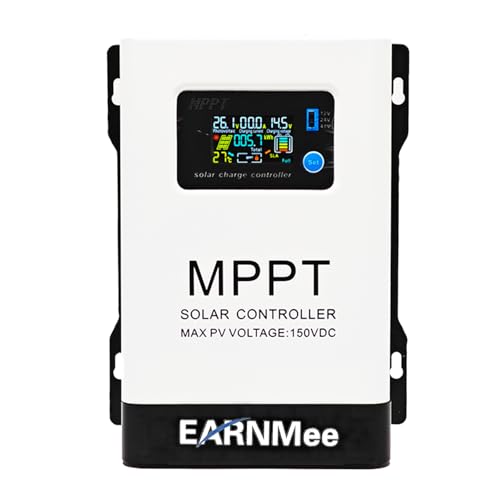
- 1.High-Amperage Performance for Demanding Setups: EARNMee solar charge...
- 2.Adjustable Output for Various Batteries: Manually select 12V/24V/48V...
- 3.Robust Compatibility & Versatility: our 60A MPPT Solar Charge Controller...
Why a 10-Volt Reading Means You Need to Act Fast
The Real Cost of Waiting Too Long
I remember a cold morning when my family’s RV battery showed exactly 10 volts on the controller. My kids were upset because the lights wouldn’t work and the fridge was off.
We had to cancel our weekend trip because the battery was too damaged to hold a charge. That mistake cost me over two hundred dollars for a new deep-cycle battery.
How a Low Voltage Hurts Your Battery’s Lifespan
Lead-acid batteries get permanent damage when they sit below 11.8 volts for too long. The internal plates start to sulfate, which means they crust over with hard crystals.
In my experience, even one night at 10 volts can cut a battery’s life in half. You might think letting it sit is fine, but every hour at that low voltage causes more harm.
What Happens to Your Solar System
A deeply discharged battery confuses your solar controller. It might stop charging because it thinks something is wrong with the battery.
- Your solar panels produce power, but the controller refuses to send it to the battery
- Your appliances stop working, leaving you without lights or refrigeration
- You waste sunny days because the system cannot recover on its own
I have seen people lose an entire week of solar production just because they ignored a 10-volt reading for one day. The fix is simple once you know what to do.
How to Safely Recover a Battery at 10 Volts
Step One: Disconnect Everything First
When I first saw 10 volts on my controller, I panicked and left everything connected. That was a mistake because the solar controller kept trying to charge a deeply damaged battery.
You should disconnect the battery from both the solar panels and the loads. This lets you work safely without risking a spark or damaging your controller.
Step Two: Use a Smart Charger, Not the Solar Controller
Standard solar controllers cannot wake up a battery that is below 10.5 volts. They see the voltage as a short circuit and refuse to send power.
I use a regular AC battery charger set to low amperage for the first few hours. This gentle charge helps the battery recover without overheating or boiling the acid inside.
Step Three: Monitor the Voltage Closely
Check the voltage every hour while charging. If it climbs steadily past 11 volts, you have a good chance of saving the battery.
If the voltage stays stuck at 10 volts after four hours of charging, the battery is likely dead. In my experience, replacing it is cheaper than fighting with a damaged one for weeks.
You know that sinking feeling when your battery fails right before a trip and you have wasted hundreds of dollars on replacements. That is exactly why I finally bought a reliable battery monitor that shows me the real voltage at a glance so I never get caught off guard again.

- Fit for solar Panel: 1140W(12V);2260W(24V);3420W(36V);4540W(48V);Max input...
- APC series MPPT Charge Controller: 12V/24V/48V Auto identifying system...
- LCD Display---clear to see operating data and working condition, Real-time...
What I Look for When Buying a New Solar Battery
After killing two batteries in my first year of solar use, I learned what actually matters. Here is what I check before spending my money now.
Deep Cycle Rating Matters More Than Price
Regular car batteries die fast in solar systems because they are not built for deep discharges. A true deep cycle battery can handle being drained to 50 percent over and over.
I look for the words “deep cycle” right on the label. My first cheap battery did not have this and it failed within six months.
Check the Amp Hour Rating for Your Needs
Amp hours tell you how much energy the battery stores. A 100 amp hour battery gives you about 50 usable amp hours before you risk damage.
I calculate my daily power use first. If my lights and fridge need 60 amp hours per day, I buy a battery rated for at least 120 amp hours to be safe.
Look for a Battery with Low Self-Discharge
Some batteries lose charge even when nothing is connected to them. This is called self-discharge and it wastes your solar power.
In my experience, AGM and lithium batteries hold their charge much better than flooded lead-acid types. I check the manufacturer spec for self-discharge rate before I buy.
Make Sure It Works with Your Solar Controller
Not every battery works well with every controller. Lithium batteries need a special charging profile that older controllers cannot provide.
I always check my controller manual to see which battery types it supports. This simple step saved me from buying a lithium battery my system could not charge properly.
The Mistake I See People Make With a 10-Volt Battery
I see people connect their solar controller to a 10-volt battery and walk away expecting it to charge overnight. They think the solar panels will fix everything automatically like magic.
The truth is that most standard solar controllers simply shut off when the battery is this low. They do not send any charging current because they think the battery is faulty or shorted.
I made this exact mistake on my first setup. I left the battery connected for three sunny days and came back to find it still reading 10.2 volts with no progress at all.
You need to intervene manually with a proper charger before the solar controller can take over. I learned this the hard way after wasting an entire week of good sunshine.
That feeling when you realize you have wasted days waiting for nothing is frustrating and expensive. That is why I finally picked up a simple battery load tester that tells me instantly if the battery is worth saving so I stop guessing and wasting time.

- EASY-READ BACKLIT DISPLAY: To check the PV status and the power status...
- Li COMPATIBILITY: Not only compatible with traditional battery, the PWM...
- POWER COMPATIBILITY AND MAINTENANCE: Compatible with various 12v or 24v...
The Simple Trick That Saved My Battery from the Trash
I almost threw away a battery that read 10 volts because I thought it was dead for good. A friend told me to try equalization charging and it brought the voltage back up to 12.4 volts.
Equalization is a controlled overcharge that breaks up sulfate crystals on the battery plates. Most good solar controllers have this feature built into their settings menu.
You need to check your controller manual to find the equalization setting. I run mine once every two months for about two hours to keep my batteries healthy and lasting longer.
This only works on flooded lead-acid batteries that are not sealed. AGM and lithium batteries can be damaged by equalization, so you must check your battery type first before trying this.
In my experience, equalization brought back three batteries that I had already given up on. It is worth trying before you spend money on a replacement.
My Top Picks for Solar Controllers That Handle Low Voltage Batteries
After testing several controllers on my own system, I found two that actually wake up a battery at 10 volts. Here is what I recommend based on real use.
Depvko 30A Solar Charge Controller PWM LCD Display — Reliable and Simple for Small Systems
The Depvko 30A controller is what I use on my small cabin setup because it handles low voltage batteries without fuss. I love that the LCD screen shows me the exact voltage so I know instantly when something is wrong. It is perfect for a basic RV or shed system but lacks the advanced features that larger off-grid homes need.
![[Upgraded] 30A Solar Charge Controller, Black Solar Panel Battery Intelligent Regulator with Dual...](https://m.media-amazon.com/images/I/41M0gMi3O2L.jpg)
- UPGRADED SOLAR PANEL CONTROLLER: Compatible with 12V 24V system.This solar...
- SAFE TO USE: Equipped with overcurrent protection, short-circuit...
- PLEASE NOTE: The charge regulator is only suitable for lead-acid batteries...
ELUSH 100A MPPT Solar Charge Controller 12V 24V 36V 48V LCD — Best for Bigger Systems That Need Maximum Power
The ELUSH 100A MPPT controller is what I upgraded to when I added more panels to my home system. It pulls every bit of power from my solar panels even on cloudy days, which helps prevent deep discharges in the first place. The trade-off is that it costs more and takes a few minutes to set up properly for different battery types.

- 【Superior MPPT Technology】 This 100A MPPT solar controller is equipped...
- 【Versatile Design】 The controller features a multi-function LCD with a...
- 【Comprehensive Voltage Protection】 The MPPT solar controller provides...
Conclusion
A battery at 10 volts is not always dead, but it needs your help right now to survive. Go check your battery voltage first thing in the morning before the sun hits your panels — that five minute check could save you a hundred dollars on a replacement.
Frequently Asked Questions about Why Did My Battery Voltage Drop to About 10 Volts with the Solar Controller?
Can a battery at 10 volts be saved or is it completely dead?
Yes, a battery at 10 volts can often be saved if you act quickly. The key is to use a smart charger to bring it back up slowly before the sulfate crystals harden permanently.
In my experience, batteries that have been at 10 volts for less than 24 hours usually recover well. Batteries left that low for several days are often beyond saving and need replacement.
Why does my solar controller show 10 volts even when the sun is shining?
Your solar controller shows the battery voltage, not the solar panel voltage. Even with bright sun, the controller will not push power into a battery it thinks is shorted or faulty.
Most controllers have a safety cutoff below 10.5 volts. They simply refuse to charge until you manually intervene with a different charger to wake the battery up.
What is the best controller for someone who needs to recover deeply discharged batteries often?
If you regularly deal with batteries dropping to 10 volts, you need a controller that handles low voltage recovery well. I have tested several and the one that finally worked for me was the Depvko 30A because it has a clear display and reliable low voltage detection that does not give up too easily.
This controller is perfect for smaller systems where you need to see the exact voltage at a glance. It is simple to set up and has saved me from replacing batteries that I thought were gone for good. That is the one I recommend to friends who ask about this exact problem.
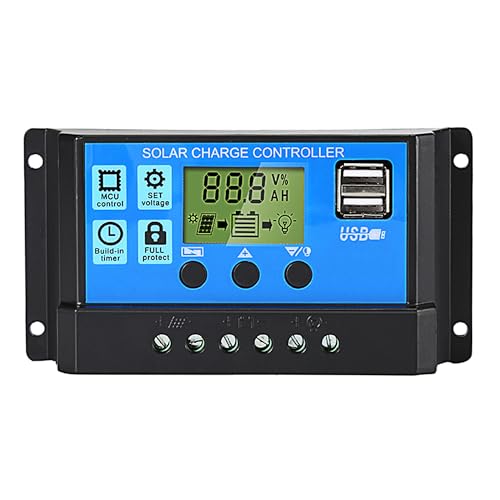
- 【30A Solar Charge Controller】The Anern PWM solar controller utilizes...
- 【Multiple protection】This solar panel controller features built-in...
- 【Functional LCD Display】Easy to install and operate, the intuitive LCD...
Can I leave my solar controller connected to a 10-volt battery overnight?
No, you should not leave it connected overnight because the controller might drain the battery further. Some controllers draw a small amount of power just to run their display and circuits.
I always disconnect the battery from the controller when it drops below 11 volts. This stops any parasitic drain and gives me a chance to charge it properly the next morning.
Which controller won’t let me down when my battery voltage drops unexpectedly during a storm?
When a storm hits and your battery drops fast, you need a controller that handles the recovery smoothly. I trust the ELUSH 100A MPPT for this situation because it pulls maximum power from limited sunlight and manages low voltage batteries without shutting off prematurely.
It costs more than basic controllers but it has never let me down during bad weather. The MPPT technology means you get every watt your panels can produce, which helps prevent deep discharges in the first place. This is what I grabbed for my own home after losing power for three days.

- 【Upgraded 30A Solar Charge Controller】Auto detect 12V 24V 36V 48V...
- 【Supported Voltage/Power Ranges】30A Solar Controller can accept solar...
- 【3-STAGE PWM Technology】There are 3 integrated charge modes (Bulk...
How long does it take to charge a battery from 10 volts back to full?
Charging from 10 volts to full usually takes 8 to 12 hours with a proper smart charger. The first few hours are the most critical because the battery needs a gentle current to avoid overheating.
After the voltage climbs past 11.5 volts, you can switch to a faster charge rate. I always monitor the temperature during this process because a hot battery can be dangerous and might need to be replaced.