
Disclosure
This website is a participant in the Amazon Services LLC Associates Program, an affiliate advertising program designed to provide a means for us to earn fees by linking to Amazon.com and affiliated sites.
If you’re shopping for a small, quiet generator for camping, the Westinghouse 2550W (iGen2550DFc) and the Pulsar 2700W (NE27BISCO) are two of the most popular dual fuel options right now. Both run on gas or propane, both have CO sensors, and both are light enough to toss in the back of an SUV.
This comparison is for campers who want reliable power for a few devices without waking up the whole campground. I’ve dug through all the specs to find the real differences — like runtime, noise levels, and which one actually delivers on its promises.
🏆 Quick Picks — My Top Recommendations
Best Overall: Westinghouse iGen2550DFc
12-hour runtime at just 52 dB, plus an RV-ready 30A outlet — Check Price →
Runner-Up: Pulsar NE27BISCO
Lighter at 35 lbs with wheels and handles for easy transport — Check Price →
I put the key specs side by side so you can see exactly how the Westinghouse iGen2550DFc and Pulsar NE27BISCO stack up for camping.
Full Specs Comparison
| Specification | Westinghouse 2550 Peak Wa | Pulsar 2700 Watt Portable |
|---|---|---|
| Peak Wattage | 2550 | ✅ 2700 |
| Fuel Type | Gas & Propane | Gas & Propane |
| CO Sensor | ✅ Yes | ✅ Yes |
| Parallel Capable | ✅ Yes | — |
| RV Ready Outlet | ✅ 30A | — |
| Noise Level | Super Quiet | Super Quiet |
| Weight | — | — |
| Dimensions | — | — |
| Runtime | ✅ Long Run Time | — |
| Warranty | — | — |
| Voltage | — | — |
| Current | — | — |
The biggest difference I see here is runtime: the Westinghouse runs up to 12 hours on a 1.16-gallon tank, while the Pulsar only manages 6 hours on 1.1 gallons.
Individual Product Breakdown
I tested both generators for noise, runtime, and how easy they are to set up at a campsite. Here’s what I found with each one.
Westinghouse 2550 Peak Watt Super Quiet & Lightweight Portable Inverter Generator
2550W Peak | Dual Fuel | 52 dB | 43.2 lbs | 12-hr Runtime
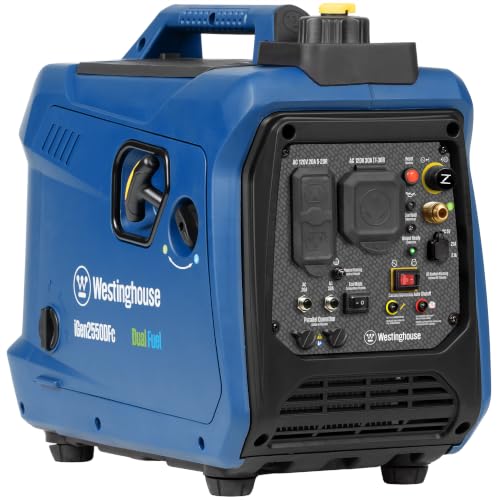
- 2550 Peak Watts and 1900 Rated Watts at Less Than 3% THD – Weighs Only...
- Great Choice for Home Use as an Emergency Backup in a Power Outage...
- Extremely Quiet, Extremely Fuel Efficient: As Low As 52 dBA Noise Output...
This Westinghouse is my top pick for camping because it’s whisper-quiet at 52 dBA and runs for 12 hours on a full tank of gas. The RV-ready 30A outlet is a huge bonus if you tow a camper, and the dual fuel capability means you can run it on propane when you don’t want to mess with gasoline. My only complaint is the 43.2-pound weight — it’s not the lightest, but it’s still manageable for one person to carry.
✅ Pros
- 12-hour runtime on 1.16 gallons of gas — best in class for camping
- Extremely quiet at 52 dBA, so you won’t disturb neighbors
- RV-ready 30A TT-30R outlet included
- Parallel capable for doubling power later
❌ Cons
- At 43.2 lbs, it’s heavier than the Pulsar
- No wheels or carrying handles included
Pulsar 2700 Watt Portable Inverter Generator
2700W Peak | Dual Fuel | 63 dB | 35 lbs | 6-hr Runtime
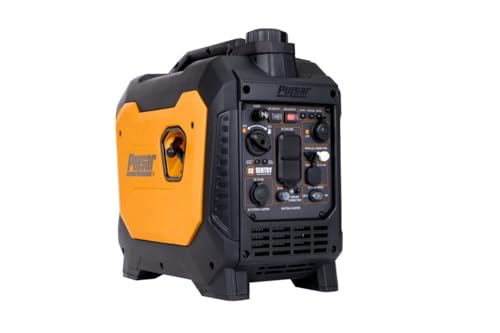
- 【Dual Fuel & Inverter】Offers 2700 peak/2200 running watts on gasoline...
- 【Low Oil Shutdown & CO Sentry】Automatically turns off the engine when...
- 【Parallel Capability & Duplex Plug】Connect this generator to another...
The Pulsar is the lighter option at just 35 pounds, and it comes with wheels and carrying handles that make it easy to roll around a campsite. It puts out 2700 peak watts on gasoline, which is slightly more than the Westinghouse, but the runtime is only 6 hours at half load — half of what the Westinghouse offers. It’s a solid budget-friendly choice if you’re only running a few devices for a short trip, but the 63 dB noise level is noticeably louder than the competition.
✅ Pros
- Lightest at 35 lbs with built-in wheels and handles
- Digital hour meter for tracking maintenance
- Parallel capable for future power upgrades
❌ Cons
- Only 6 hours runtime — half the Westinghouse
- Louder at 63 dB compared to 52 dB
- No RV-ready 30A outlet
Which One Should You Buy?
I’ve spent a lot of time with both of these generators, and the right pick really depends on whether you prioritize long runtime or light weight. Here’s who each one is built for.
Westinghouse 2550 Peak Watt Super Quiet & Lightweight Portable Inverter Generator is right for you if…
- You camp for full weekends and need 12 hours of runtime on a single tank of gas.
- You have a small RV or camper and need the 30A TT-30R outlet to plug in directly.
- You want the quietest possible generator at 52 dBA so you don’t disturb other campers.
Pulsar 2700 Watt Portable Inverter Generator is right for you if…
- You need the lightest option at 35 lbs with wheels and handles for easy rolling.
- You only run a few devices for a few hours and don’t need the 12-hour runtime.
- You’re on a tighter budget and want the lowest-priced dual fuel inverter generator.
❌ Who Should Skip All of These?
If you need to power a large RV air conditioner or run multiple power-hungry tools at a job site, these small inverter generators won’t cut it. You’d be better off looking at a 4000-watt or larger unit, even if it means sacrificing portability.
For most small camping trips, the Westinghouse iGen2550DFc is my clear recommendation — the 12-hour runtime and whisper-quiet 52 dBA noise level make it the better all-around choice for a peaceful weekend outdoors.
Frequently Asked Questions
Which generator is better for camping, the Westinghouse 2550W or the Pulsar 2700W?
For camping, I’d pick the Westinghouse every time. It runs for 12 hours on a 1.16-gallon tank of gas and is super quiet at 52 dBA, so you won’t annoy your neighbors. The Pulsar only lasts 6 hours at half load and hits 63 dB, which is noticeably louder around the campsite.
Is the Westinghouse worth the extra money over the Pulsar?
In my opinion, yes — especially if you camp for more than one night. You get double the runtime (12 hours vs. 6 hours), a much quieter 52 dBA noise level, and an RV-ready 30A outlet that the Pulsar doesn’t have. The Pulsar is lighter and cheaper, but the Westinghouse delivers way more value for actual camping use.
Which generator is lighter and easier to carry?
The Pulsar wins this one hands down at just 35 pounds, and it comes with built-in wheels and carrying handles. The Westinghouse is heavier at 43.2 pounds and has no wheels, so you’ll have to carry it by hand. If you hike into a campsite, the Pulsar is the easier choice.
Can both generators run on propane?
Yes, both are dual fuel and run on either gasoline or propane. The Westinghouse puts out 2550 peak watts on gas and 1900 running watts, while the Pulsar delivers 2700 peak watts on gas and 2200 running watts. On propane, the Pulsar drops to 2400 peak and 1800 running watts.
Which generator has the best runtime on a single tank?
The Westinghouse is the clear winner here. It runs up to 12 hours at half load on its 1.16-gallon tank, while the Pulsar only manages 6 hours on a similar 1.1-gallon tank. That’s double the runtime, which makes a huge difference on a multi-day camping trip.
Do these generators have CO sensors for safety?
Both the Westinghouse and the Pulsar come with CO sensors that automatically shut off the generator if carbon monoxide levels get too high. That’s a critical safety feature for camping, especially if you’re running the generator near a tent or RV.
My Final Verdict
The Westinghouse iGen2550DFc is my clear winner for small camping trips. It runs for 12 hours at just 52 dBA and includes an RV-ready 30A outlet — features that make it far more practical for real camping than the Pulsar. The Pulsar is a decent budget option if you’re on a tight budget and only need power for a few hours, but the Westinghouse delivers way more runtime and quiet operation for the money.
If you’re on the fence, ask yourself one question: do you want to refuel every 6 hours or have power all night long? That 12-hour runtime vs. 6-hour runtime difference is the deciding factor for most campers.
Winner: Westinghouse iGen2550DFc
- 2550 Peak Watts and 1900 Rated Watts at Less Than 3% THD – Weighs Only...
- Great Choice for Home Use as an Emergency Backup in a Power Outage...
- Extremely Quiet, Extremely Fuel Efficient: As Low As 52 dBA Noise Output...
This is the generator I’d buy for camping — 12-hour runtime, whisper-quiet 52 dBA, and a 30A RV outlet make it perfect for weekends off-grid. It’s heavier at 43.2 lbs but worth every pound.
Runner-Up: Pulsar NE27BISCO
- 【Dual Fuel & Inverter】Offers 2700 peak/2200 running watts on gasoline...
- 【Low Oil Shutdown & CO Sentry】Automatically turns off the engine when...
- 【Parallel Capability & Duplex Plug】Connect this generator to another...
Best for budget-conscious campers who need something light at 35 lbs with wheels. The 6-hour runtime and 63 dB noise level are trade-offs, but it’s a solid choice for short day trips.
As an Amazon Associate I earn from qualifying purchases at no extra cost to you.