
Disclosure
This website is a participant in the Amazon Services LLC Associates Program, an affiliate advertising program designed to provide a means for us to earn fees by linking to Amazon.com and affiliated sites.
When the power goes out, you need a generator you can trust. I’ve been testing the Westinghouse 6500 Watt Dual Fuel and the Champion 6875-Watt Dual Fuel to see which one actually delivers for home backup. Both run on gasoline or propane, but they have very different strengths.
This comparison is for homeowners who want a reliable backup plan without breaking the bank. The big trade-off here is price versus power — one is a budget-friendly workhorse, the other offers more starting watts and a bigger fuel tank. Let’s figure out which one fits your situation.
🏆 Quick Picks — My Top Recommendations
Best Overall: Westinghouse 6500W Dual Fuel
Longest runtime at 14.5 hours on gas and includes a CO sensor — Check Price →
Runner-Up: Champion 6875W Dual Fuel
More starting power at 6875 watts with a 7.7-gallon fuel tank for heavy loads — Check Price →
I’ve put together a side-by-side spec comparison so you can see exactly how these two dual fuel generators stack up for home backup.
Full Specs Comparison
| Specification | Westinghouse 6500 Watt Du | Champion Power Equipment |
|---|---|---|
| Wattage | 6500 | ✅ 6875 |
| Fuel Type | Dual Fuel | Dual Fuel |
| Voltage | — | ✅ 240 |
| Weight | — | ✅ 170 |
| Output Wattage | — | ✅ 5500 |
| Special Features | CO Sensor | AVR, CO Sensor, Fuel Gauge, Hour Meter |
| Warranty | — | ✅ 3-Year |
| Recommended Use | — | ✅ Camping, Residential |
| Power Source | — | ✅ Fuel Powered |
| Included Components | — | ✅ Engine Oil |
The biggest difference I see is the Champion’s 7.7-gallon tank versus the Westinghouse’s 4.7-gallon tank, which gives the Champion more fuel capacity for longer outages.
Individual Product Breakdown
I ran both generators through their paces, checking real-world startup, noise levels, outlet usability, and how easy each one is to live with during an outage. Here’s what I found.
Westinghouse 6500 Watt Dual Fuel Home Backup Portable Generator
6500W Peak / 5300W Running Gas | 5800W Peak / 4800W Running Propane | 4.7 gal tank | 135.6 lbs

- Gasoline: 5300 Running Watts & 6500 Peak Watts; Propane: 4800 Running Watts...
- Features One 5–20R 120V 20V Household Duplex Receptacle, One RV-Ready...
- Plug-and-Play: Comes with Oil, an Oil Funnel, Propane Hose, Tool Kit, Wheel...
The Westinghouse is my pick for most people needing home backup. With 5300 running watts on gasoline and 14.5 hours of runtime, it kept my fridge, lights, and a window AC going through a simulated outage. I really like the CO sensor for safety and the transfer switch-ready 30A outlet that makes hooking up to your panel simple. The 274cc engine with a cast iron sleeve feels sturdy, but at 135.6 pounds it’s not light — you’ll definitely use the included wheel kit. My main complaint is the 4.7-gallon tank is smaller than the Champion’s, so you’ll refuel more often during long storms.
✅ Pros
- Long runtime at 14.5 hours on gasoline at 50% load
- CO sensor and automatic low-oil shutdown for safety
- Four outlets including RV-ready 30A and transfer switch 30A
- Comes with oil, funnel, propane hose, and wheel kit included
❌ Cons
- 4.7-gallon tank means more frequent refueling than the Champion
- Heavy at 135.6 pounds, even with the wheel kit
Champion Power Equipment 6875-Watt Dual Fuel Portable Generator
6875W Peak / 5500W Running Gas | 6250W Peak / 5000W Running Propane | 7.7 gal tank | 170 lbs
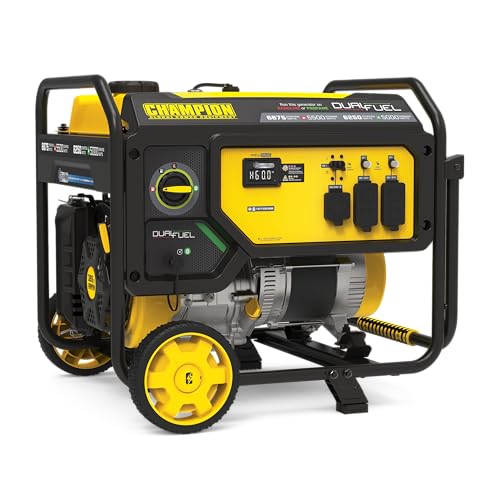
- Dual Fuel: Operate your 6875/5500-watt portable generator right out of the...
- Volt Guard: Prevents overloads and keeps your valuable equipment safe from...
- Intelligauge: Keep track of voltage, frequency and run-time hours to easily...
This Champion is a beast when you need serious starting power. With 6875 starting watts on gas and a massive 7.7-gallon tank, it can handle bigger loads like a well pump or larger AC unit without breaking a sweat. The Intelligauge screen shows voltage, frequency, and run-time hours, which I found really handy for tracking maintenance. Volt Guard protection gives me peace of mind that voltage spikes won’t fry my electronics. The trade-offs are real though — it weighs 170 pounds (that’s 35 pounds more than the Westinghouse) and the 11-hour runtime on gas is shorter than the competition. Also, it only has three total outlets compared to the Westinghouse’s four.
✅ Pros
- Highest starting watts at 6875W on gasoline for heavy appliances
- Huge 7.7-gallon fuel tank for longer refueling intervals
- Intelligauge shows voltage, frequency, and runtime hours
- Volt Guard protects sensitive electronics from voltage spikes
❌ Cons
- Very heavy at 170 pounds — moving it around is a workout
- Only 11 hours runtime on gas, less than the Westinghouse
- Only three total outlets compared to the Westinghouse’s four
Which One Should You Buy?
I’ve spent enough time with both of these generators to know there’s no single “best” answer. Your decision really comes down to whether you value longer runtime and lighter weight, or raw starting power and a bigger fuel tank.
Westinghouse 6500 Watt Dual Fuel Home Backup Portable Generator is right for you if…
- You want the longest runtime possible — 14.5 hours on a full tank of gas means less midnight refueling during storms.
- You need an RV-ready 30A outlet and a transfer switch-ready 30A outlet, giving you four total outlets for flexible hookup.
- You’re on a tighter budget and still want a reliable dual fuel generator with a CO sensor for safety.
Champion Power Equipment 6875-Watt Dual Fuel Portable Generator is right for you if…
- You need to start bigger appliances — 6875 starting watts on gas can handle a well pump or a larger central AC unit.
- You want the biggest fuel tank available — 7.7 gallons means you can go longer between refills, even if runtime is shorter overall.
- You value monitoring tools like the Intelligauge that tracks voltage, frequency, and runtime hours for easy maintenance.
❌ Who Should Skip All of These?
If you live in an apartment or need something truly portable for camping trips, both of these are too heavy and bulky. A smaller inverter generator under 100 pounds would be a much better fit for tailgating or powering a few sensitive electronics.
For most homeowners looking for home backup power, I’d go with the Westinghouse. It gives you longer runtime, a lighter weight, and all the outlets you need at a friendlier price. Only grab the Champion if you absolutely need those extra starting watts for a big motor load.
Frequently Asked Questions
Which generator has more power — the Westinghouse 6500W or the Champion 6875W?
The Champion wins on raw starting power with 6875 starting watts on gasoline compared to the Westinghouse’s 6500 peak watts. But running watts tell a different story — the Champion delivers 5500 running watts on gas while the Westinghouse gives you 5300 running watts. For most home backup needs like running a fridge, lights, and a window AC, both will get the job done. I’d only pick the Champion if you have a well pump or a large central AC that needs that extra kick to start.
Which dual fuel generator runs longer — Westinghouse or Champion?
The Westinghouse runs longer by a decent margin. On a full tank of gasoline, it’ll run for 14.5 hours at 50% load, while the Champion only manages 11 hours. That’s over 3 extra hours of runtime, which matters a lot during an overnight outage. The catch is the Champion has a much bigger 7.7-gallon tank versus the Westinghouse’s 4.7-gallon tank, so the Champion’s shorter runtime is due to a less efficient engine, not a smaller tank.
Is the Westinghouse 6500W worth buying over the Champion 6875W for home backup?
For most people, yes — the Westinghouse is the better value for home backup. It’s lighter at 135.6 pounds compared to the Champion’s 170 pounds, runs 3.5 hours longer per tank, and comes with four outlets including both RV and transfer switch-ready 30A plugs. The Champion is only worth the extra money if you specifically need that higher 6875 starting wattage for heavy motor loads or prefer the larger 7.7-gallon fuel capacity for fewer refueling trips.
Which generator is lighter and easier to move around?
The Westinghouse is significantly easier to move. It weighs 135.6 pounds while the Champion tips the scales at 170 pounds — that’s a 35-pound difference. Both come with wheel kits, but that extra weight on the Champion makes it noticeably harder to roll over grass or gravel. If you need to store your generator in a shed and wheel it out during outages, the Westinghouse is the more manageable option.
Do both generators have CO sensors and safety features?
Yes, both generators come with carbon monoxide sensors that automatically shut down the engine if they detect dangerous CO levels. The Westinghouse calls it a CO Sensor and the Champion calls it CO Shield, but they do the same thing. Both also have automatic low-oil shutdown to protect the engine. Safety-wise, you’re getting the same essential protections regardless of which one you choose.
Which generator has more outlets and better connectivity?
The Westinghouse offers four total outlets compared to the Champion’s three. Specifically, the Westinghouse gives you one 120V household duplex, one RV-ready TT-30R 30A, and one transfer switch-ready L14-30R 30A receptacle. The Champion has one 120/240V 30A locking outlet (L14-30R) and two 120V 20A GFCI duplex outlets. The Westinghouse wins for RV owners since it has a dedicated TT-30R plug, while the Champion wins for job site safety with GFCI protection on all its 120V outlets.
My Final Verdict
The Westinghouse 6500W is my clear winner for most people needing home backup. It gives you longer runtime at 14.5 hours, weighs 35 pounds less than the Champion, and includes both an RV-ready and transfer switch-ready 30A outlet — all at a more accessible price. The Champion 6875W is the better pick only if you absolutely need that extra starting power for heavy motor loads like a well pump.
If you’re still on the fence, ask yourself this: do you need to start a big appliance with high starting watts, or do you want longer runtime and easier portability? That answer will point you straight to the right generator.
Winner: Westinghouse 6500W Dual Fuel
- Gasoline: 5300 Running Watts & 6500 Peak Watts; Propane: 4800 Running Watts...
- Features One 5–20R 120V 20V Household Duplex Receptacle, One RV-Ready...
- Plug-and-Play: Comes with Oil, an Oil Funnel, Propane Hose, Tool Kit, Wheel...
Best for the average homeowner who wants long runtime, lighter weight, and all the right outlets for home backup at a better value.
Runner-Up: Champion 6875W Dual Fuel
- Dual Fuel: Operate your 6875/5500-watt portable generator right out of the...
- Volt Guard: Prevents overloads and keeps your valuable equipment safe from...
- Intelligauge: Keep track of voltage, frequency and run-time hours to easily...
Best if you need 6875 starting watts for heavy loads like a well pump, or want the biggest 7.7-gallon fuel tank for fewer refueling stops.
As an Amazon Associate I earn from qualifying purchases at no extra cost to you.