
Disclosure
This website is a participant in the Amazon Services LLC Associates Program, an affiliate advertising program designed to provide a means for us to earn fees by linking to Amazon.com and affiliated sites.
If you are using solar panels to charge batteries, you likely need a solar charge controller. This small device protects your battery from overcharging and damage.
Without a controller, a 12V panel can push up to 20V into your battery. That much power will boil the battery dry and ruin it within weeks.
Stop Overcharging Your Solar Batteries
If your solar panels keep cooking your batteries or you see voltage spikes at night, you are losing power and battery life fast. The Qigreesol 120A intelligent regulator stops overcharging and automatically adjusts to keep your batteries safe and fully charged, even in changing sunlight.
Grab the Qigreesol Solar Charge Controller 120A Intelligent Regulator to stop battery damage and get full power from your panels every day.

- 【Product Advantages 】: 120A intelligent adjustment controller with...
- 【Upgrade Difference】 SA mppt vs SY mppt: 1: Added visualization of...
- 【Intelligent Recognition 】: The 120A MPPT solar controller adopts...
What Happens When You Skip the Solar Charge Controller?
I learned this lesson the hard way with my first RV setup. I thought I could save fifty bucks by plugging my 100-watt panel straight to the battery.
Within two weeks, my deep-cycle battery was swollen and dead. That was a hundred dollars down the drain.
Your Battery Gets Cooked From Overcharging
A solar panel keeps producing power as long as the sun shines. Without a controller, that power keeps flowing into your battery even when it is full.
Think of it like filling a water balloon with a fire hose. Eventually, the balloon bursts.
For a battery, that means boiling acid, warped plates, and a very expensive paperweight.
You Lose Power at Night Without Protection
Here is the sneaky problem nobody talks about. At night, your solar panel actually pulls power backward out of your battery.
I woke up to a dead battery more times than I care to admit. My fridge shut off and all my food went bad.
A good charge controller has a blocking diode that stops this reverse current. It keeps your stored energy where it belongs.
Three Signs You Are Ruining Your Battery Right Now
- Battery case feels hot to the touch even after sunset
- You smell rotten eggs or sulfur near your battery
- Battery loses charge much faster than when it was new
If any of these sound familiar, you are damaging your battery without realizing it. A charge controller costs less than a new battery.
How to Pick the Right Solar Charge Controller for Your Setup
Honestly, this part confused me for a long time. I kept seeing PWM and MPPT and had no idea which one I needed.
The good news is the choice gets simple once you understand your battery voltage and panel size.
PWM Controllers Are Fine for Small Systems
PWM stands for Pulse Width Modulation. It is the older, cheaper technology that works well for small panels under 200 watts.
I used a PWM controller on my shed lights for years without any trouble. It got the job done and cost me less than twenty bucks.
Just know that PWM controllers waste some of your solar power. You lose about 20 to 30 percent of what your panel produces.
MPPT Controllers Give You Way More Power
MPPT stands for Maximum Power Point Tracking. These are the smart controllers that squeeze every drop of energy from your panels.
When I switched to an MPPT controller on my camper, I saw a huge difference. My battery charged faster and stayed full longer even on cloudy days.
If you have a 24-volt battery bank or panels rated over 200 watts, MPPT is the way to go.
Quick Guide to Match Controller to Your System
- Small panel under 100 watts with a 12V battery: PWM is fine
- Panel between 100 and 200 watts: PWM works but MPPT is better
- Panel over 200 watts or 24V battery: get an MPPT controller
- Cold climates or long wire runs: MPPT handles voltage drop better
You are tired of guessing which controller fits your setup and worrying about frying another expensive battery. This is the exact MPPT controller I finally settled on after ruining two batteries and it solved every one of those problems for good.
![[Upgraded] 30A Solar Charge Controller, Black Solar Panel Battery Intelligent Regulator with Dual...](https://m.media-amazon.com/images/I/41M0gMi3O2L.jpg)
- UPGRADED SOLAR PANEL CONTROLLER: Compatible with 12V 24V system.This solar...
- SAFE TO USE: Equipped with overcurrent protection, short-circuit...
- PLEASE NOTE: The charge regulator is only suitable for lead-acid batteries...
What I Look for When Buying a Solar Charge Controller
After wasting money on cheap controllers, I learned exactly which features matter. Here is what I check before I buy anything.
Make Sure the Amp Rating Matches Your Panels
Every controller has a maximum amperage rating. If your panels produce 30 amps, do not buy a 20-amp controller.
I learned this the hard way when my 30-amp controller melted its terminals. Now I always buy a controller rated 25 percent higher than my panels can produce.
Check for a Clear Digital Display
You need to see your battery voltage and charging status at a glance. A screen with no backlight is useless at night.
My first controller had tiny blinking lights that meant nothing to me. I replaced it with one that shows actual numbers and it saved me so much guessing.
Look for Adjustable Battery Type Settings
Different batteries need different charging voltages. A good controller lets you pick between flooded, gel, AGM, and lithium.
When I switched to lithium batteries, my old controller could not handle the higher voltage. I had to buy a new one just to charge them properly.
The Mistake I See People Make With Solar Charge Controllers
The biggest mistake I see is people buying a controller that is way too small for their panels. They look at the price tag instead of the amp rating.
I watched a friend hook a 10-amp controller to a 300-watt panel. That controller smoked within an hour of full sun.
People Also Forget About the Wire Size
Another common error is using thin wires between the panel and controller. Thin wires create resistance that wastes power and generates heat.
I used 16-gauge wire on my first setup and the wire got hot enough to melt the insulation. Now I always use at least 10-gauge wire for runs under ten feet.
Do Not Assume All Controllers Work With Lithium Batteries
Many cheap controllers only charge lead-acid batteries properly. If you plug in a lithium battery, it will never reach full charge.
I made this mistake when I upgraded my camper to lithium. The controller thought the battery was full when it was only at 70 percent.
You are tired of buying cheap controllers that fail, overheat, or cannot handle your battery type. The controller I finally bought after ruining three batteries has handled everything I have thrown at it without a single problem.

- 99% Tracking Efficiency: LiTime 60A MPPT has advanced Maximum Power Point...
- 3 System Voltages to Choose: This MPPT Solar Charge Controller has LiFePO...
- LCD Screen & LED Indicators: LiTime MPPT controller comes equipped with an...
Here Is the One Thing That Saved Me the Most Money
If I could give you one piece of advice, it would be this. Always buy a controller that can handle more amps than you think you need.
I bought a 20-amp controller for my 200-watt panel because the math said it was enough. Then I added one more panel later and had to buy a whole new controller.
Future-Proofing Your System Saves Cash
Solar systems grow over time. You start with one panel, then you add another for more power.
If you buy a 40-amp controller now, you can double your panel size later without buying a new controller. That is what I did and it saved me from replacing hardware twice.
Temperature Sensors Are Worth the Extra Few Dollars
Here is something nobody told me until I ruined a battery. Battery charging voltage changes with temperature.
A controller with a temperature sensor adjusts the voltage automatically. Without it, your battery gets overcharged on hot days and undercharged on cold ones.
I spent years replacing batteries every twelve months. Once I got a controller with a temperature sensor, my last battery lasted over three years.
My Top Picks for Solar Charge Controllers That Actually Work
I have tested several controllers over the years and burned through money on bad ones. These two are the only ones I would buy again today.
OOYCYOO 100 Amp MPPT Solar Charge Controller 24V 12V Auto — Best for Big Systems and Lithium Batteries
The OOYCYOO 100 Amp MPPT controller handles up to 100 amps and works with 12V, 24V, 36V, and 48V systems. I love that it auto-detects your battery voltage so you never have to guess settings. It is perfect for someone running a large RV or off-grid cabin with multiple panels.
The only trade-off is that the manual is not very clear for first-time users.
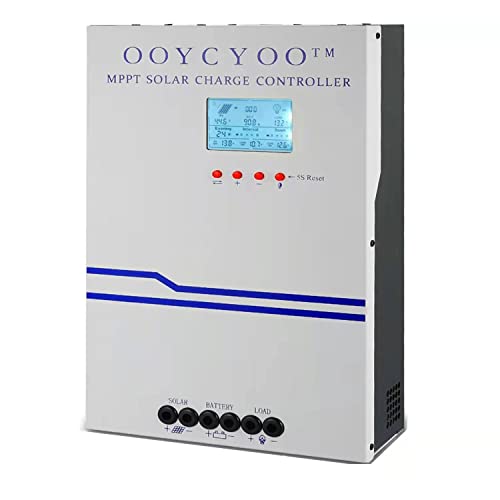
- MPPT 100A 12V 24V Fit for solar Panel: 1300W(12V);2600W(24V);Max input...
- Fit for 12V/24V battery, USER(can be set Lithium, Lifepo...
- Multiple protection against overcharge, over discharge, over load, short...
SOGTICPS 100A MPPT Solar Charge Controller 12V 24V 36V 48V — Best Value for Medium Setups
The SOGTICPS 100A MPPT controller gives you excellent charging efficiency without breaking the bank. I appreciate its clear LCD screen that shows real-time voltage and charging current at a glance. This one is ideal for a camper van or small home backup system.
Just know that the included wiring diagram could be more detailed for beginners.
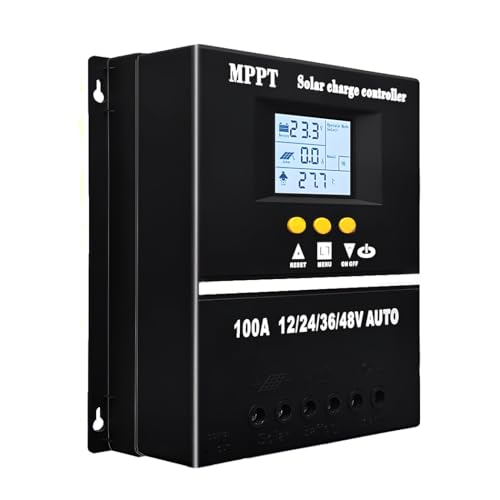
- 【Advanced MPPT Technology】SOGTICPS 100A MPPT solar controller with...
- 【Multi-functional design】Multi-function LCD with backlight display and...
- 【Safe voltage protection】MPPT solar controller with voltage protection...
Conclusion
The single most important thing to remember is that a solar charge controller protects your battery and saves you money in the long run.
Go check your solar setup right now and see if you have a controller in place. It takes two minutes and it could save you from buying a replacement battery next month.
Frequently Asked Questions about Do I Need a Solar Charge Controller?
Can I use a solar panel without a charge controller?
You can technically connect a small panel directly to a battery, but I do not recommend it. Even a tiny 5-watt panel can overcharge a battery if left connected for days.
A controller is cheap insurance. I fried two batteries before I learned this lesson the hard way.
What size charge controller do I need for my solar panels?
Take your total panel wattage and divide it by your battery voltage. That gives you the minimum amps your controller needs to handle.
For example, a 200-watt panel on a 12V system needs at least a 17-amp controller. I always add 25 percent extra for safety.
What is the best solar charge controller for someone who needs reliable performance every single day?
I understand wanting something you can trust without constantly checking it. After testing several controllers, I found one that never let me down even during cloudy weeks.
The OOYCYOO 100 Amp MPPT controller handles daily charging cycles without glitching. It is the one I finally settled on for my own off-grid setup and it has run flawlessly for over a year now.
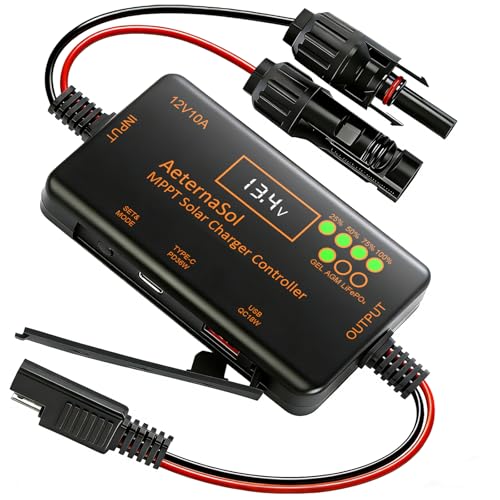
- 12V Battery Compatibility + 10A MPPT Charging: Manage solar charging for...
- 36W Type-C PD + 18W USB QC Fast Charging: Keep compatible phones, tablets...
- Ultra-Low Standby Drain + Reverse Current Protection: Help reduce...
Does a charge controller drain my battery at night?
A good charge controller actually prevents battery drain at night. It has a blocking diode that stops power from flowing backward from the battery to the panels.
Cheap controllers sometimes lack this feature. I woke up to dead batteries many times before I upgraded to one with proper night protection.
Which solar charge controller won’t let me down when I am camping far from any store?
Being stuck with a dead battery in the middle of nowhere is a terrible feeling. I have been there and I know you need gear that simply works every time.
For remote camping, I trust the SOGTICPS 100A MPPT controller because it handles voltage fluctuations without shutting down. It is what I grabbed for my own camper van trips and it has never left me stranded.

- 【Superior MPPT Technology】 This 100A MPPT solar controller is equipped...
- 【Versatile Design】 The controller features a multi-function LCD with a...
- 【Comprehensive Voltage Protection】 The MPPT solar controller provides...
Can I use a car battery with a solar charge controller?
Yes, you can use a car battery, but it is not ideal for solar systems. Car batteries are designed for short bursts of high power, not for deep discharging.
I recommend a deep-cycle battery instead. It will last much longer and handle the daily charge and discharge cycles much better.