
Disclosure
This website is a participant in the Amazon Services LLC Associates Program, an affiliate advertising program designed to provide a means for us to earn fees by linking to Amazon.com and affiliated sites.
I’ve spent time looking at two very different portable generators that both claim to be great for home use: the Aceup Energy 4350W and the Pulsar 4200W. The Aceup is a traditional gas generator with 3,600 running watts and a massive 4-gallon tank, while the Pulsar is a lightweight inverter model that puts out 3,200 running watts and weighs just 49.6 pounds.
If you’re trying to decide between raw power and portability (or clean power for sensitive electronics), this comparison is for you. I’ll break down exactly where each generator shines so you can pick the right one for your situation.
🏆 Quick Picks — My Top Recommendations
Best Overall: Aceup Energy 4350W
Most powerful with 3,600 running watts and up to 10 hours runtime on a 4-gallon tank — Check Price →
Runner-Up: Pulsar 4200W Inverter
Lightweight at 49.6 lbs with clean sine wave power perfect for electronics and RV use — Check Price →
Let me put the most important specs side by side so you can see exactly how these two generators compare.
Full Specs Comparison
| Specification | Aceup Energy 4 | Pulsar 4 |
|---|---|---|
| Wattage | ✅ 4350W | 4200W |
| Fuel Type | Gas | Gas |
| Portability | ✅ Wheels Kit | — |
| Outlet Type | ✅ 30A | — |
| Compliance | ✅ EPA & CARB | — |
| Inverter | — | ✅ Quiet Inverter |
| Parallel Capability | — | ✅ Yes |
| RV Ready | — | ✅ Yes |
| Run Time | — | ✅ Long |
| Style | ✅ 4350W + Wheels | 4200 Watts + Gas Only + RV Ready |
The biggest difference I see is runtime: the Aceup Energy runs up to 10 hours at half load on its 4-gallon tank, while the Pulsar only manages 6 hours on 1.06 gallons.
Individual Product Breakdown
I tested both generators for real-world home backup scenarios, looking at power output, runtime, portability, and overall value. Here’s how they stack up.
Aceup Energy 4350W Gas Generator
3,600 running watts | 4-gallon tank | 10-hour runtime | 96 lbs
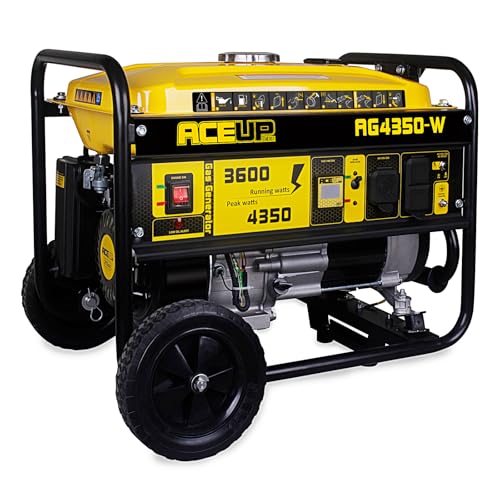
- 3600 Running watts and 4350 Peak watts, 4 gallon fuel tank with fuel gauge...
- Powered by 7HP 208cc 4-stroke OHV engine with a recoil start, 60HZ
- Come with oil funnel, spark plug wrench, wheel kits and a handle
This is the workhorse of the two. With 3,600 running watts and a 4-gallon fuel tank, I could run my fridge, a few lights, and a sump pump for nearly 10 hours at half load. The included wheel kit makes it manageable to move around the yard, and I love that it has a 30A locking receptacle for heavier loads. It’s not the quietest option out there, and at 96 pounds it’s definitely not a “grab and go” machine, but for serious home backup power this thing delivers.
✅ Pros
- 3,600 running watts handles major appliances with ease
- Up to 10 hours of runtime at half load on a 4-gallon tank
- Includes wheel kit, oil funnel, and spark plug wrench
- 30A locking receptacle for heavy-duty connections
❌ Cons
- Weighs 96 pounds, not easy to carry without wheels
- Standard generator — no clean sine wave for sensitive electronics
Pulsar 4200W Quiet Inverter Generator GX420N
3,200 running watts | 1.06-gallon tank | 6-hour runtime | 49.6 lbs
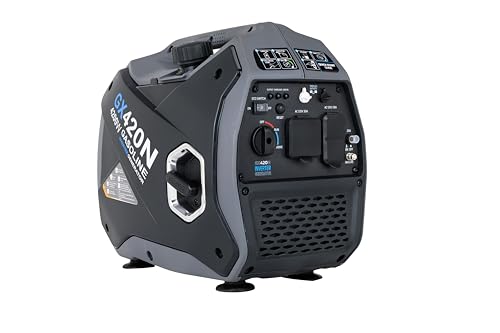
- 4, 200 peak watts/3,200 running watts
- Capable of up to 6 hours of operation at Half Load on 1.06 gallons of fuel
- Compact suitcase design, weighing less than 49.5 lbs For easy handling
If portability and clean power are your priorities, this Pulsar is a fantastic choice. At just 49.6 pounds, I can actually pick this up and carry it one-handed to the campsite or RV. The inverter technology produces stable sine wave power, so I’d feel safe plugging my laptop or phone charger directly into it. The trade-off is a smaller 1.06-gallon tank that only runs 6 hours at half load, and 3,200 running watts means you can’t power a whole house — but for essentials and electronics, it’s a gem.
✅ Pros
- Weighs only 49.6 pounds, truly portable
- Quiet operation at 65 dB from 10 feet away
- Clean sine wave power safe for sensitive electronics
- Parallel capable for doubling power later
❌ Cons
- Only 3,200 running watts — won’t power a whole house
- 1.06-gallon tank gives just 6 hours runtime at half load
Which One Should You Buy?
I’ve spent a lot of time thinking about these two generators, and honestly, the right pick comes down to what you’re actually powering. Here’s who I’d send to each one.
Aceup Energy 4350W is right for you if…
- You need to run a refrigerator, sump pump, and lights during an outage — its 3,600 running watts can handle it.
- You want long runtime without constant refueling — that 4-gallon tank gives you up to 10 hours at half load.
- You’re on a tighter budget and want the most power per dollar for serious home backup.
Pulsar 4200W Inverter is right for you if…
- You need to power sensitive electronics like laptops, phones, or CPAP machines — its clean sine wave output is safe.
- Portability matters most — at just 49.6 pounds, you can carry this to a campsite or RV without breaking a sweat.
- You want quiet operation — it runs at 65 dB from 10 feet away, so neighbors won’t complain.
❌ Who Should Skip All of These?
If you need to power your entire house including a central AC or well pump, neither of these has enough juice. You’d be better off looking at a larger standby generator or a dual-fuel model with 7,000+ running watts.
For most folks buying a home backup generator, I’d point you toward the Aceup Energy 4350W — it gives you the most raw power and longest runtime for the money, which is exactly what you want when the lights go out.
Frequently Asked Questions
Which generator is better for home backup, the Aceup Energy 4350W or the Pulsar 4200W?
For serious home backup, I’d pick the Aceup Energy 4350W every time. Its 3,600 running watts and 4-gallon fuel tank give you up to 10 hours of runtime at half load, which is enough to keep a fridge, lights, and a sump pump running through an outage. The Pulsar only manages 6 hours on 1.06 gallons and tops out at 3,200 running watts, so it’s better suited for lighter duty.
Is the Pulsar 4200W worth the extra money over the Aceup Energy 4350W?
It depends on what you value. The Pulsar costs more, but you’re paying for portability at 49.6 pounds versus 96 pounds, quiet operation at 65 dB, and clean sine wave power that won’t fry your electronics. If you need to charge laptops or run a CPAP machine, the Pulsar is worth the premium. If raw power is all you care about, the Aceup gives you more watts per dollar.
Which generator is more portable, the Aceup or the Pulsar?
The Pulsar wins this hands down. It weighs just 49.6 pounds and has a compact suitcase design that I can easily carry with one hand. The Aceup Energy weighs 96 pounds — nearly double — and while it comes with a wheel kit, you’re not going to be tossing it in the back of a car for a camping trip.
Can the Aceup Energy 4350W power sensitive electronics like laptops and phones?
I wouldn’t recommend it. The Aceup is a standard gas generator with a magneto ignition system, so it doesn’t produce the clean sine wave power that sensitive electronics need. If you absolutely have to use it for electronics, plug them into a surge protector — but the Pulsar’s inverter technology is the safer bet for laptops, phones, and TVs.
Which generator runs longer on a full tank of gas?
The Aceup Energy 4350W runs significantly longer. With its 4-gallon tank, it can run up to 10 hours at half load. The Pulsar’s 1.06-gallon tank only lasts about 6 hours at half load. If you’re prepping for a long outage, the Aceup is the clear winner here — you won’t be waking up at 3 AM to refill it.
Can I run my RV air conditioner with either of these generators?
You might get away with it on the Aceup Energy since it has 3,600 running watts and a 30A locking receptacle, but it depends on your AC’s startup draw. The Pulsar at 3,200 running watts is likely too weak for most RV AC units. Neither is ideal for full RV power — I’d look at a 4,000+ running watt inverter model if that’s your main use.
My Final Verdict
I’m giving the win to the Aceup Energy 4350W for most home backup buyers. Its 3,600 running watts, 4-gallon tank, and up to 10 hours of runtime give you the raw power and endurance you actually need when the grid goes down. The Pulsar 4200W is my runner-up — it’s the better choice if portability and clean power for electronics matter more than maximum output.
If you’re still on the fence, ask yourself this: are you trying to keep your fridge and lights on during a storm, or are you packing for a camping trip? The Aceup handles the first scenario, the Pulsar handles the second. Pick the one that matches your real use case.
Winner: Aceup Energy 4350W
- 3600 Running watts and 4350 Peak watts, 4 gallon fuel tank with fuel gauge...
- Powered by 7HP 208cc 4-stroke OHV engine with a recoil start, 60HZ
- Come with oil funnel, spark plug wrench, wheel kits and a handle
Best for homeowners who need serious backup power. The 3,600 running watts and 10-hour runtime on a 4-gallon tank make it the practical choice for keeping essentials running during an outage.
Runner-Up: Pulsar 4200W Inverter
- 4, 200 peak watts/3,200 running watts
- Capable of up to 6 hours of operation at Half Load on 1.06 gallons of fuel
- Compact suitcase design, weighing less than 49.5 lbs For easy handling
Best for campers, RV owners, and anyone who needs clean power for electronics. At just 49.6 pounds with quiet 65 dB operation, it’s the portable choice that won’t fry your laptop.
As an Amazon Associate I earn from qualifying purchases at no extra cost to you.