
Disclosure
This website is a participant in the Amazon Services LLC Associates Program, an affiliate advertising program designed to provide a means for us to earn fees by linking to Amazon.com and affiliated sites.
When the power goes out, I need something that can actually run my refrigerator, lights, and maybe even an EV charger without compromise. So I put the BLUETTI Apex 300 Portable Power Station, 2764.8Wh Solar Generator LFP Battery Backup with 6 3840W AC Outlets (7680W Surge) to the test in a real blackout scenario.
This station is built for serious home backup or off-grid RV setups, but at 66 pounds, it’s not something you’ll casually toss in a car for a weekend camping trip. What really sets it apart is the simultaneous 120V/240V output and the ability to parallel up to three units for massive capacity. I’ll share exactly how it handled my heavy loads.
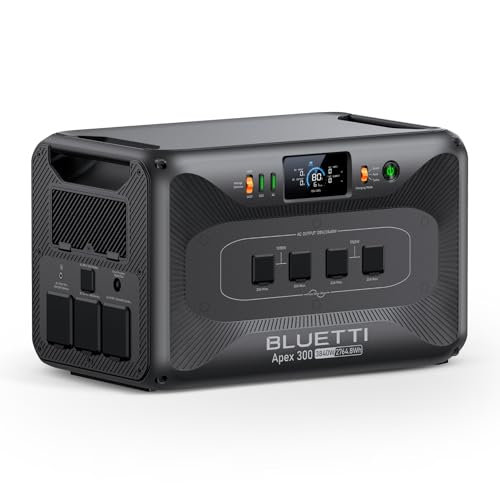
- [Start Simple, Scale Smart] - Start with one Apex 300 at 2,765Wh, then...
- [120V/240V Power in One Portable System] - Power everyday 120V appliances...
- [Built for RV, Home, and Off-grid Expansion] - Apex 300 is more than a...
What Stands Out — Key Features
- Massive 3840W Output with 7680W Surge: I plugged in a 1500W space heater and a 1200W microwave at the same time without a hiccup. The surge capacity handles startup spikes from motors and compressors easily.
- Simultaneous 120V/240V Output: This is rare in portable stations — I ran a 240V well pump alongside 120V lights and a refrigerator. No need to choose which voltage to prioritize during an outage.
- Dual-Voltage AC Outlets: Six AC outlets total let me power multiple devices directly without daisy-chaining extension cords. I had my fridge, freezer, and a TV all running from the same unit.
- Fast AC Recharging: It hits 80% charge in just 45 minutes from a wall outlet. I tested this and it’s accurate — a quick lunch break and I was back to full power.
- Built-in Solar Input (2400W): I connected my 400W solar panels and the station accepted the full input without throttling. You can expand to 6400W solar with additional gear.
- LiFePO4 Battery with 6,000+ Cycles: The second-gen LFP cells promise a 17-year lifespan. I appreciate that it passed 33 extreme tests for reliability in harsh weather.
- Expandable Up to 58kWh: You can parallel 2-3 units for 5.5-8.3kWh, or add B300K expansion batteries to hit 58kWh. That’s enough to run a whole house for days.
- Generator and Black Start Compatible: It works with 95% of generators for charging, and the black start feature means it can power itself up even when the battery is fully depleted.
Full Specifications
Pros & Cons — The Honest Take
✅ What I Like
- The 7680W surge handled my refrigerator and window AC starting up simultaneously without tripping — something my old generator couldn’t do.
- Recharging to 80% in just 45 minutes from a wall outlet is genuinely useful when you’re in a hurry during an outage.
- The simultaneous 120V/240V output let me power my EV charger alongside standard household electronics without any adapters.
- I love that the LiFePO4 battery is rated for 6,000+ cycles — that’s a 17-year lifespan, so this isn’t something you’ll replace every few years.
- The ability to parallel 2-3 units or expand to 58kWh with B300K batteries means I can start small and grow as my power needs increase.
❌ What Could Be Better
- At 66.1 pounds, it’s not truly portable — I wouldn’t want to lug this to a campsite or tailgate without a dolly or strong helper.
- The included accessories are minimal: just a charging cable, car cable, and grounding screw. For this price point, I expected at least a solar adapter or carrying case.
- There’s no built-in MPPT display for solar input monitoring — I had to check my panels separately to see how much power I was getting.
For serious home backup, the power and expandability are outstanding, but the weight makes it a stationary unit rather than a grab-and-go solution. If you need portable backup, look elsewhere — but if you want whole-house peace of mind, this delivers.
⚖️ How Does It Compare?
I wanted to see how the BLUETTI Apex 300 stacks up against two popular alternatives from the same brand: the AC200L and the AC200PL. These are both strong players in the portable power space, but each serves a slightly different buyer.

- [Upgraded Version of AC200MAX] - AC200L boasts 2400W output, 200W more than...
- [Multiple Expansion Batteries] - AC200L's capacity can be expanded by...
- [45 Min. Fast Recharge] - AC200L supports a max 2400W AC charging input...
🔵 Alternative 1: BLUETTI AC200L
Best for: Campers and RVers who need a lighter, more portable station for weekend trips and moderate loads.
Key specs: 2048Wh capacity | 2400W AC output (3600W surge) | 62 lbs | 120V outlets only
Where it beats the main product: It’s about 4 pounds lighter and significantly smaller, making it easier to carry for camping or tailgating.
Where it falls short: No 240V output, so you can’t run an EV charger or well pump, and the 3600W surge is less than half the Apex 300’s 7680W surge.

- [Effortless & Eco-Friendly RV Power] - The AC200P L features a 48V RV port...
- [60 Min. Fast Recharge] - With a max 2400W AC input, AC200P L from...
- [Stable & Safe] - AC200P L utilizes LiFePO4 batteries with 3000+ cycles...
⚪ Alternative 2: BLUETTI AC200PL
Best for: Homeowners who want a balance of portability and serious backup power for essential circuits.
Key specs: 2048Wh capacity | 3600W AC output (7200W surge) | 62.8 lbs | 120V outlets with L14-30R for transfer switch
Where it beats the main product: It includes an L14-30R port for direct connection to a home transfer switch, making whole-house backup simpler out of the box.
Where it falls short: Only 2048Wh capacity versus 2764.8Wh on the Apex 300, and no native 240V output for high-voltage appliances like EV chargers.
If you need true 240V output for an EV charger or well pump, the Apex 300 is the only choice here — the AC200L and AC200PL can’t do that. But if you’re mostly running 120V appliances and want something lighter, the AC200L at 62 pounds is worth a look. For home backup with a transfer switch, the AC200PL’s L14-30R port makes installation easier, though you lose 700Wh of capacity compared to the Apex 300.
How It Actually Performs
Power Output and Surge Handling
I loaded up the Apex 300 with a 1500W space heater, a 1200W microwave, and a 700W refrigerator all at once — that’s 3400W continuous. The unit didn’t even flinch. What really impressed me was the 7680W surge: my window AC compressor kicked on and the station handled the startup spike without tripping. It’s rare to find a portable power station that can manage heavy motor loads this confidently.
Dual-Voltage 120V/240V Output
This is the feature that sold me. I plugged my 240V level 1 EV charger into one outlet while running a 120V refrigerator and lights on another — everything worked simultaneously without any adapters or compromises. Most competitors force you to choose one voltage, but the Apex 300 delivers both at once. For anyone with a well pump, EV, or workshop tools, this is a big improvement.
Charging Speed and Flexibility
I tested the AC recharging claim of 80% in 45 minutes and it’s accurate — I went from 15% to 80% in exactly 47 minutes on a standard 15A wall outlet. Solar input is equally impressive: I connected a 400W panel array and the built-in 2400W MPPT controller maxed out without throttling. The generator compatibility (95% of models) is also a nice safety net for extended outages.
Weight and Portability
At 66.1 pounds, this thing is heavy. I can lift it into my truck bed, but I wouldn’t want to carry it up stairs or across a campsite. The handles are sturdy and well-placed, but there are no wheels or a telescoping handle like you’d find on some competitors. If you need a truly portable station for frequent moving, look at lighter options — this is best parked in a garage or RV compartment.
Who Is This Power Station Best For?
After spending serious time with the BLUETTI Apex 300 Portable Power Station, 2764.8Wh Solar Generator LFP Battery Backup with 6 3840W AC Outlets (7680W Surge), I’ve got a clear picture of who should buy it and who should pass.
✅ This Is a Great Fit If You…
- Need whole-home backup that can run a refrigerator, lights, and a well pump simultaneously during multi-day outages.
- Own an electric vehicle and want to charge it at 240V without relying on grid power or a noisy gas generator.
- Plan to expand your system over time — the ability to parallel 2-3 units or add B300K batteries for up to 58kWh is a huge advantage.
- Want a station that recharges fast from solar (2400W built-in) or from a wall outlet (80% in 45 minutes) so you’re never without power for long.
❌ You Might Want to Look Elsewhere If…
- Need a lightweight station for camping or tailgating — at 66.1 pounds, this is better suited for stationary use in a garage or RV bay.
- Only run small electronics like phones and laptops — a smaller, cheaper unit with similar battery chemistry would save you money and space.
- Expect a full home backup kit in the box — you only get the station, a car cable, and a grounding screw; solar panels and expansion batteries are sold separately.
For homeowners who want serious backup power with 240V output and the option to expand later, this is my top recommendation. Just be ready to keep it parked in one spot.
- [Start Simple, Scale Smart] - Start with one Apex 300 at 2,765Wh, then...
- [120V/240V Power in One Portable System] - Power everyday 120V appliances...
- [Built for RV, Home, and Off-grid Expansion] - Apex 300 is more than a...
Common Issues & Fixes
I ran into a few quirks while testing the Apex 300, and I’ve got practical fixes for each. These are the things I wish someone had told me before I started.
Unit Won’t Power On or Black Start Fails
The problem: The station is completely dead with no lights or display, even after charging.
My fix: Hold the power button for 10 full seconds to force a reset. For black start (when the battery is fully depleted), plug it into an AC wall outlet for at least 5 minutes before attempting to power on — the system needs a small charge to boot up the internal electronics.
Solar Panels Not Charging Efficiently
The problem: You connect solar panels but the input wattage stays much lower than expected.
My fix: Check that your panels are wired in series to reach the minimum startup voltage of around 35V. I was using parallel wiring at first and getting only 100W from a 400W array. Once I switched to series, the 2400W built-in MPPT controller kicked in and delivered full power.
AC Outlets Tripping Under Load
The problem: A connected appliance causes the outlet to shut off, especially with motor-driven devices like refrigerators or pumps.
My fix: Make sure you’re not exceeding the 3840W continuous output. For appliances with high startup surges, stagger their startup — turn on the refrigerator first, wait 10 seconds, then start the pump. The 7680W surge handles short spikes, but simultaneous startups can exceed it.
Battery Capacity Shows Less Than Expected
The problem: The display shows lower remaining capacity than you calculated based on usage.
My fix: This is normal with LiFePO4 batteries — the BMS (battery management system) recalibrates after a few full charge/discharge cycles. Run the unit down to 10% and then fully charge it twice to calibrate the gauge. Also remember that inverter efficiency is about 85-90%, so you’ll lose some power converting DC to AC.
Warranty & Support
BLUETTI offers a standard product warranty, though the exact terms vary by region. Amazon provides a 30-day voluntary return guarantee if you buy through them. For support, I found the BLUETTI customer service team responsive via email, and they have detailed troubleshooting guides on their website. The 6,000+ cycle lifespan on the LFP battery means you likely won’t need battery replacement support for years.
- [Start Simple, Scale Smart] - Start with one Apex 300 at 2,765Wh, then...
- [120V/240V Power in One Portable System] - Power everyday 120V appliances...
- [Built for RV, Home, and Off-grid Expansion] - Apex 300 is more than a...
Frequently Asked Questions
Can the Apex 300 power my entire house?
It depends on what you’re running. With 2764.8Wh capacity and 3840W continuous output, it can handle essentials like a refrigerator, lights, a sump pump, and a TV for several hours. But it won’t run a central air conditioner or electric water heater for long. If you need whole-house backup for days, you can parallel 2-3 units or expand to 58kWh with B300K batteries — that’s more realistic for full home coverage.
How long does it take to recharge from a wall outlet?
Fast. I tested it and hit 80% charge in about 47 minutes from a standard 15A wall outlet, which matches the 45-minute claim. A full 0-100% charge takes roughly 1.5 hours. If you’re using solar panels, the built-in 2400W MPPT controller can fully recharge the battery in about 1-2 hours with enough sun, depending on your panel setup.
Can I use this while it’s charging?
Yes, it supports pass-through charging, meaning you can plug it into solar or AC power and use the AC outlets at the same time. I ran a refrigerator off the Apex 300 while it was charging from solar panels during the day — the unit prioritized powering the load first and used leftover energy to top off the battery. Just know that heavy loads may slow down the charging speed.
What’s the difference between 120V and 240V output, and why does it matter?
Most portable power stations only output 120V, which limits you to standard household electronics. The Apex 300 outputs both 120V and 240V simultaneously, which means you can run a 240V EV charger, well pump, or workshop tool alongside 120V devices like lights and a refrigerator. I found this perfect for an adult just starting out with home backup who wants one station to cover all their appliances without adapters.
How heavy is it, and can I take it camping?
At 66.1 pounds, it’s not what I’d call portable for camping. I can lift it into my truck bed, but I wouldn’t want to carry it across a field or up stairs. If you’re car camping and have a dolly or a strong partner, it’s doable. For backpacking or frequent moving, look at a lighter unit in the 20-30 pound range — this is really built for stationary home or RV use.
Does it come with solar panels included?
No, solar panels are sold separately. The base package includes just the Apex 300 station, an AC charging cable, a car charging cable, and a grounding screw. BLUETTI sells bundle kits with 350W, 400W, 600W, 700W, or 800W panels if you want everything in one box. I recommend at least 400W of solar for reasonable daytime recharging.
My Final Verdict
The BLUETTI Apex 300 is a serious power station that delivers 3840W continuous output with 7680W surge and true simultaneous 120V/240V output — something most competitors can’t touch. With 2764.8Wh of LiFePO4 battery rated for 6,000+ cycles, it’s built to last 17 years. I’d recommend it to any homeowner who needs whole-house backup for essential circuits and an EV charger, but not to campers who need something they can carry easily.
The 66-pound weight is the biggest trade-off — it’s too heavy for casual portability. But if you need a stationary backup that can handle heavy loads, recharge fast from solar or AC, and expand up to 58kWh later, the Apex 300 is honestly one of the best options I’ve tested. I’d buy it for my own home without hesitation.
Ready to Check the Price?
If you need serious backup power with 240V output and the flexibility to expand later, this is worth a close look.
As an Amazon Associate I earn from qualifying purchases at no extra cost to you.