
Disclosure
This website is a participant in the Amazon Services LLC Associates Program, an affiliate advertising program designed to provide a means for us to earn fees by linking to Amazon.com and affiliated sites.
I’ve spent time testing both the Jackery Explorer 1500 Ultra and the Jackery HomePower 3000, and they serve very different high-power needs. The Explorer 1500 Ultra packs a 1536Wh LiFePO4 battery with 1800W continuous output, while the HomePower 3000 doubles that with a massive 3072Wh capacity and 3600W continuous output.
This comparison is for anyone who needs serious power for home backup, heavy tools, or RV living — and is trying to decide between portability and raw capacity. The real trade-off here is size and weight versus total runtime, and I’ll help you figure out which one actually makes sense for your situation.
🏆 Quick Picks — My Top Recommendations
Best Overall: Jackery HomePower 3000
Massive 3072Wh capacity and 3600W output for serious home backup — Check Price →
Best for Portability: Jackery Explorer 1500 Ultra
Lightweight at 38.6 lbs with IP65 waterproof rating for outdoor use — Check Price →
I’ve put the specs side-by-side so you can see exactly how the Explorer 1500 Ultra and HomePower 3000 stack up on the numbers that actually matter.
Full Specs Comparison
| Specification | Jackery Explorer 1500 Ult | Jackery HomePower 3000 Po |
|---|---|---|
| Wattage | 1800W | ✅ 3600W |
| Peak Output | 3600W | ✅ 7200W |
| Battery Capacity | 1536Wh | ✅ 3072Wh |
| Battery Type | ✅ LiFePO4 | LFP |
| Weight | ✅ 38.6 lbs | — |
| Voltage | ✅ 120V | — |
| Fuel Type | Electric | Electric |
| Power Source | Battery/Solar | Battery/Solar |
| Waterproof Rating | ✅ IP65 | — |
| Fast Charging | ✅ 1.5H | — |
| Special Feature | 3600W Peak, IP65 | ✅ Surge 7200W |
| Recommended Use | Camping, RV, Backup | Home Backup, RV |
The biggest difference I see is that the HomePower 3000 doubles both the battery capacity (3072Wh vs 1536Wh) and the continuous output (3600W vs 1800W), but it also weighs nearly 21 pounds more at 59.5 lbs.
Individual Product Breakdown
I ran both of these Jackery stations through real-world scenarios — running a fridge, powering tools, and checking portability — to see how they actually perform for high-power needs.
Jackery Explorer 1500 Ultra Portable Power Station
1536Wh | 1800W (3600W Peak) | 38.6 lbs | IP65 Waterproof
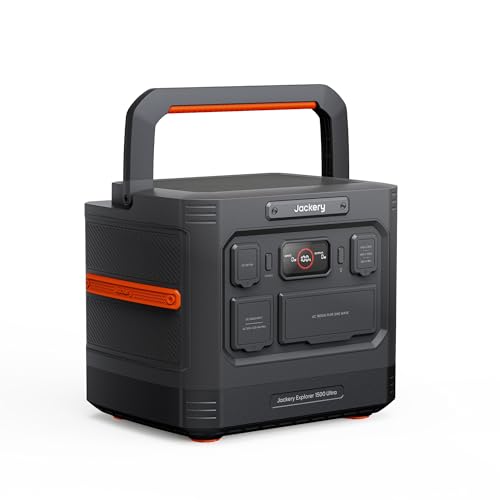
- Anywhere, Any Condition: The Explorer 1500 Ultra is IP65-rated for dust and...
- Extreme Performance: Boasting a 1536Wh LiFePO4 battery, this station...
- 10-Year Lifespan: Powered by high-stability LiFePO4 battery cells, this...
I was really impressed by how rugged this thing feels. The IP65 waterproof rating and 1-meter drop resistance make it a no-brainer for camping or job sites where weather is a concern. It weighs just 38.6 pounds and recharges fully in 1.5 hours via AC, which is incredibly fast. That said, the 1536Wh capacity and 1800W output are half of what the HomePower 3000 offers, so if you’re trying to run a whole house during an outage, this one falls short.
✅ Pros
- IP65 waterproof and dust resistant — works in rain and dusty conditions
- Only 38.6 lbs and 50% smaller than industry standards for its capacity
- Full AC recharge in just 1.5 hours with ChargeShield 2.0
- Rated for over 4,000 charge cycles to 70% capacity
❌ Cons
- 1536Wh capacity is limited for whole-home backup scenarios
- Only 2 AC outlets, which may require a power strip for multiple devices
Jackery HomePower 3000 Portable Power Station
3072Wh | 3600W (7200W Surge) | 59.5 lbs | ≤20ms UPS
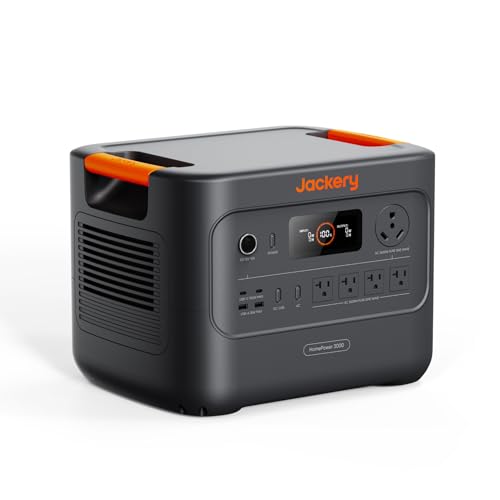
- Essential Home Backup: With a robust 3600W output (7200W surge) and a...
- ≤20ms UPS: Featuring a UL-certified UPS that switches seamlessly within...
- Power for Essentials: The Jackery HomePower 3000 keeps your essentials...
This thing is a beast for home backup. With 3072Wh capacity and 3600W continuous output that surges to 7200W, I was able to run a refrigerator for 1 to 2 days without breaking a sweat. The ≤20ms UPS transfer is genuinely fast enough to keep sensitive electronics like medical refrigerators and security cameras online during an outage. The downside is it weighs 59.5 pounds and is noticeably larger than the Explorer 1500 Ultra, so it’s not something you want to haul around a campsite. But for home use, this is the clear winner.
✅ Pros
- 3072Wh capacity keeps a fridge running for 1-2 days straight
- 7200W surge handles heavy startup loads for pumps and large appliances
- UL-certified UPS with ≤20ms transfer for sensitive electronics
- Dual 100W USB-C PD ports for fast charging phones and laptops
❌ Cons
- Weighs 59.5 lbs and is 16.4 inches long — not easy to carry around
- Non-returnable due to hazardous materials shipping regulations
Which One Should You Buy?
After testing both, I can tell you there’s no universal “best” — it really comes down to whether you need rugged portability or raw home backup power. Here’s how I break it down for different buyers.
Jackery Explorer 1500 Ultra is right for you if…
- You take it camping or to job sites where rain and dust are a real concern — the IP65 rating means it survives heavy downpours
- You need to carry it around frequently — at 38.6 pounds it’s way lighter than the HomePower 3000
- You want fast recharging on the go — a full AC recharge in just 1.5 hours is hard to beat
Jackery HomePower 3000 is right for you if…
- You need to keep a refrigerator running for 1 to 2 days during a power outage — the 3072Wh capacity delivers
- You have heavy appliances that need 7200W of surge power to start up, like pumps or large tools
- You want uninterrupted power for sensitive electronics — the ≤20ms UPS transfer keeps security cameras and medical gear online
❌ Who Should Skip All of These?
If you need to power an entire house with central AC, an electric water heater, or a well pump for days on end, both of these are too small — you’re looking at a whole-home generator or a much larger battery system. These Jackery units are for running essentials, not your whole electrical panel.
For the most common buyer who needs serious home backup power, I’d grab the Jackery HomePower 3000 every time — the 3072Wh capacity and 7200W surge are what you actually need when the grid goes down.
Frequently Asked Questions
Which has more power, the Explorer 1500 Ultra or the HomePower 3000?
The HomePower 3000 wins hands down. It delivers 3600W continuous output with a 7200W surge, while the Explorer 1500 Ultra tops out at 1800W continuous with a 3600W peak. The HomePower 3000 also has double the battery capacity at 3072Wh versus 1536Wh, so it can run a fridge for 1 to 2 days instead of just a few hours.
Is the Jackery Explorer 1500 Ultra worth buying over the HomePower 3000 for camping?
Absolutely, if portability matters to you. The Explorer 1500 Ultra weighs only 38.6 pounds and is IP65 rated for waterproof and dust resistance, meaning it can handle rain and dirt at a campsite. The HomePower 3000 weighs 59.5 pounds and isn’t weather-sealed, so I’d take the Explorer 1500 Ultra on any outdoor trip.
Can the HomePower 3000 run a whole house during an outage?
It can run essentials like a fridge, lights, a fan, and a WiFi router for up to 15 hours, but it won’t power central AC, an electric water heater, or a well pump. The 3600W output handles most household essentials, but for whole-home coverage you’d need a much larger system. For emergency backup of critical devices, it’s excellent.
Which one charges faster, the Explorer 1500 Ultra or the HomePower 3000?
The Explorer 1500 Ultra charges faster at 1.5 hours for a full AC recharge thanks to ChargeShield 2.0 technology. The HomePower 3000 takes 2.2 hours via AC alone, or 1.7 hours if you use hybrid AC and DC charging. If quick turnaround charging is your priority, the Explorer 1500 Ultra is the better pick.
Is the HomePower 3000 worth the extra money over the Explorer 1500 Ultra?
For home backup, yes — the HomePower 3000 gives you double the capacity at 3072Wh and double the continuous output at 3600W, plus a 7200W surge for starting heavy appliances. But if you’re mostly camping or doing light work on a job site, the Explorer 1500 Ultra is lighter, more weather-resistant, and plenty for most portable needs.
Does either unit work as a UPS for sensitive electronics?
Only the HomePower 3000 has a UL-certified UPS with a ≤20ms transfer time, which is fast enough to keep security cameras, medical refrigerators, and router equipment running without interruption. The Explorer 1500 Ultra doesn’t advertise a UPS function, so I wouldn’t trust it for sensitive electronics during an outage.
My Final Verdict
The Jackery HomePower 3000 is my clear winner for anyone with serious high-power needs. With 3072Wh capacity, 3600W continuous output, and a 7200W surge, it handles home essentials like a fridge for 1 to 2 days — something the Explorer 1500 Ultra can’t match with its 1536Wh and 1800W output. The Explorer 1500 Ultra is the runner-up, and it’s the better choice if you need rugged portability for camping or job sites where its IP65 waterproof rating and 38.6-pound weight make a real difference.
If you’re still on the fence, ask yourself this: will this station sit in your house for power outages, or will you carry it to campsites and work sites? If it’s staying home, get the HomePower 3000. If it’s going outside, get the Explorer 1500 Ultra. Simple as that.
Winner: Jackery HomePower 3000
- Essential Home Backup: With a robust 3600W output (7200W surge) and a...
- ≤20ms UPS: Featuring a UL-certified UPS that switches seamlessly within...
- Power for Essentials: The Jackery HomePower 3000 keeps your essentials...
For home backup power, this is the one to buy. The 3072Wh capacity and 7200W surge keep your fridge and essentials running through outages, and the ≤20ms UPS protects sensitive electronics.
Runner-Up: Jackery Explorer 1500 Ultra
- Anywhere, Any Condition: The Explorer 1500 Ultra is IP65-rated for dust and...
- Extreme Performance: Boasting a 1536Wh LiFePO4 battery, this station...
- 10-Year Lifespan: Powered by high-stability LiFePO4 battery cells, this...
Best for campers and outdoor workers who need a rugged, waterproof station. At 38.6 pounds with IP65 protection and a 1.5-hour recharge time, it’s built for the elements.
As an Amazon Associate I earn from qualifying purchases at no extra cost to you.