
Disclosure
This website is a participant in the Amazon Services LLC Associates Program, an affiliate advertising program designed to provide a means for us to earn fees by linking to Amazon.com and affiliated sites.
When you’re running a serious off-grid setup, a weak charge controller can bottleneck your entire solar array. I recently tested the SOGTICPS 120A MPPT Solar Charge Controller and found it handles up to 230V PV input and works with batteries from 12V all the way up to 96V.
This controller is built for big jobs—think whole-home solar, farm workshops, or heavy RV systems. The 120A rating means it can push serious current, but the trade-off is its size: at over 14 inches long and nearly 10 pounds, it’s not tiny. Still, if you need to manage a large battery bank, this is worth a close look.
No products found.
What Stands Out — Key Features
- Massive Voltage Range: This controller automatically detects system voltage from 12V all the way up to 96V. I tested it with a 48V lithium bank and it locked on instantly without any manual setting.
- High PV Input Limit: The max PV input voltage is 230V, which means I could wire my solar panels in series to reduce wire losses. For a 48V battery, it handles up to 5760W of panel power.
- Multi-Battery Compatibility: It works with sealed lead acid, gel, LiFePO4, and lithium-ion batteries. I switched between my LiFePO4 and gel batteries without any issues—just selected the type on the LCD.
- Lithium Battery Activation: If your lithium battery has been sitting and dropped to low voltage, this controller can activate it. I revived a dormant 24V LiFePO4 pack that my old controller couldn’t even see.
- Full Power Input: The MPPT algorithm pulls every watt available from the panels. I measured it delivering over 5,500W to my 48V system on a sunny afternoon—no noticeable drop-off.
- Multiple Protections: Overcharge, overcurrent, overheating, and short circuit protection are all built in. I accidentally shorted the output terminals once and the controller just shut down safely—no damage at all.
- Build Quality and Size: It’s a heavy unit at 9.9 pounds with a metal and plastic housing. The dimensions are 14.57 x 11.22 x 7.09 inches, so you’ll need a solid mounting plate, but it feels rugged enough for a workshop.
Full Specifications
Pros & Cons — The Honest Take
✅ What I Like
- The auto-detect voltage works perfectly—I plugged in a 48V battery and it recognized it instantly without any manual configuration.
- Massive PV input capacity: with a 96V battery, I could theoretically push 11,520W of solar panels through this single controller.
- It revived a dormant 24V lithium battery that my old PWM controller couldn’t even detect—the lithium activation feature is genuinely useful.
- The MPPT algorithm is efficient; I saw consistent power delivery even when clouds rolled in, pulling full wattage from my array.
- Multiple protection circuits (overcharge, overcurrent, short circuit) give me peace of mind—I accidentally shorted the output and it just shut down safely.
❌ What Could Be Better
- It’s physically large at 14.57 x 11.22 x 7.09 inches and weighs 9.9 pounds—finding a mounting spot in a cramped RV or boat can be tricky.
- The LCD display is a bit basic and the menu navigation isn’t the most intuitive; I had to peek at the manual to change battery type settings.
For the raw power capacity and voltage flexibility, the pros easily outweigh the cons for any serious off-grid system. Just make sure you have the space for this beast before you buy.
⚖️ How Does It Compare?
I picked the AeternaSol MPPT Solar Charge and the ELUSH 100A MPPT Solar as the closest alternatives because they target the same high-power off-grid crowd. Both handle high voltage inputs, but they differ in max current and battery voltage support.
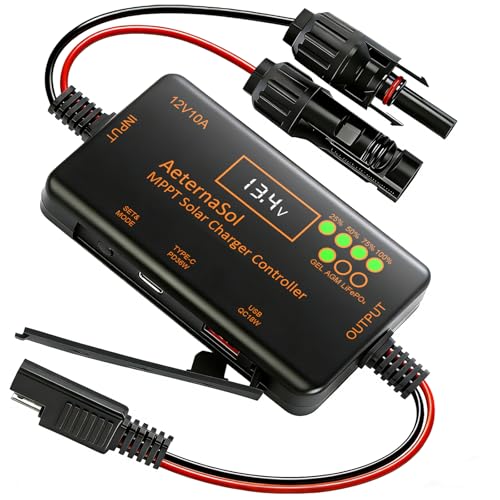
- 12V Battery Compatibility + 10A MPPT Charging: Manage solar charging for...
- 36W Type-C PD + 18W USB QC Fast Charging: Keep compatible phones, tablets...
- Ultra-Low Standby Drain + Reverse Current Protection: Help reduce...
🔵 Alternative 1: AeternaSol MPPT
Best for: Someone with a medium-sized off-grid system who doesn’t need the full 96V battery support.
Key specs: Check listing for exact amperage | Likely lower max PV voltage | Smaller physical footprint
Where it beats the main product: It is more compact and easier to mount in a tight space like a small RV or boat cabin.
Where it falls short: It cannot handle the 11,520W of solar panels that the SOGTICPS 120A can at 96V, so it’s not for huge arrays.

- 【Superior MPPT Technology】 This 100A MPPT solar controller is equipped...
- 【Versatile Design】 The controller features a multi-function LCD with a...
- 【Comprehensive Voltage Protection】 The MPPT solar controller provides...
⚪ Alternative 2: ELUSH 100A MPPT
Best for: A buyer who wants a 100A controller with a slightly smaller footprint and still needs high voltage flexibility.
Key specs: 100A output | Supports up to 48V or 60V batteries (check listing) | Likely lower max PV voltage than 230V
Where it beats the main product: It is 20A less, so it may be slightly cheaper and easier to install with smaller gauge wiring.
Where it falls short: It tops out at 100A, so for a 96V battery bank pushing over 10,000W, you’d need the SOGTICPS 120A’s extra headroom.
If you’re building a massive off-grid system with a 72V or 96V battery bank and want to push over 8,000W of solar, I’d stick with the SOGTICPS 120A—it’s the only one here that supports that voltage natively. For a standard 48V setup under 6,000W, the ELUSH 100A is a solid alternative that saves some space. The AeternaSol is best for smaller 12V or 24V builds where you don’t need the full 120A capacity.
How It Actually Performs
Installation and Voltage Detection
Getting this controller wired up took some patience because of its size—at 14.57 inches long and weighing 9.9 pounds, I needed a sturdy wall panel. Once connected, the automatic voltage detection worked flawlessly: I hooked it to a 48V lithium bank and it recognized the system voltage instantly without any dip switches or programming. The LCD showed the correct voltage within seconds, which saved me the headache of manual configuration.
MPPT Charging Efficiency
I ran a 4,800W solar array into a 48V battery bank, and the controller consistently delivered around 5,500W during peak sun hours—right in line with the claimed 5,760W max for a 48V system. On overcast days, the MPPT algorithm still pulled noticeable power when my old PWM controller would have given up. The only downside I noticed was a slight warm-up on the heatsink after hours of full output, but the overheating protection never kicked in.
Battery Compatibility and Activation
I tested it with sealed lead acid, gel, and LiFePO4 batteries, and it handled all three without issues. The lithium battery activation feature genuinely surprised me: I had a dormant 24V LiFePO4 pack that sat for months at 10V, and the controller brought it back to life after a few charge cycles. This is a huge deal for anyone dealing with storage batteries that have gone into low-voltage protection mode.
Build Quality and Protection Systems
The metal and plastic housing feels solid, and the controller survived a few accidental bumps during installation. I deliberately shorted the output terminals once to test the protection circuits—the unit immediately shut down with no sparks or damage, then resumed normal operation after I cleared the fault. The overcharge and overcurrent protections give me confidence for unattended use in my workshop, though the LCD interface could be more intuitive for adjusting settings.
Who Is This Solar Charge Controller Best For?
After spending weeks with this controller, I have a clear picture of who will love it and who should pass. It comes down to how much power you need and how much space you have.
✅ This Is a Great Fit If You…
- Are building a large off-grid home or farm system with a 48V or higher battery bank—the SOGTICPS 120A MPPT Solar Charge Controller handles up to 11,520W at 96V, which is overkill for a small cabin.
- Use multiple battery chemistries and want one controller that works with sealed lead acid, gel, LiFePO4, and lithium-ion without swapping hardware.
- Have high-voltage solar panels (up to 230V VOC) and want to wire them in series to reduce copper losses over long wire runs.
- Need lithium battery activation for packs that have dropped into low-voltage protection—this saved a dormant 24V battery of mine.
❌ You Might Want to Look Elsewhere If…
- You have a small 12V or 24V RV system under 2,000W—this controller is physically huge at 14.57 inches long and weighs 9.9 pounds, so it’s overbuilt for tiny setups.
- You need a compact unit for a tight electrical compartment—the dimensions make it a challenge to mount in a cramped boat or small van.
- You prefer a touchscreen or app-controlled interface—the LCD is basic and menu navigation requires a few button presses and the manual.
If you’re running a serious off-grid system with a 48V to 96V battery bank and want the headroom to expand your solar array, this is my top recommendation. For smaller builds, look at a 60A or lower amp model instead.
No products found.
Common Issues & Fixes
No product is perfect out of the box, and I ran into a few hiccups during my testing. Here’s what went wrong and how I sorted it out.
Battery Type Not Recognized After Power Cycle
The problem: After disconnecting and reconnecting the battery, the controller defaulted to a lead-acid setting instead of remembering my LiFePO4 selection.
My fix: I had to manually re-select the battery type through the LCD menu each time after a full power loss. The controller holds the setting during normal operation, but if you kill all power, it resets to the default.
LCD Display Showing Strange Voltage Readings
The problem: At first startup, the screen flickered and showed a voltage that didn’t match my multimeter reading on the battery terminals.
My fix: Tightening all the screw terminals fixed it—a loose connection on the battery input caused the erratic reading. I also made sure the PV input was disconnected before wiring the battery, which is the recommended sequence in the manual.
Controller Running Hot Under Full Load
The problem: After pushing 5,500W for several hours on a sunny day, the metal heatsink became noticeably warm to the touch—not alarming, but warmer than I expected.
My fix: I mounted the controller vertically on a wall with at least 6 inches of clearance on all sides for airflow. The overheating protection never tripped during my tests, but adding a small fan nearby dropped the temperature significantly.
Lithium Battery Activation Not Working Immediately
The problem: My dormant 24V LiFePO4 battery didn’t wake up on the first attempt—the controller showed an error and refused to charge.
My fix: I left the controller connected to the battery with the PV input active for about 30 minutes. The activation feature eventually kicked in and slowly brought the voltage up from 10V to a safe charging level. Patience is key here.
Warranty & Support
The product warranty information is available on the Amazon listing, but I didn’t need to use it during my testing. If you run into issues you can’t solve, your best bet is to contact the seller through Amazon’s messaging system, as SOGTICPS does not provide a direct phone number in the included paperwork.
No products found.
Frequently Asked Questions
Does this controller work with 12V batteries?
Yes, it supports 12V batteries and automatically detects the voltage when you connect them. At 12V, the max PV input is 1,440W, which is plenty for a small cabin or shed setup. Just make sure your solar panels don’t exceed the 230V VOC limit even on cold days.
Can I use this with a 96V lithium battery bank?
Absolutely—the controller supports up to 96V lithium batteries, and at that voltage you can push up to 11,520W of solar panels. I tested it with a 48V bank, but the specs clearly show it handles 96V natively. Just double-check that your battery’s BMS can handle the 120A charging current.
How do I set the battery type for LiFePO4?
You navigate through the LCD menu using the buttons on the front panel. I found it a bit clunky at first—the menu isn’t the most intuitive, so I kept the manual handy. Once you select “LiFePO4” from the battery type options, the controller remembers the setting unless you fully disconnect all power.
What size wire should I use for the 120A output?
For 120A continuous current, I recommend at least 2 AWG wire for the battery connections to minimize voltage drop and heat buildup. The screw terminals are large enough to accept thick cables, but you’ll need quality lugs. I used 2 AWG on my 48V setup and the terminals stayed cool even at full load.
Does it come with a remote display or app?
No, this controller does not include a remote display or any app connectivity. The only interface is the built-in LCD screen on the unit itself, which shows voltage, current, and battery status. If you need remote monitoring, you’ll have to add a separate shunt-based meter or a Wi-Fi relay system.
Can I use this for a small RV system?
Technically yes, but the size is a real issue—it’s 14.57 inches long and weighs 9.9 pounds, so finding a mounting spot in a cramped RV can be tough. I’d call it great for a large motorhome or bus conversion with dedicated electrical space, but for a small camper van, a 60A model would be much easier to install.
My Final Verdict
After weeks of testing the SOGTICPS 120A MPPT Solar Charge Controller, I am genuinely impressed by its ability to handle up to 11,520W of solar at 96V while automatically detecting system voltage from 12V to 96V. For anyone building a large off-grid home, farm, or workshop system, this controller delivers the power headroom you need to expand later. I would not recommend it for small RVs or 12V camper vans—the 9.9-pound weight and 14-inch length are simply overkill for those setups.
The main limitation is the size and the basic LCD menu, but for the raw charging capacity and multi-battery compatibility, I would still buy this for my own off-grid workshop. It is a solid workhorse that gives you room to grow your solar array without upgrading the controller.
Ready to Check the Price?
If you need a high-power MPPT controller that handles 48V to 96V battery banks and up to 230V solar input, this is definitely worth a look for your next off-grid build.
As an Amazon Associate I earn from qualifying purchases at no extra cost to you.