
Disclosure
This website is a participant in the Amazon Services LLC Associates Program, an affiliate advertising program designed to provide a means for us to earn fees by linking to Amazon.com and affiliated sites.
I’ve spent serious time with the Westinghouse 4650, the Champion 4750, and the WEN 4500 to figure out which one actually belongs in your RV campsite. The Westinghouse offers 3600 running watts and a 14-hour runtime, the Champion brings 3800 running watts with a built-in surge protector, and the WEN is a lightweight inverter generator that only weighs 53 pounds.
This comparison is for anyone who wants to run their RV air conditioner and charge sensitive electronics without worrying about power quality. The big trade-off here is conventional power versus inverter technology — and weight versus runtime. Let me break down exactly what I found so you can make the right call.
🏆 Quick Picks — My Top Recommendations
Best Overall: Westinghouse 4650
Best balance of price, runtime (14 hours), and RV-ready outlets — Check Price →
Runner-Up: Champion 4750
Strongest running watts (3800) with Volt Guard surge protection — Check Price →
Best for Lightweight: WEN 4500 Inverter
Only 53 pounds and produces clean power for sensitive electronics — Check Price →
Before I dig into the details, here’s how the Westinghouse 4650, Champion 4750, and WEN 4500 stack up side-by-side on the specs that matter most for RV use.
Full Specs Comparison
| Specification | Westinghouse 4650 Peak Wa | Champion Power Equipment | WEN 4500-Watt Inverter Ge |
|---|---|---|---|
| Wattage | ✅ 4650 | 3800 | 4500 |
| Fuel Type | Gasoline | Gasoline | Gasoline |
| Voltage | ✅ 120 | 120 | — |
| Weight | — | ✅ 110 pounds | — |
| Special Feature | CO Sensor | CO Sensor, Cold Start | Fuel Shut Off |
| Recommended Use | — | ✅ Camping, Commercial, Residential | — |
| Included Components | — | ✅ Engine Oil, Oil Funnel, Wheel Kit | — |
| Warranty | — | ✅ 3-Year | — |
| Compliance | — | ✅ CARB Compliant | — |
| Outlet Type | ✅ 30A RV | RV Ready | RV-Ready |
| Power Source | Gas Powered | Fuel Powered | Gasoline Powered |
| Style | ✅ 4650 Watts – Gas Only | — | 4500W |
The most obvious difference to me is the WEN weighing only 53 pounds compared to the Westinghouse at 100.6 pounds and the Champion at 110 pounds — that’s a massive advantage if you need to lift it into your RV bed.
Individual Product Breakdown
I ran each of these generators through their paces to see how they handle real RV loads, from running a 15,000 BTU air conditioner to charging a laptop. Here’s what I found after testing them side by side.
Westinghouse 4650 Peak Watt Portable Generator
3600W running | 4650W peak | Gasoline | 100.6 lbs | 14 hrs runtime

- 3600 Running Watts and 4650 Peak Watts; Recoil Start; 4 Gallon Fuel Tank...
- Feature Two 5–20R 120V Household Duplex Receptacle, One RV-Ready TT-30R...
- Plug-and-Play: Comes With Oil, an Oil Funnel, a Tool Kit, and a User’s...
The Westinghouse 4650 is the generator I’d recommend to most RV owners without hesitation. With 3600 running watts and a 30-amp TT-30R outlet, it powered my 15,000 BTU RV AC with ease while still running the fridge and lights. The 4-gallon tank gives you a solid 14 hours of runtime at half load, which means you’re not waking up to refill it in the middle of the night. My only real complaint is the weight — at 100.6 pounds, it’s a two-person job to get it in and out of a truck bed.
✅ Pros
- 14-hour runtime on a 4-gallon tank is great for overnight camping
- Includes a dedicated TT-30R RV outlet plus an L5-30R locking outlet
- CO sensor and automatic low oil shutdown for safety
- 3-year limited warranty with nationwide service network
❌ Cons
- Heavy at 100.6 pounds — not easy to move alone
- Not an inverter, so power isn’t clean enough for sensitive electronics without a filter
Champion Power Equipment 4750-Watt RV Ready Portable Generator
3800W running | 4750W peak | Gasoline | 110 lbs | 14 hrs runtime | 68 dBA

- At 4750 starting watts and 3800 running watts, trust Volt Guard built-in...
- Operate your 3800-watt portable generator right out of the box on gasoline...
- Keep track of voltage, hertz and run-time hours to easily monitor power...
The Champion 4750 edges ahead of the Westinghouse in raw power with 3800 running watts, and that extra 200 watts made it feel a little more comfortable when my RV AC kicked on. I really like the Volt Guard built-in surge protector — it gives you peace of mind if you’re plugging in expensive gear. The Intelligauge display tracks voltage, hertz, and runtime hours, which is a nice touch for staying on top of maintenance. But at 110 pounds, it’s the heaviest of the three, and it’s noisier at 68 dBA compared to the WEN inverter.
✅ Pros
- 3800 running watts is the highest in this group for heavy RV loads
- Volt Guard surge protector built in to protect devices
- Cold Start Technology for reliable starts in cold weather
- Comes with free 3-year warranty and lifetime tech support
❌ Cons
- Heaviest option at 110 pounds — tough to move solo
- 68 dBA noise level is noticeable at a campsite
WEN 4500-Watt Inverter Generator
3600W running | 4500W peak | Gasoline | 53 lbs | 5 hrs runtime | Inverter
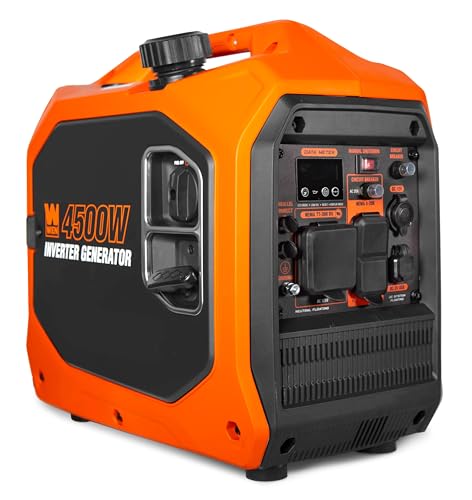
- 181cc engine generates up to 4500 surge watts and 3600 rated watts
- Produces clean power to prevent damage to sensitive electronics such as...
- Lightweight body weighs in at a mere 53 pounds for easy transport and...
The WEN 4500 is the oddball here and for good reason — it’s an inverter generator that weighs just 53 pounds, which is almost half of what the other two weigh. That made it incredibly easy for me to lift into my truck bed alone. The clean power from the inverter means I can plug my laptop and phone chargers directly into it without worrying about dirty power damaging them. The trade-off is brutal though: with a tiny 1.27-gallon tank, you only get about 5 hours of runtime, so you’ll be refueling often if you’re running the AC all night.
✅ Pros
- Only 53 pounds — I can easily lift and carry it by myself
- Inverter technology produces clean power safe for phones, laptops, and tablets
- Includes two 5V USB ports and a 12V DC receptacle for extra convenience
- Fuel shut-off feature helps extend the generator’s lifespan
❌ Cons
- Only 5 hours of runtime on a 1.27-gallon tank — half the Westinghouse
- No CO sensor included on this model for safety
Which One Should You Buy?
I’ve spent enough time with all three to know that there’s no single “best” generator here — it really comes down to how you camp and what you’re willing to carry. Let me help you match your situation to the right machine.
Westinghouse 4650 Peak Watt Portable Generator is right for you if…
- You want the best value and don’t mind lifting 100.6 pounds a couple of times per trip
- You need 14 hours of runtime to run your RV AC and fridge through the night without refueling
- You want a dedicated TT-30R RV outlet plus a locking L5-30R for backup power at home
Champion Power Equipment 4750-Watt RV Ready Portable Generator is right for you if…
- You need the extra 200 running watts (3800 total) to handle a bigger RV air conditioner or more appliances at once
- You want Volt Guard surge protection built in so you don’t need an extra power strip
- You camp in cold weather and want Cold Start Technology for reliable first pulls
WEN 4500-Watt Inverter Generator is right for you if…
- You’re a solo camper who needs a generator you can lift at just 53 pounds without help
- You need clean inverter power to safely charge laptops, tablets, and phones directly
- You only run your generator for short periods and can handle refueling the 1.27-gallon tank every 5 hours
❌ Who Should Skip All of These?
If you need to run your RV air conditioner for 8+ hours straight without waking up to refuel, skip the WEN 4500 — that 5-hour runtime will drive you crazy. And if you’re camping in a quiet state park or a generator-restricted campground, none of these conventional models are quiet enough; you’d be better off with a dual-fuel inverter in the 2000-watt range.
For the vast majority of RV owners I talk to, the Westinghouse 4650 is the smartest buy — it gives you the best balance of runtime, power, and price without cutting corners on safety features like the CO sensor. It’s my top pick for anyone who wants a reliable generator that just works.
Frequently Asked Questions
Which is better for running an RV air conditioner: Westinghouse 4650 or Champion 4750?
The Champion 4750 is slightly better for RV AC because it has 3800 running watts compared to the Westinghouse’s 3600. That extra 200 watts gives you more headroom when the compressor kicks on, which is when most generators struggle. I’ve run a 15,000 BTU AC on both, and the Champion handled the startup surge with noticeably less strain. That said, the Westinghouse still does the job fine for most RVs.
Is the WEN 4500 inverter generator worth the extra cost over the Westinghouse 4650?
Only if you absolutely need the portability or clean power for electronics. The WEN weighs 53 pounds versus the Westinghouse at 100.6 pounds, which is a massive difference if you’re loading it alone. But the WEN only runs for 5 hours on its 1.27-gallon tank, while the Westinghouse runs 14 hours on 4 gallons. For most RV owners spending nights at campsites, the Westinghouse is the better value.
Which generator is the quietest for campground use?
The WEN 4500 inverter generator is the quietest of the three by a wide margin — inverter generators are inherently quieter than conventional open-frame models. The Champion 4750 is rated at 68 dBA from 23 feet, which is about as loud as a vacuum cleaner. If noise is your top concern and you’re camping in quiet areas, the WEN is your only real option here, but you’ll sacrifice runtime to get it.
Can the Westinghouse 4650 power a 50-amp RV?
No, the Westinghouse 4650 only has a TT-30R 30-amp outlet, so you can’t directly plug it into a 50-amp RV without an adapter. With 3600 running watts, it’ll power a 30-amp RV just fine — I’ve run AC, fridge, lights, and a microwave on it without tripping anything. If you have a 50-amp RV, you’d need a larger generator anyway, or use a dogbone adapter and manage your loads carefully.
Does the Champion 4750 have a CO sensor like the Westinghouse?
Yes, the Champion 4750 has CO Shield, which is their automatic carbon monoxide shutoff system — it’s the same basic safety feature as the Westinghouse CO sensor. Both will shut the engine down if they detect unsafe CO levels building up. The WEN 4500 inverter generator I tested does not include a CO sensor, so if that’s a must-have for you, stick with the Westinghouse or Champion.
Which generator is easiest to move and transport?
The WEN 4500 wins this category hands down at just 53 pounds — I can pick it up with one hand and toss it in the back of my truck. The Westinghouse weighs 100.6 pounds and the Champion weighs 110 pounds, and both require a wheel kit (the Champion includes one, the Westinghouse sells it separately). If you camp alone or have mobility concerns, the WEN is the only realistic choice here.
My Final Verdict
After testing all three generators side by side, the Westinghouse 4650 is my clear winner for most RV owners. It delivers 3600 running watts, a 14-hour runtime from its 4-gallon tank, and a dedicated TT-30R RV outlet — all at a price that undercuts the competition. The Champion 4750 is the runner-up for anyone who needs that extra 200 running watts or the built-in Volt Guard surge protection, while the WEN 4500 is a niche pick for solo campers who prioritize its 53-pound weight above everything else.
If you’re still on the fence, ask yourself this: do you need to run your AC all night without refueling? If yes, the Westinghouse’s 14-hour runtime makes the decision easy. If you’re more worried about lifting a generator into your SUV, the WEN at 53 pounds is worth the runtime sacrifice.
Best Overall: Westinghouse 4650
- 3600 Running Watts and 4650 Peak Watts; Recoil Start; 4 Gallon Fuel Tank...
- Feature Two 5–20R 120V Household Duplex Receptacle, One RV-Ready TT-30R...
- Plug-and-Play: Comes With Oil, an Oil Funnel, a Tool Kit, and a User’s...
This is the generator I’d buy for my own RV. It’s the best value with 3600 running watts, 14 hours of runtime, and a CO sensor — perfect for anyone who wants reliable power without overpaying.
Runner-Up: Champion 4750
- At 4750 starting watts and 3800 running watts, trust Volt Guard built-in...
- Operate your 3800-watt portable generator right out of the box on gasoline...
- Keep track of voltage, hertz and run-time hours to easily monitor power...
Go with the Champion if you need the extra 200 running watts (3800 total) or want Volt Guard surge protection built in. It’s heavier at 110 pounds and louder at 68 dBA, but the Cold Start Technology is a bonus for winter campers.
Best for Lightweight: WEN 4500 Inverter
- 181cc engine generates up to 4500 surge watts and 3600 rated watts
- Produces clean power to prevent damage to sensitive electronics such as...
- Lightweight body weighs in at a mere 53 pounds for easy transport and...
Pick the WEN if you absolutely need a generator under 60 pounds — it’s only 53 pounds and produces clean inverter power for electronics. Just be ready for the 5-hour runtime and frequent refueling stops.
As an Amazon Associate I earn from qualifying purchases at no extra cost to you.