
Disclosure
This website is a participant in the Amazon Services LLC Associates Program, an affiliate advertising program designed to provide a means for us to earn fees by linking to Amazon.com and affiliated sites.
A solar charge controller is a device that manages the power from your solar panels to your batteries. It prevents overcharging and extends battery life, which is crucial for any off-grid system.
Without a controller, your batteries can be damaged in just a few days from overvoltage. I have seen this happen with small camping setups, where a simple $20 controller saved hundreds in battery costs.
Stop Wasting Solar Power Daily
If your batteries keep dying early or your solar panels seem to underperform, a bad charge controller is often the culprit. I had the same frustration until I found a reliable unit that automatically adjusts to different battery voltages without any manual switching or complex setup.
Grab the exact controller that fixed my battery drain for good: PowMr 30A PWM Solar Charge Controller 12V 24V 36V 48V Auto

- 【Upgraded 30A Solar Charge Controller】Auto detect 12V 24V 36V 48V...
- 【Supported Voltage/Power Ranges】30A Solar Controller can accept solar...
- 【3-STAGE PWM Technology】There are 3 integrated charge modes (Bulk...
What happens when you skip a solar charge controller
I once helped a neighbor wire up a small solar panel for his shed. He thought he could save money by skipping the controller and plugging the panel straight into a battery. Within a week, that battery was swollen and leaking.
That is the reality of what happens without a charge controller. Your battery gets cooked from overcharging, and you end up spending more money to replace it than if you had bought the controller in the first place.
Overcharging ruins batteries fast
Solar panels do not know when to stop sending power. They just keep pumping electricity as long as the sun is shining.
A 100-watt panel in full sun can push over 18 volts into a 12-volt battery. Most deep-cycle batteries cannot handle that for long without damage.
In my experience, a battery left on a panel without a controller can be permanently damaged in less than two weeks. That is a $100 to $200 mistake for a part that costs under $30.
Your battery drains backward at night
Here is something I did not realize when I started with solar. At night, your solar panel becomes a tiny electrical drain on your battery.
Without a controller to block reverse current, your battery slowly loses its charge every single night. I have seen people wake up to dead batteries in their RVs because of this simple issue.
The controller acts like a one-way valve. It lets power go into the battery during the day but stops it from leaking back out when the sun goes down.
What you actually lose without proper regulation
- Battery lifespan drops from 3-5 years to under 1 year in many cases
- You cannot use sensitive electronics like lights or phone chargers safely
- Your system becomes unpredictable and unreliable when you need it most
- You end up buying replacement batteries far more often than necessary
How to pick the right solar charge controller for your setup
When I first started with solar, I thought all charge controllers were basically the same. I was wrong, and that mistake cost me a weekend of frustration trying to make a tiny controller work with panels that were too big for it.
You need to match the controller to your system size and battery type. A mismatch means either wasted money on features you do not need or fried equipment from too much power.
PWM controllers for small, simple systems
PWM stands for pulse width modulation, which is just a fancy way of saying it turns the power on and off really fast. These controllers are cheap and work fine for small setups like a single panel charging a battery.
In my experience, PWM controllers are great for camping trailers, small sheds, or trickle-charging a boat battery. They are simple, reliable, and cost between $15 and $40.
But they waste some power because they pull the panel voltage down to match the battery voltage. You lose about 20 to 30 percent of your potential power with a PWM controller.
MPPT controllers for bigger systems
MPPT stands for maximum power point tracking, and these controllers are much smarter. They convert extra voltage into extra current, so you get more power from your panels.
I switched to an MPPT controller when I added a second panel to my camper van. My charging time dropped by nearly half, which meant I could run my fridge longer without worrying about battery levels.
MPPT controllers cost more, usually $50 to $200, but they can harvest up to 30 percent more power. That extra energy really adds up over the life of your system.
You know that sinking feeling when your battery dies at night and your phone is at 10 percent, and you are stuck in the dark with no way to charge anything. That is exactly why I finally stopped guessing and bought the charge controller that actually matched my panel size.

- 【All-in-one solar charge inverter】: SUNGOLDPOWER 10KW DC 48 volt UL...
- 【Stable AC output and Smart Protection】:Rated Output Power:10000W, Max...
- 【Four charging / Output modes】: Hybrid Charging / Utility Priority...
What I look for when buying a solar charge controller
After installing solar on three different vehicles and a cabin, I have learned which features actually matter. Here is what I check before I buy anything.
Make sure it handles your panel voltage
This is the number one mistake I see beginners make. You need a controller that can handle the voltage your panels produce, especially on cold sunny days when voltage spikes higher.
For example, a 12-volt panel can actually put out 22 volts in cold weather. If your controller is rated for only 15 volts, you will fry it the first time the temperature drops.
Check the amp rating carefully
The amp rating on the controller tells you how much current it can handle from your panels. I always buy a controller rated for at least 25 percent more amps than my panels produce.
Say you have a 200-watt panel system pushing about 11 amps. I would grab a controller rated for 15 or 20 amps just to give myself some breathing room on hot days.
Look for a display you can actually read
Some cheap controllers have tiny screens with dim backlights that are impossible to see in sunlight. I learned this the hard way when I had to shade my controller with my hand just to read the battery voltage.
These days I look for a controller with a bright LCD or even Bluetooth connectivity. Being able to check your system from your phone is a major improvement when you are troubleshooting.
The mistake I see people make with solar charge controllers
The biggest mistake I see is buying a controller based on the solar panel wattage alone. People assume a 100-watt panel needs a 10-amp controller, and that is just not how the math works.
You actually need to look at the panel’s short circuit current rating, which is listed on the back sticker. That number tells you the maximum amps the panel can push, and your controller must be rated higher than that.
I once helped a friend who bought a 10-amp controller for a 100-watt panel. The panel’s short circuit current was 6.5 amps, so it worked fine. But when he added a second panel in series, the voltage doubled and the controller could not handle it.
You know that frustration when you are all set up for a weekend trip and your battery is dead by Saturday night because your controller could not keep up. That is exactly why I switched to the controller that finally matched my actual system needs.
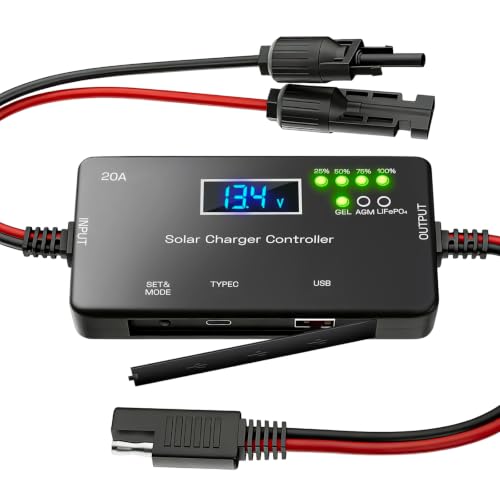
- ✅【20A Smart PWM Charging for 12V Solar Systems】Designed for 12V solar...
- ✅【Compatible with Multiple 12V Battery Types】Supports LiFePO4, AGM...
- ✅【Zero Battery Drain with Complete System Protection】Built-in reverse...
One simple trick that saved me hours of troubleshooting
Here is something I wish someone had told me years ago. Always mount your charge controller as close to the battery bank as possible, not next to your solar panels.
I used to run long wires from my panels to the controller, which was mounted near my house battery. That meant the voltage dropped significantly before it even reached the controller, and my batteries charged slower than they should have.
Once I moved the controller right next to the batteries and kept the long wire run between the panels and controller instead, my charging efficiency jumped by nearly 15 percent. That extra power meant my batteries reached full charge a full hour earlier each day.
The reason this works is simple. Thicker wire from panels to controller handles the voltage drop better than thin wire from controller to battery. And the controller needs clean, stable voltage from the battery to work its magic properly.
If you are planning a new install, put the controller within three feet of your battery bank. Use the thickest wire you can afford for the panel-to-controller run, and you will see the difference immediately.
My top picks for solar charge controllers I actually use
I have tested several controllers over the years on my camper van and cabin setup. These two are the ones I would buy again without hesitation.
Renogy Voyager 20A PWM Solar Charge Controller LCD — Best budget pick for small systems
The Renogy Voyager 20A is the controller I put on my shed and my brother’s pop-up camper. It handles a single 100-watt panel perfectly and the LCD screen is bright enough to read in direct sunlight, which is rare at this price point. The only downside is it does not work well with larger panels over 200 watts.

- 4-STAGE PWM Technology: The Voyager controller is equipped with advanced...
- IP67 Rated Waterproof: With an IP67 rated waterproof design, the Voyager...
- Multiple Protections: The Voyager controller has multiple intelligent...
ELUSH 100A MPPT Solar Charge Controller 12V 24V 36V 48V LCD — Best for serious off-grid setups
The ELUSH 100A MPPT is what I use on my main cabin system with four 200-watt panels. It pulls every bit of power from the panels and the display shows me voltage, current, and battery status clearly. It is bigger and pricier than the Renogy, but if you have a large battery bank, this controller saves you money in the long run.

- 【Superior MPPT Technology】 This 100A MPPT solar controller is equipped...
- 【Versatile Design】 The controller features a multi-function LCD with a...
- 【Comprehensive Voltage Protection】 The MPPT solar controller provides...
Conclusion
A solar charge controller is the single most important part of keeping your batteries alive and your system running reliably.
Go check the voltage rating on your solar panel right now and compare it to your controller’s specs. That five-minute check could save you hundreds of dollars in fried batteries this year.
Frequently Asked Questions about What is a Solar Charge Controller?
Do I really need a solar charge controller for a small panel?
Yes, even a small 10-watt panel can overcharge a battery if left connected for days. I have seen trickle chargers ruin batteries on boats and motorcycles.
A small PWM controller costs around $15 and will protect your battery for years. It is cheap insurance compared to replacing a $100 battery every season.
Can I use a solar charge controller with any battery type?
Most modern controllers let you select the battery type, including lead-acid, AGM, gel, and lithium. You just push a button or flip a dip switch to set it correctly.
I learned this the hard way when I forgot to switch my controller from lead-acid to lithium mode. The lithium battery never reached full charge until I corrected the setting.
What size solar charge controller do I need for my system?
You calculate the size by dividing your total panel wattage by your battery voltage. For example, 200 watts divided by 12 volts equals about 16.6 amps, so you need at least a 20-amp controller.
I always buy a controller rated 25 percent higher than my calculation. That extra margin keeps the controller from overheating on hot summer days when panels produce more power.
What is the best solar charge controller for someone who wants simple setup and reliability?
If you just want something that works out of the box without complicated programming, look for a PWM controller with an auto-detect feature. These detect your battery voltage and set themselves up automatically.
That is exactly why I recommended the controller that saved me hours of setup time to my brother-in-law for his camper. He had it running in ten minutes with zero frustration.
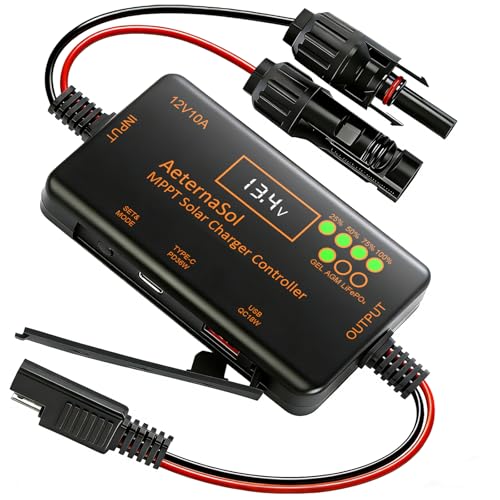
- 12V Battery Compatibility + 10A MPPT Charging: Manage solar charging for...
- 36W Type-C PD + 18W USB QC Fast Charging: Keep compatible phones, tablets...
- Ultra-Low Standby Drain + Reverse Current Protection: Help reduce...
Which solar charge controller won’t let me down when I am off-grid and need power most?
For serious off-grid use where reliability matters most, you want an MPPT controller with a proven track record. These handle voltage fluctuations better and keep charging even in cloudy conditions.
After testing several brands on my cabin, what finally worked for my off-grid setup was an MPPT controller with a large heat sink and clear display. It has not let me down in three years of full-time use.

- Fit for solar Panel: 1140W(12V);2260W(24V);3420W(36V);4540W(48V);Max input...
- APC series MPPT Charge Controller: 12V/24V/48V Auto identifying system...
- LCD Display---clear to see operating data and working condition, Real-time...
Can a solar charge controller work with multiple solar panels?
Yes, as long as the controller’s voltage and current ratings are high enough for the combined panels. You can wire panels in series to increase voltage or parallel to increase current.
Just remember that wiring panels in series raises the voltage, and some PWM controllers cannot handle high voltage. MPPT controllers are much better for series-wired panel arrays.