
Disclosure
This website is a participant in the Amazon Services LLC Associates Program, an affiliate advertising program designed to provide a means for us to earn fees by linking to Amazon.com and affiliated sites.
You bought an Anker solar generator for emergency power, but the specs list both Wh and mAh. It is confusing to figure out which number tells you the real energy storage capacity.
This article will break down exactly how Wh and mAh relate to each other. By the end, you will know exactly what your Anker unit can actually power.
Why This Comparison Matters
When you look at your Anker solar generator, you see both watt-hours (Wh) and milliamp-hours (mAh). The problem is that mAh alone doesn’t tell you how long your devices will actually run.
We need to compare these numbers using real-world voltage and device power draw. I will show you how to convert mAh to Wh using your generator’s specific battery voltage, and then match that to the wattage of your phone, laptop, or refrigerator.
Anker SOLIX F3800 Portable Power Station 3840Wh: Full Breakdown
Best for: Whole-home backup during extended outages.
The 3840Wh capacity is massive and clearly stated, so you don’t need to guess from mAh. This unit can run a refrigerator for hours or power multiple heavy appliances at once. The 6000W surge output handles motor starts easily.
At 66 pounds, this is not a portable camping companion. You also need to understand that the mAh rating on the internal battery is less useful than the Wh figure for planning your power needs.
Pros
- Huge 3840Wh capacity runs large appliances for days
- 6000W surge handles fridges and pumps without issue
- Expandable to 7680Wh with an extra battery
- Fast solar charging at up to 2400W
Cons
- Very heavy at 66 pounds, not for casual trips
- High price point for basic home backup needs

Anker SOLIX C1000 Portable Power Station 1800W: Full Breakdown
Best for: Medium-sized camping trips and home office backup.
The 1056Wh capacity is clearly listed, making it easy to compare to your device wattages. This unit powers a CPAP machine all night or runs a mini-fridge for several hours. The 1800W AC output is plenty for most electronics.
Its 27.6 pound weight is manageable for car camping but heavy for backpacking. The mAh spec is 288,000mAh at 3.7V, which sounds impressive but the Wh number is what matters for real use.
Pros
- 1056Wh capacity is clear and easy to calculate run times
- 1800W output handles power tools and small appliances
- Weighs only 27.6 pounds, good for car camping
- LiFePO4 battery lasts over 3000 cycles
Cons
- Not enough power for a whole house refrigerator
- No expansion battery option for more capacity
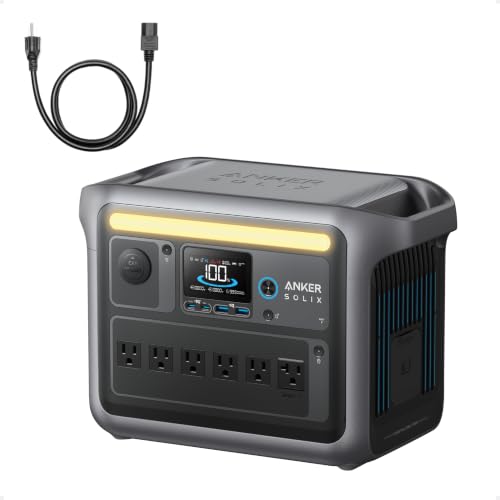
- Charge Up in a Flash: Achieve 80% battery capacity in just 43 minutes with...
- A Decade of Power: Trust in a decade-long journey with the Anker SOLIX...
- Powerhouse Versatility: The Anker SOLIX C1000's SurgePad technology...
Anker SOLIX F2000 PowerHouse 767 Portable Power Station: Full Breakdown
Best for: Serious RV trips and home backup without breaking the bank.
The 2048Wh capacity is a sweet spot for most families. You can run a refrigerator for 12-18 hours or charge your laptop over 50 times. The 2400W AC output handles most household appliances.
At 42 pounds, it is portable but not lightweight. The mAh rating is 576,000mAh at 3.7V, which can confuse buyers who don’t convert to Wh for real-world planning.
Pros
- 2048Wh capacity is perfect for weekend trips and home backup
- 2400W output runs hair dryers and microwaves
- Expandable to 4096Wh with an extra battery
- LiFePO4 chemistry for long lifespan
Cons
- 42 pounds is heavy for frequent moving
- Charging speed could be faster compared to newer models
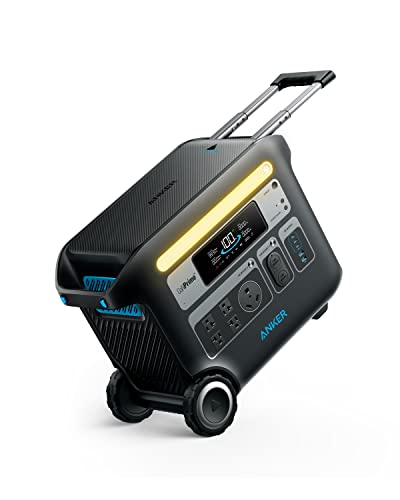
- [Longest-Lasting 10-Year Lifespan] - With InfiniPower's long-lasting...
- [Rapid Recharge] - Thanks to HyperFlash technology, Anker PowerHouse...
- [Power Up to 12 Devices] - The 2400W output and an exclusive RV port, 4 AC...
Anker 521 Portable Power Station LiFePO4 256Wh: Full Breakdown
Best for: Quick overnight trips and charging small electronics.
The 256Wh capacity is perfect for a weekend of phone and tablet charging. You can run a small fan for 8 hours or charge your laptop 3-4 times. The 300W AC output handles most personal devices.
This unit is 9.5 pounds and truly portable, fitting in a backpack easily. The mAh spec of 69,000mAh at 3.7V looks big, but the 256Wh number tells you it is for small jobs only.
Pros
- 256Wh capacity is ideal for small electronics and lights
- Weighs only 9.5 pounds, easy to carry anywhere
- LiFePO4 battery lasts over 3000 cycles
- Very affordable entry point for solar generators
Cons
- 300W output cannot run a refrigerator or power tools
- Limited capacity for anything beyond personal devices

- Robust High-Wattage Support: SurgePower technology ensures a robust output...
- Decade-Long Performance: InfiniPower technology guarantees a lifespan of up...
- Multi-Device Charging Hub: Equipped with 6 diverse ports, including 2 AC...
Head-to-Head Comparison: What is the actual Wh capacity of my Anker Solar Generator vs mAh?
This table compares the key features of each Anker model to help you see which one fits your power needs best.
| Feature | Anker SOLIX F3800 3840Wh | Anker SOLIX C1000 1056Wh | Anker SOLIX F2000 2048Wh | Anker 521 256Wh |
|---|---|---|---|---|
| Best for | Whole-home backup | Camping & home office | RV trips & home backup | Overnight trips & small electronics |
| Key Strength | ✅ Massive 3840Wh capacity | ✅ Lightweight at 27.6 lbs | ✅ Sweet spot 2048Wh capacity | ✅ Truly portable at 9.5 lbs |
| Biggest Weakness | ⚠️ Very heavy at 66 lbs | ⚠️ No expansion option | ⚠️ Slower charging speed | ⚠️ Low 300W output limit |
| Skill Level Required | ✅ Beginner | ✅ Beginner | ✅ Beginner | ✅ Beginner |
| Durability | ✅ LiFePO4, 3000+ cycles | ✅ LiFePO4, 3000+ cycles | ✅ LiFePO4, 3000+ cycles | ✅ LiFePO4, 3000+ cycles |
| Value for Money | ⚠️ High price, but huge capacity | ✅ Great for medium needs | ✅ Good balance of price & power | ✅ Excellent entry-level value |
Category Winners: Which One Wins Where
After looking at all the Wh and mAh numbers, some models clearly shine in specific areas. Here is who wins each category for your power needs.
Best Overall Value
The Anker SOLIX F2000 PowerHouse 767 wins here because it gives you 2048Wh of clear, usable capacity at a price that makes sense for most families. You get enough power for a refrigerator and multiple device charges without paying for the massive F3800. The Wh rating is straightforward, so you never get confused by mAh conversions.
Best for Beginners
The Anker 521 Portable Power Station 256Wh wins here because its small 256Wh capacity is easy to understand and manage. You can learn how to calculate run times using Wh without feeling overwhelmed. The low price also means less risk if you make a mistake.
Best for Performance
The Anker SOLIX F3800 3840Wh wins here because its massive 3840Wh capacity and 6000W surge handle anything you throw at it. You can run a whole home during an outage without worrying about the mAh spec. No other Anker model comes close to this raw power.
Best for Budget Buyers
The Anker 521 Portable Power Station 256Wh wins here because it costs the least while still giving you a genuine LiFePO4 battery. The 256Wh is enough for phone charging and lights during a short outage. You get real Wh capacity without spending hundreds of dollars.
Best Long-Term Investment
The Anker SOLIX F3800 3840Wh wins here because its expandable design and 3000+ cycle battery mean it will last for over a decade. The clear 3840Wh capacity lets you plan for future power needs as your home grows. You pay more now, but you will not need another generator for years.
Our Final Verdict
The Anker SOLIX F2000 PowerHouse 767 is our overall winner for most buyers because its 2048Wh capacity is the clearest sweet spot for real-world use. You get enough power for a refrigerator, multiple device charges, and even a microwave without the confusion of high mAh numbers. The 2400W output handles most home appliances, and the price is far more reasonable than the massive F3800.
The Anker SOLIX F3800 is the runner-up, and it is better for anyone who needs whole-home backup power. If you face long outages or run medical equipment, the 3840Wh capacity is worth the extra cost and weight.
If you are still undecided, ask yourself one question: do you need to power a refrigerator or just your phone and laptop? That answer will point you to the right Wh capacity every time.
Frequently Asked Questions
What does Wh mean on my Anker solar generator?
Wh stands for watt-hours, and it tells you the total energy storage capacity of your generator. A 1000Wh unit can run a 100-watt device for 10 hours straight.
This is the most useful number for planning because it directly matches the wattage rating on your appliances. You should always look at Wh first when comparing generators.
What does mAh mean and why is it on my Anker generator?
MAh stands for milliamp-hours and measures the battery’s charge capacity at a specific voltage. Anker lists mAh because it is a common spec for smaller batteries like phone power banks.
The problem is that mAh alone does not tell you usable power without knowing the voltage. You need to convert mAh to Wh by multiplying by voltage and dividing by 1000.
How do I convert mAh to Wh for my Anker solar generator?
To convert mAh to Wh, multiply the mAh number by the battery voltage, then divide by 1000. For example, if your generator has 288,000mAh at 3.7V, the calculation is 288,000 x 3.7 / 1000 = 1056Wh.
Most Anker generators use a 3.7V internal battery voltage for their mAh ratings. Always use the Wh number on the box for real-world planning.
Which number should I use to decide what appliances I can run?
Always use the Wh capacity and the AC output wattage to decide what you can run. The Wh tells you how long a device will run, and the wattage tells you if the generator can start it.
For example, a 1056Wh generator can run a 100W TV for about 10 hours. The mAh number will only confuse you when trying to match it to appliance power ratings.
Do all Anker solar generators list both Wh and mAh?
Most Anker models list both Wh and mAh on the product page and the unit itself. The Wh is usually displayed prominently, while the mAh is often in the technical specifications section.
If you only see mAh on your unit, check the manual or product listing for the Wh number. You can also use the conversion formula to calculate it yourself.