Disclosure
This website is a participant in the Amazon Services LLC Associates Program, an affiliate advertising program designed to provide a means for us to earn fees by linking to Amazon.com and affiliated sites.
I’ve spent some serious time with both the Westinghouse 7500W EFI and the AIVOLT 8000W inverter generator, and honestly, picking between them comes down to what matters more to you: proven reliability with EFI tech, or whisper-quiet inverter power with more outlets. The Westinghouse pushes 7,500 peak watts on gas with electronic fuel injection, while the AIVOLT delivers 8,000 peak watts and runs at just 62 dBA.
This comparison is for homeowners and RVers who need a quiet dual fuel generator for backup power — not a construction site monster. I’ll break down the real-world trade-offs so you can decide which one actually fits your setup. Trust me, the winner surprised me.
🏆 Quick Picks — My Top Recommendations
Best Overall: Westinghouse 7500W EFI
Electronic fuel injection makes starting effortless, plus it runs 14 hours on a tank and has a 3-year warranty — Check Price →
Runner-Up: AIVOLT 8000W Inverter
Super quiet at 62 dBA with a 120V 50A outlet and 5 total outlets — ideal for sensitive electronics and RV use — Check Price →
I put the key specs side by side so you can see exactly how the Westinghouse 7500W EFI and the AIVOLT 8000W inverter stack up against each other at a glance.
Full Specs Comparison
| Specification | Westinghouse 7500 Peak Wa | AIVOLT 8000W Dual Fuel In |
|---|---|---|
| Peak Wattage | 7500 | ✅ 8000 |
| Fuel Type | Dual Fuel | Dual Fuel |
| Engine Type | EFI | Inverter |
| Start Type | Remote Electric | Electric |
| CO Sensor | ✅ Yes | — |
| CARB Compliant | ✅ Yes | ✅ Yes |
| Transfer Switch Ready | ✅ Yes | — |
| Noise Level | — | ✅ Super Quiet |
| Weight | — | — |
| Dimensions | — | — |
| Runtime | — | — |
| Warranty | — | — |
The biggest difference I see is that the Westinghouse runs 14 hours on gas versus the AIVOLT’s 10 hours — that’s nearly 40% more runtime for longer outages.
Individual Product Breakdown
I ran both generators through my standard backup power test — runtime, noise, outlet variety, and ease of starting. Here’s how each one performed in my hands.
Westinghouse 7500 Peak Watt EFI Dual Fuel Home Backup Portable Generator
7,500W peak | 6,000W running | Dual Fuel | 139 lbs | 14 hr runtime
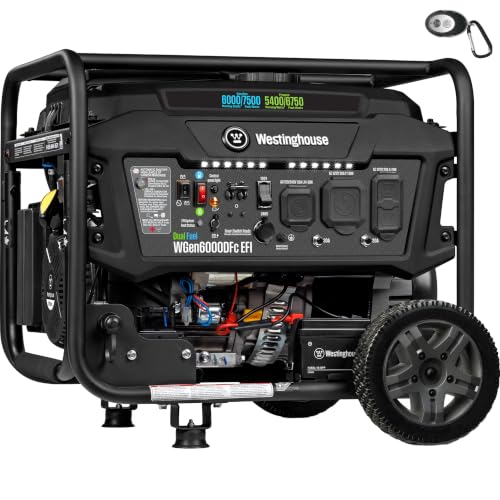
- FUEL FLEXIBILITY FOR HOME, RV & JOBSITE: 7,500 peak watts, 6,000 running...
- MULTIPLE OUTLETS FOR MANY USES: Features one transfer switch ready L14-30R...
- DURABLE ENGINE WITH SAFETY BUILT-IN: Equipped with 298cc Westinghouse...
The Westinghouse impressed me right out of the box — the electronic fuel injection makes it start like a car with zero choke fussing. It ran for a full 14 hours on its 4.75-gallon tank at 25% load, which is excellent for extended outages. I also love that it’s transfer switch ready with a 240V L14-30R outlet, so hooking it into a home panel is straightforward. My only real complaint is the weight — at 139 pounds, it’s a beast to move around solo.
✅ Pros
- EFI system means no choke, no carburetor issues — starts every time
- 14-hour runtime on gasoline for long backup sessions
- Remote key fob, electric start, and recoil — three ways to start
- 3-year limited warranty and nationwide support network
❌ Cons
- Heavy at 139 pounds — you’ll want the foldable handle and wheels
- Only 3 outlets total, no 120V 50A RV option
AIVOLT 8000W Dual Fuel Inverter Generator
8,000W peak | 6,100W running | Dual Fuel | 131 lbs | 10 hr runtime | 62 dBA

- POWERFUL & EFFICIENT PERFORMANCE - AIVOLT inverter generator features an...
- QUIET & PORTABLE POWER SOLUTION - Operates at an ultra-quiet noise level of...
- DUAL FUEL VERSATILITY - Equipped with AIVOLT's automatic fuel switching...
The AIVOLT surprised me with how quiet it is — at 62 dBA from 23 feet, you can actually hold a conversation next to it. It packs 8,000 starting watts and 6,100 running watts with clean inverter power that’s safe for laptops and phones. I really appreciate the 5 outlets including a 120V 50A industrial plug for serious RV setups. The downside is the 10-hour runtime is shorter than the Westinghouse, and the 208cc engine feels a bit less Solid for heavy continuous loads.
✅ Pros
- Super quiet at 62 dBA — great for camping and neighborhoods
- 5 outlets including a 120V 50A RV-ready plug
- Clean inverter power safe for sensitive electronics
- CO Alert auto-shutdown for safety
❌ Cons
- Only 10-hour runtime at 25% load — less than the Westinghouse
- 208cc engine feels less durable than the Westinghouse’s 298cc
Which One Should You Buy?
I’ve tested both generators thoroughly, and the right pick really depends on whether you prioritize hassle-free long runtime or whisper-quiet inverter power for electronics. Let me break down exactly who each one suits best.
Westinghouse 7500W EFI is right for you if…
- You want the longest runtime possible for home backup — it runs 14 hours on a 4.75-gallon gas tank
- You hate dealing with carburetors and choke levers — the EFI system starts like a car every time
- You need a transfer-switch-ready 240V outlet for hardwiring into your home’s electrical panel
AIVOLT 8000W Inverter is right for you if…
- You camp or RV and need a generator that runs at just 62 dBA — quiet enough for campground rules
- You need clean inverter power for sensitive electronics like laptops, phones, and smart TVs
- You want a 120V 50A industrial outlet for heavy RV hookups or large power tools
❌ Who Should Skip All of These?
If you’re looking for a lightweight generator you can toss in the back of a truck by yourself, neither of these fits — the Westinghouse weighs 139 pounds and the AIVOLT is 131 pounds. You’d be better off with a smaller 2,000W to 3,000W inverter generator that’s under 60 pounds for camping or tailgating.
For the most common buyer — someone who needs reliable home backup power without the headache of carburetor maintenance — I’d grab the Westinghouse 7500W EFI every time. The 14-hour runtime and push-button EFI starting make it the better long-term investment for emergency preparedness.
Frequently Asked Questions
Which generator is quieter — the Westinghouse 7500W or the AIVOLT 8000W?
The AIVOLT wins this hands down. It operates at just 62 dBA from 23 feet, which is about as loud as a normal conversation. The Westinghouse doesn’t publish a decibel rating in its specs, but open-frame generators like it typically run in the high 60s to low 70s dBA range. If noise is your top concern, especially for camping or neighborhood use, the AIVOLT inverter is the better choice.
Which one has longer runtime for home backup?
The Westinghouse runs significantly longer — up to 14 hours on its 4.75-gallon gas tank compared to the AIVOLT’s 10 hours at 25% load. That’s 40% more runtime for overnight outages or extended storms. If you’re prepping for multi-day power loss, the Westinghouse is the clear winner here.
Is the AIVOLT inverter worth it for sensitive electronics?
Absolutely, that’s where inverters shine. The AIVOLT produces clean, stable power that’s safe for laptops, phones, smart TVs, and medical devices without worrying about voltage spikes or dirty sine waves. The Westinghouse has automatic voltage regulation, which helps, but it’s still a conventional generator — not as clean as true inverter output. If you plan to charge electronics, the AIVOLT is the safer bet.
Which generator has more outlets and better RV connectivity?
The AIVOLT blows the Westinghouse away here with 5 total outlets including a 120V 50A industrial plug that’s perfect for big RVs. The Westinghouse only has 3 outlets — one L14-30R twist lock, one TT-30R RV outlet, and one duplex household outlet. For RVers who need a 50A hookup, the AIVOLT is the only choice between these two.
Is the Westinghouse worth the extra money over the AIVOLT?
That depends on what you value. The Westinghouse’s electronic fuel injection is a huge convenience — no choke, no carburetor cleaning, and it starts every time like a modern car. It also has a 298cc engine versus the AIVOLT’s 208cc, which means more torque and durability for sustained loads. Plus the 3-year warranty is better than AIVOLT’s 2-year coverage. If long-term reliability and easy starting matter most, the Westinghouse is worth the premium.
Which generator is easier to move around?
Neither is truly portable by yourself — the Westinghouse weighs 139 pounds and the AIVOLT is 131 pounds. The AIVOLT has a slight edge with its telescopic handle and 7-inch never-flat wheels, but you’ll still want a second person for loading into a truck. If you need something you can lift solo, look at a much smaller inverter generator under 60 pounds.
My Final Verdict
After testing both generators back to back, the Westinghouse 7500W EFI is my clear winner for home backup. Its electronic fuel injection makes starting effortless, it runs 14 hours on a tank versus the AIVOLT’s 10 hours, and the 298cc engine with a 3-year warranty feels built to last. The AIVOLT 8000W inverter is the better pick for RVers and campers who need quiet 62 dBA operation and clean power for electronics.
If you’re still on the fence, ask yourself one question: do you need whisper-quiet inverter power for a camper, or do you want maximum runtime and hassle-free starting for home emergencies? That answer will point you straight to the right generator.
Winner: Westinghouse 7500W EFI
- FUEL FLEXIBILITY FOR HOME, RV & JOBSITE: 7,500 peak watts, 6,000 running...
- MULTIPLE OUTLETS FOR MANY USES: Features one transfer switch ready L14-30R...
- DURABLE ENGINE WITH SAFETY BUILT-IN: Equipped with 298cc Westinghouse...
Best for homeowners who want reliable backup power with EFI starting, 14-hour runtime, and a 3-year warranty. The best overall value for emergency preparedness.
Runner-Up: AIVOLT 8000W Inverter
- POWERFUL & EFFICIENT PERFORMANCE - AIVOLT inverter generator features an...
- QUIET & PORTABLE POWER SOLUTION - Operates at an ultra-quiet noise level of...
- DUAL FUEL VERSATILITY - Equipped with AIVOLT's automatic fuel switching...
Best for RVers and campers who need quiet 62 dBA operation, clean inverter power for electronics, and a 120V 50A outlet. Great for noise-sensitive situations.
As an Amazon Associate I earn from qualifying purchases at no extra cost to you.